Matiang’i Reflects on Gen Z Protests: “It Would Not Have Happened Under My Watch”
Former Interior Cabinet Secretary Dr. Fred Matiang’i has offered his perspective on the Gen Z-led demonstrations last year that saw protesters breach Parliament, asserting that the situation would have unfolded differently had he still been in charge of the security docket.
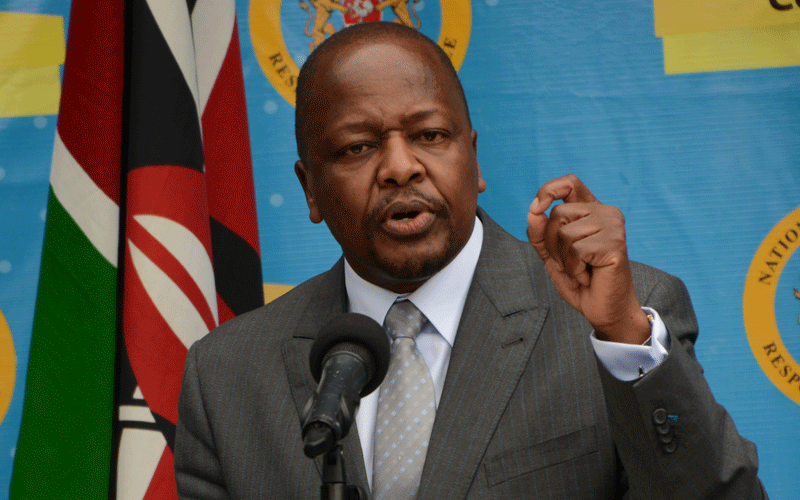
In an exclusive interview on Citizen TV on Tuesday, Matiang’i acknowledged the constitutional right to protest but emphasized the need for limits when public order and national security are at stake.
The former CS stated he would have leveraged intelligence from the National Intelligence Service (NIS) to anticipate the protests. His approach would have involved inviting Gen Z representatives for discussions to understand their grievances and collaboratively seek solutions before they took to the streets. “It’s not a surprise accident, it’s something that ought to have been known. I know the NIS capacity, but I know they must have known it would happen,” he remarked.
Matiang’i drew a distinction between the recent Gen Z protests, which he described as peaceful and well-organized, and past opposition demonstrations that he felt posed greater threats. “If you were to write a manifesto out of the Gen Z uprising, you would outline several things; one is that Gen Zs voice is not being heard. Time is here for the leaders to have conversations with young people about their issues,” he noted.
He expressed disbelief at the breach of Parliament, an unprecedented event since 1963, and the carting away of “instruments of power.”
“What I would have done differently: it would not have happened under my watch. How would it have gotten to a point that there’s a rampage in town, Parliament is overrun? Since 1963, this has never happened before, instruments of power are carted away and we did not know that it was coming?”
Matiang’i suggested that an inquest should have been formed to address the issues raised by Gen Z, thereby preventing the need for street protests.
“I expected the government to orchestrate an all-party inquiry to answer the question of what happened,” he said. He further commented on the President’s subsequent statement, initially finding it hopeful, but noting that “Clearly, it hasn’t happened and we had another riot. I don’t know what will be done to avert the next one.”
Recalling his tenure, Matiang’i highlighted the constant vigilance required by security agencies, particularly concerning terrorism threats in coastal regions. He cited the different environment in 2017, where intelligence indicated protests could lead to business disruption, and the need for vigilance after attacks like the 2019 Dusit complex incident.
Addressing concerns about police brutality during his time, where reports of police excesses during opposition-led protests were recorded, Matiang’i asserted that individual officers may violate the law. He stressed that police are guided by established rules for conflict management during demonstrations.
“We don’t train police to kill citizens. The theory of policing is for the preservation of law and order. That doesn’t mean individual police officers can go above the responsibilities they have. Police have standing orders. When riots have happened, there are rules of conflict management,” he explained, adding that his ministry was transparent and took responsibility where necessary.