
Kenya Breaks Ground on Nairobi – Nakuru – Mau Summit Highway
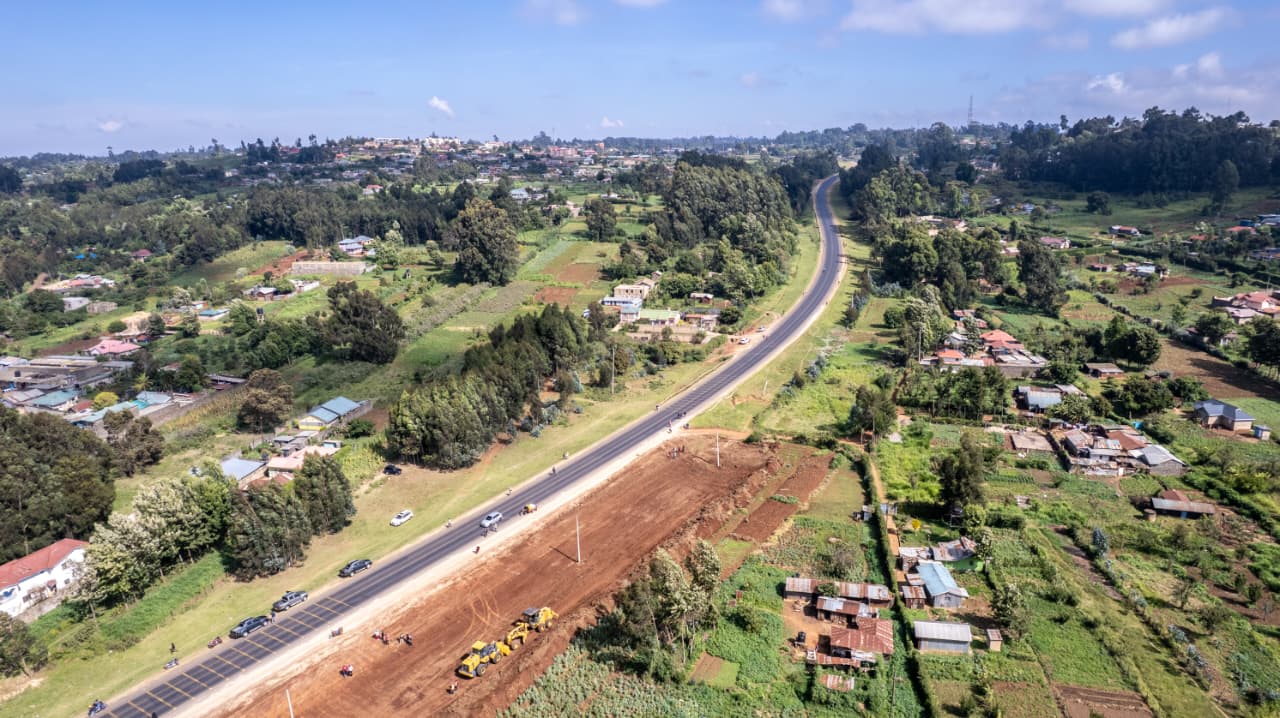
President William Ruto launched the Nairobi – Nakuru – Mau Summit Road and the Nairobi – Maai Mahiu – Naivasha Project, marking one of the most significant infrastructure undertakings in the country’s recent history.
The launch came through a public–private partnership (PPP) – a financing model designed to deliver large infrastructure without leaning on the exchequer.
Speaking during the launch, the president outlined the three challenges that come with every large infrastructure project:
1. Rely on the national budget (which can’t support mega-highways without crippling other services),
2. Borrow heavily (when debt limits are already strained),
3. Simply slow down development (which the government says is no longer an option).
To justify the PPP, he mentioned that waiting for budget availability would have taken decades; borrowing would stretch future generations; and standing still would mean accepting stagnation on a route that feeds multiple economies.
The Scope of the Project
The two projects combine into an ambitious upgrade of Kenya’s most important transport artery:
175 km: Nairobi – Nakuru – Mau Summit
58 km: Nairobi – Maai Mahiu – Naivasha
Together, they represent an investment of more than KSh170 billion.
Under the PPP model, the roads will be designed, financed, expanded, operated, and maintained by private partners, with government oversight.
Expected Changes on the New Highway
The Nairobi – Nakuru – Mau Summit section will be strengthened to handle extremely heavy commercial traffic, with additions such as:
- New interchanges
- Truck lay-bys
- Pedestrian bridges
- Improved lighting and barriers
- Upgraded drainage systems
- Intelligent transport systems for better safety
The Maai Mahiu – Naivasha section, known for steep gradients and heavy cargo, will be upgraded to seamlessly feed the Naivasha Inland Container Depot and the growing industrial zone around it.
Government says the upgrades aim to reduce congestion, cut travel time, reduce accidents, and boost regional trade across Uganda, South Sudan, Rwanda, Burundi, and the DRC.
What’s the Expected Impact?
The highway is projected to employ about 15,000 young Kenyans during construction, offering training and skill-building opportunities in engineering, logistics, environmental management and construction technology.
Local businesses, suppliers, and transport operators are expected to benefit as well, with government emphasising that local content will take the lead even as Chinese partners provide technical expertise.
The Larger National Infrastructure Push
The launch signals the beginning of an aggressive infrastructure agenda.
Several other dual-carriageway corridors are scheduled to break ground soon, including:
- Muthaiga – Kiambu – Ndumberi
- Machakos Junction – Mariakani
- Mau Summit – Kericho – Kisumu
- Kisumu – Busia
- Karatina – Nanyuki – Isiolo
- Makutano – Embu – Meru – Isiolo
- Mtwapa – Malindi
- Mombasa – Lunga Lunga
- Nakuru – Nyahururu – Nanyuki
And multiple Nairobi links such as the Northern Bypass and Bomas – Karen – Ngong are slated for expansion.
The government notes that since independence, Kenya has built about 22,000 km of paved roads – a figure dwarfed by global counterparts like Japan.
The new agenda, they say, is designed to correct this historic lag.
The Long-Term Vision
The President tied the highway launch to a broader transformation strategy, outlining parallel investments in:
- Expanded STEM and research funding
- Large-scale water harvesting and irrigation
- New dams to boost agro-industrial output
- An additional 10,000 MW of energy generation
- Expansion of ports and airports
- Extension of the Standard Gauge Railway from Naivasha to Kisumu and Malaba beginning January 2026
To fund this sustainably, government plans to operationalise a National Infrastructure Fund and a Sovereign Wealth Fund, drawing resources from budget allocations, privatisation revenues, natural resource royalties, and private sector investment.
In a Nutshell …
The Nairobi – Nakuru – Mau Summit project signals a new financing model, a new development philosophy, and a wider intention to modernise Kenya’s economic backbone.
Whether the PPP model delivers as promised will unfold over time.
But, for now, the country’s busiest highway is finally on course for the kind of transformation Kenyans have expected for years.