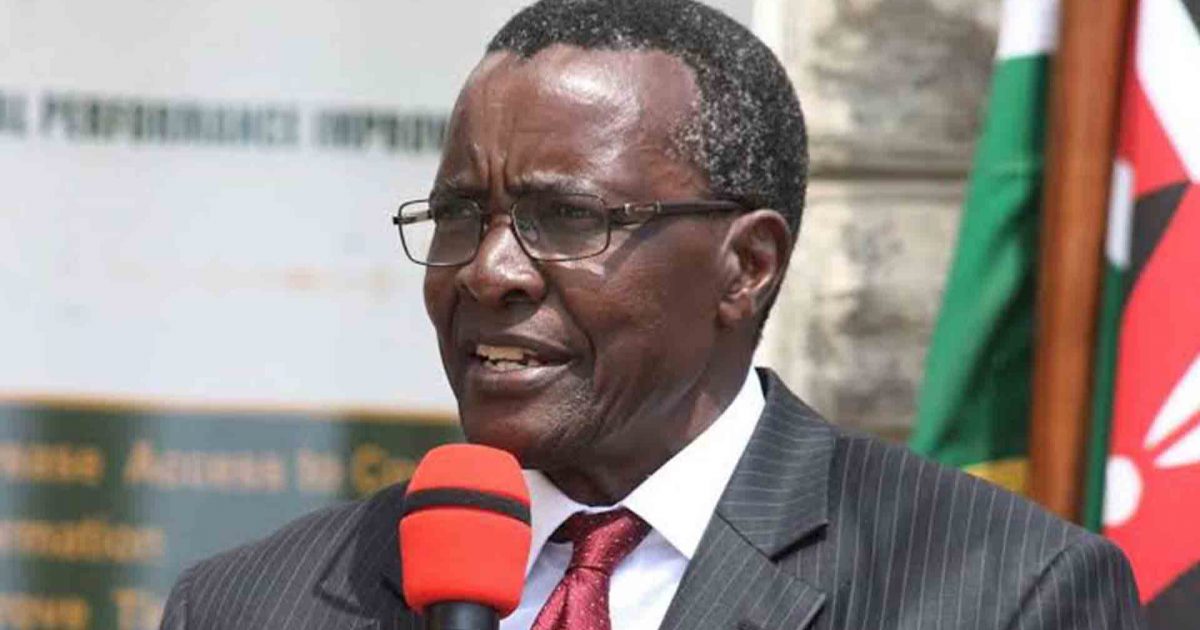
In a dramatic escalation of public pushback against state infrastructure plans, former Chief Justice and current presidential aspirant David Maraga was arrested by law enforcement on Monday morning while leading a demonstration against the allocation of 76 acres of the Nairobi National Park.
The retired head of the judiciary had joined environmental activists in blocking a section of Lang’ata Road, near the Bomas of Kenya, to protest the state’s plan to utilize the parkland for commercial construction and relocate the historic Nairobi Animal Orphanage. Plain-clothed police officers intervened during the demonstration, rounding up and apprehending Maraga alongside several other protestors.
Activists Cry Foul Over Secretive 76-Acre Carve-Out
The dispute centers on a directive from the Kenya Wildlife Service (KWS) to clear 76 acres of the protected wildlife reserve to facilitate the ongoing Ksh41.9 billion Bomas of Kenya expansion project. The project also mandates moving the 62-year-old animal orphanage from its foundational grounds.
Speaking to Citizen TV from the demo site, prominent social justice activist Njeri Mwangi confirmed that Maraga and eight other demonstrators were packed into police vehicles and driven to the Lang’ata Police Station.
“We know they plan to use 76 acres to build a parking space and it should not happen because it did not have any public participation. We came here to stop the action. This is the only park in the capital city and we are against it,” Mwangi asserted. “Nine people have been arrested and we do not know their offence.”
Ex-CJ David Maraga arrested in Nairobi National Park protests-photo/courtesy
Maraga Refuses to Leave Jail Without Fellow Protestors
Following standard processing at the Lang’ata precinct, police authorities offered the former Chief Justice an immediate release. However, in a display of solidarity, Maraga flatly refused to leave the police station, demanding that all eight detained youth and environmental activists be freed unconditionally alongside him before he steps out.
The high-profile arrests occur against a backdrop of intensifying legal and legislative scrutiny surrounding the multi-billion-shilling project, officially dubbed the Bomas International Convention Complex (BICC).
The BICC project, a flagship initiative championed by the Kenya Kwanza administration to establish a premier regional hub for international meetings, conferences, and exhibitions, has faced steep opposition within the corridors of parliament.
Members of the National Assembly’s Tourism and Wildlife Committee recently summoned project coordinators, questioning the exorbitant Ksh42 billion price tag. Lawmakers have termed the budget heavily inflated and disproportionate when contrasted against the construction costs of similar world-class convention facilities within the East African region.
With a former Chief Justice now joining the frontline of the resistance, the multi-billion-shilling convention center faces a combined bottleneck of parliamentary budget queries and high-stakes civil litigation over environmental conservation laws.
NAIROBI, Kenya — Former Chief Justice David Maraga has issued a chilling warning over the staggering surge of missing, abducted, and trafficked children in Kenya, declaring the situation a national emergency that reflects a total institutional failure.
In a powerful public statement, the retired jurist implored the government to treat the crisis with the same gravity as other high-profile felonies, highlighting a breakdown in state security and child protection frameworks.
The Shocking Statistics: 18 Children Vanish Daily
Drawing from data retrieved from the Child Protection Information Management System (ICPIMS), Justice Maraga revealed that the crisis has hit unprecedented levels. Between January 2025 and March 2026 alone, the country logged over 10,500 child protection cases—including 1,952 outright abductions and 1,636 missing children reports.
Most damningly, Maraga spotlighted a nearly non-existent recovery rate, pointing out that in the 2022/2023 cycle, a mere 1.2 percent of the nearly 7,000 missing children were ever reunited with their families.
“These are not statistics,” Maraga cautioned. “These are our sons and daughters who leave home for school, errands, or play and never return. This trend reflects deep institutional failure and weak accountability systems.”
Identifying Hotspots and New Digital Frontiers
The former Chief Justice explicitly called out five counties that have morphed into ground zero for syndicates targeting minors, demanding targeted, sustained police operations in: Nairobi, Nakuru, Kakamega, Homa Bay, Kiambu
Maraga also sounded the alarm on the digital dimension of the crisis. With more than 70 percent of Kenyan minors aged between 10 and 18 actively navigating the internet, he warned that sophisticated trafficking networks are heavily exploiting online spaces to groom and tracking vulnerable children. He urged the state to aggressively overhaul its cyber-protection frameworks to match this evolving threat.
A Call for Action and Protection for the Vulnerable
The statement brought to light a heartbreaking trend from 2025: the deliberate targeting of children living with disabilities. Minors with autism, epilepsy, and speech or hearing impairments have formed a disproportionate number of unresolved missing cases, requiring specialized tracking protocols that law enforcement currently lacks.
To combat the syndicates, Maraga mapped out an immediate checklist for state action:
DCI Intervention: The Directorate of Criminal Investigations must elevate child disappearances to high-priority criminal probes.
Revamping Helpline 116: Immediate financial and human resource backing to scale up the national Child Helpline for instant rapid response.
Grassroots Funding: Increased budgetary allocation to the Ministry of Gender, Culture, and Children Services, alongside increased support for civil society groups tracking missing minors.
Maraga’s heavy intervention adds immense institutional weight to an ongoing public outcry, as families across Kenya demand that security organs pivot their attention toward the safety of the nation’s most vulnerable citizens.
Former Chief Justice David Maraga has weighed in on the ongoing energy crisis, urging the government to immediately exempt all petroleum products from Value Added Tax (VAT) and temporarily suspend all fuel levies to stabilize pump prices.
His remarks come as a crippling nationwide matatu strike continues to paralyze the public transport sector, leaving thousands of commuters stranded and causing massive business disruptions across major towns and cities.
Call for Urgent Parliamentary Action
The strike was triggered by the latest pricing review from the Energy and Petroleum Regulatory Authority (EPRA), which saw Super Petrol surge by Sh16 to retail at Sh214.25 per litre, while Diesel jumped by an unprecedented Sh46 to cost Sh242.92 per litre.
Expressing solidarity with citizens bearing the brunt of the transport shutdown, the retired Chief Justice termed the current economic strain a reflection of deeper leadership challenges.
“I wish to express my solidarity with Kenyans who have to bear the burden of bad governance that has led to the paralysis of the transport sector today,” Maraga stated on Monday, May 18, 2026.
While acknowledging that global geopolitical shocks—specifically referencing the international fallout from the conflict involving Iran—have disrupted global oil markets, Maraga argued that responsible leadership demands decisive domestic intervention to protect citizens.
To resolve the impasse, Maraga called on National Assembly lawmakers to cut short their recess and urgently restructure the country’s fuel taxation framework.
“As a first step, Parliament should convene immediately to exempt all fuel products from VAT, temporarily remove all fuel levies to stabilise the fuel prices, and redirect more resources being squandered through budgeted corruption to alleviate the energy crisis,” he urged, concluding with a call to action: “Let us join hands to liberate this country.”
Widespread Economic Fallout
The former Chief Justice’s statement amplifies growing political and public pressure on the government to find an immediate solution to the fuel gridlock.
With major public service vehicle (PSV) operators maintaining their service suspension, millions of workers have been forced to trek long distances, while commercial sectors report mounting financial losses due to labor shortages and distribution delays.
Former Chief Justice David Maraga has firmly ruled out the possibility of collaborating with President William Ruto, stating that their fundamental values are incompatible.
In a candid interview with Radio Maisha, Maraga emphasized that he could never work with the current administration, even if such an alliance was said to be in the country’s best interest.
“How can I work with him (Ruto)? We can’t work together because his values are completely different from mine,” Maraga said.
An Opening for Gachagua?
While he categorically rejected working with Ruto, Maraga signaled a willingness to engage with other political figures, including former Deputy President Rigathi Gachagua. However, he made it clear that any potential alliance with Gachagua would be contingent on a shared commitment to the rule of law and service to the Kenyan people.
“Gachagua, we will sit down and see what they want to do for the people of Kenya,” Maraga asserted. “If it is to do with what we want to do for Kenyans, then we can work together. I am open to it. But if his character and record do not follow the law, it will be difficult to work with him.”
Maraga, who has emerged as a vocal critic of the Ruto-led administration, noted that his decision to run for the presidency in 2027 was born out of a deep concern for the country’s governance. He has positioned himself as a direct alternative to President Ruto, offering what he describes as clean, accountable, and ethical leadership.
“It is the way things are run in this country. If we all stay back and watch, we will find ourselves drowning in the Indian Ocean. Everyone will suffer,” he warned. “We should not let those in power mess the country up while we are watching.”
While he has yet to declare which political party he will use to seek the presidency, Maraga has repeatedly stated that he is committed to bringing about change in Kenya’s leadership.
Declared presidential candidate for the upcoming general elections David Maraga, has announced that his technical team is currently undertaking a significant upgrade to his digital campaign platform. This necessary enhancement may lead to temporary system downtime.
In a statement released on Wednesday, July 23, the former Chief Justice expressed gratitude to the thousands of Kenyans who have already contributed to his campaign. He noted that the platform’s rapid and unprecedented growth has necessitated this urgent system upgrade.
“Our technical team continues to strengthen our digital platform’s capacity and security. This will include the public ticker on all digital fundraising platforms,” read part of the statement. “We ask that you please be patient with us as we work to stabilise the system. As those in the digital technology space will understand, this may occasionally require brief maintenance downtime.”
Among the key planned updates, the platform will introduce a structured framework to support the growing number of volunteers, enabling them to meaningfully contribute their skills and talents to the campaign. The technical team is also developing a sophisticated system to efficiently gather and organize public feedback on critical issues outlined in Maraga’s manifesto.
Just a few days ago, Maraga officially launched his fundraising platform, declaring that his presidential bid would be entirely financed by well-meaning Kenyans. This approach aims to give ordinary citizens a direct stake in the leadership they aspire to see. In a media interview last week, he famously stated that he would personally contribute only a modest Ksh1 million or Ksh2 million from his own pocket.
Remarkably, two days later, Maraga revealed that Kenyans from across the country, including those in the diaspora, had already collectively raised an impressive Ksh500,000 in just 48 hours. “I told you I don’t have money, and I am appealing, actually, I’ve already appealed to the Kenyan people,” Maraga reiterated. “Those in the diaspora are putting in dollars, which tells you Kenyans want change.”
Maraga also took the opportunity to reiterate his steadfast commitment to reforming Kenya’s electoral system. He believes such reforms are crucial to make it possible for qualified individuals without deep financial resources to seek and attain public office. Maraga, who has quickly emerged as one of the top contenders for the presidency, highlighted that the current system disproportionately locks out capable candidates who cannot match the colossal campaign budgets of the privileged few.