What it was like for Ugandans cut off the internet for 100hrs for Museveni’s elections

After nearly 100 hours in the digital dark, Ugandans are officially back online following a government-ordered internet shutdown that kicked off ahead of the country’s presidential elections.

The Uganda Communications Commission (UCC) confirmed that full internet access was restored on the evening of Saturday, January 17, just hours after the Electoral Commission announced the final presidential results.

Why the Internet Went Dark

The blackout began at exactly 6:00 pm on January 13 and was rolled out as a precautionary security measure ahead of the January 15 polls. Authorities said the shutdown was meant to curb the spread of misinformation, disinformation, and online activity that could threaten public order or national security during the tense election period.

Museveni Declared Winner

Incumbent President Yoweri Kaguta Museveni was declared the winner after securing 71.65% of the vote — roughly 7.9 million ballots. His main challenger, opposition leader Bobi Wine, garnered 24.72%, translating to about 2.7 million votes.

With the results now public, internet services have been switched back on, allowing citizens to flood social media and messaging platforms with reactions, debate, and commentary after days of enforced silence.

What Was Affected

Under the UCC directive, all licensed telecom operators and internet service providers were ordered to suspend public internet access. The shutdown affected:

  • Mobile data services

  • Fibre optic and fixed wireless connections

  • Leased lines and microwave radio links

  • Satellite internet services

The sale and registration of new SIM cards were also suspended, alongside outbound data roaming within the One Network Area.

Services That Stayed Online

Despite the sweeping blackout, several critical services remained operational under strict controls. These included national referral hospital systems, core banking and interbank transfers, government payment platforms, and Uganda Revenue Authority tax services.

Key government infrastructure — such as immigration systems, voter verification platforms, election result transmission networks, and electoral databases — continued to run on restricted, non-public internet connections.

Essential utilities like electricity, water supply, fuel distribution, aviation control, railway signalling, and transport systems were also kept online through secured channels. Cybersecurity and network monitoring centres were similarly exempt.

Social Media Was Strictly Blocked

During the shutdown, the UCC made it clear that access to social media and messaging apps was completely prohibited. Telecom operators were instructed to enforce tight controls using private networks, whitelisted IP addresses, and secured VPNs limited to approved systems. Mobile VPN services were fully disabled.

With connectivity restored, Ugandans are once again plugged into the digital world — and the online conversation around the election results is already in full swing.
Museveni Maintains Lead In Uganda’s High-Stakes Election Amid Historic Challenge From Bobi Wine

As the final tallies emerge from the Ugandan Electoral Commission, President Yoweri Museveni has maintained a decisive lead, positioning himself to extend his four-decade rule. Despite a surging “People Power” movement led by the charismatic musician-turned-politician Robert Kyagulanyi Ssentamu, popularly known as Bobi Wine, the incumbent’s grip on the rural heartlands and the security apparatus remains the defining factor of the race.

The Numbers and the Narrative

Provisional results indicate that Museveni, representing the National Resistance Movement (NRM), has secured a significant percentage of the vote, particularly in traditional strongholds where his record on stability and regional security continues to resonate with older generations.

In contrast, Bobi Wine, representing the National Unity Platform (NUP), swept the urban centers, including the capital, Kampala. His message of “A New Uganda” found a home among the country’s youth—a demographic that makes up nearly 75% of the population and has never known another president. However, the sheer volume of Museveni’s support in the countryside has proved a formidable barrier for the opposition.

A Campaign Defined by Friction

This election cycle will be remembered as one of the most contentious in Uganda’s history. The campaign was marked by:

  • Internet Disruptions: Periods of digital blackouts aimed at controlling the flow of information.
  • Security Crackdowns: High-profile arrests and clashes between security forces and NUP supporters.
  • Generational Divide: A stark contrast between Museveni’s “stability” narrative and Bobi Wine’s “generational change” movement.

The Opposition’s Response

Bobi Wine has characterized the results as a “mockery of democracy,” citing widespread reports of ballot stuffing and the intimidation of polling agents. While the NUP has indicated plans to challenge the results through legal and diplomatic channels, the Electoral Commission has defended the integrity of the process, urging all parties to accept the outcome for the sake of national peace.

Looking Ahead

For President Museveni, a victory reaffirms his status as one of Africa’s longest-serving leaders. His supporters argue that his leadership is essential for navigating East Africa’s complex security challenges and overseeing the nation’s burgeoning oil sector.

For Bobi Wine and the NUP, the results—while not a victory in the highest office—represent a seismic shift in the Ugandan parliament. The NUP is set to become the largest opposition party, signaling that the “Ghetto President” has successfully transitioned from a cultural icon to a legitimate political force that cannot be ignored.

As the dust settles in Kampala, the primary challenge for the government will be addressing the deep-seated economic frustrations of the youth who voted overwhelmingly for change. Whether Museveni will adopt a more inclusive approach or continue his “no-nonsense” governance remains the central question for Uganda’s future.

President Museveni Dismisses ICU Rumours, Declares He Is In Good Health

Ugandan President Yoweri Kaguta Museveni has put an emphatic end to weeks of intense public speculation about his health by making a spirited public appearance at a rally in Adjumani on Monday, October 20. The rally served as a powerful dismissal of rumours that had intensified following the 81-year-old Head of State’s prolonged absence from key public events, including reports of him missing the state burial of Kenyan former Prime Minister Raila Odinga.

Addressing a large gathering at Paridi Stadium, President Museveni demonstrated his characteristic vigour, walking from his car upon arrival and later speaking from a specially designed vehicle while standing—a clear visual signal of his good health ahead of the January 2026 General Elections.

“I thank the people of Adjumani for the warm welcome. As I conclude engaging our people in West Nile, I submit that there’s no question or fear of contradiction on these facts. I thank the people of Pakwach, Nebbi, Zombo, Obongi, Madi-Okollo, Arua, Koboko, Yumbe, Moyo, Terego, Maracha, and Adjumani for the warmth and support. Continue supporting NRM, and we shall do even more,” the President stated, highlighting his commitment to the region.

Missing Raila Odinga’s Burial Fuelled Speculation

The rumours about the President’s well-being peaked last week, particularly after he missed the state funeral of his long-time ally Raila Odinga, alongside his Tanzanian counterpart, Samia Suluhu. Uganda sent a high-level delegation, led by former Prime Minister and Special Envoy Ruhakana Rugunda, who delivered Museveni’s condolence message describing Odinga as a distinguished statesman.

Despite photos circulating on social media suggesting he was unwell, the President’s appearance in Adjumani, where he took questions and addressed a wide variety of topics, aimed to dispel the concerns and reaffirm his readiness for the political contest ahead.

Eyes on the 2026 Ballot

The Adjumani rally marks a critical phase in Museveni’s campaign for a sixth full term, extending his nearly 40-year hold on power. His appearance comes shortly after the Ugandan Electoral Commission confirmed his place on the January 2026 presidential ballot, following his endorsement by the ruling National Resistance Movement (NRM) in June.

The President’s campaign is heavily focused on the country’s economic progress, claiming Uganda’s GDP has doubled from USD 34 billion to USD 66 billion in the last five years, with a pledge to push that figure to USD 500 billion in the next term.

The upcoming presidential polls are set for January 12, where Museveni is expected to face renewed pressure from his fiercest rival, popular musician-turned-politician Robert Kyagulanyi, better known as Bobi Wine. Wine, who was also cleared to run in September, remains Museveni’s most significant threat, having pushed the incumbent close in the 2021 election.

Uganda’s President Yoweri Museveni Tests Negative For COVID-19

Ugandan President Yoweri Museveni has tested negative for COVID-19 after 11 days of battling the virus.

In a statement on Sunday, Museveni said that he had initially ignored the symptoms of the virus, but after developing a runny nose, he decided to get tested. The results came back positive.

Museveni said that he was then examined by a doctor, who found that he had very low levels of vitamin D and vitamin B12. These conditions, Museveni said, predisposed him to a more severe case of COVID-19.

“Unbelievable! My vitamin D levels were very low, my vitamin B12 were very low etc. Imagine the President of Uganda is malnourished to the detriment of his life,” Museveni said.

Museveni said that he immediately started taking vitamins and that his condition soon improved. He also received the COVID-19 vaccine and a booster shot.

“I immediately started taking the vitamins and soon that front was robust. Then we had the immunization and boosters,” Museveni said.

Museveni said that he is grateful to God for his recovery and that he urges all Ugandans to get vaccinated and boosted against COVID-19.

Ugandan President Museveni tests positive for COVID-19

Ugandan President Yoweri Museveni has tested positive for COVID-19, the Ministry of Health announced on Friday.

Museveni, 77, said he had been feeling unwell for a few days and had taken a COVID-19 test, which came back positive. He said he was isolating at his home in Nakasero and was receiving treatment.

“I have been very cautious with corona but recently I had to stop using face masks because they were giving me adverse reactions in the eyes and throat,” Museveni said in a tweet. “Therefore, I have secluded myself at Nakasero and have given the Prime Minister, Robinah Nabanjja, responsibility for today and tomorrow (Heroes’ Day in Luwero).”

Museveni said he had been experiencing mild symptoms, including a fever and a cough. He said he was confident that he would make a full recovery.

“Remember when I had vocal problems twice during the election? It is a component of the allergy. Thus, I have received the second forced leave in the 53 years since we began the battle against Idi Amin. Another occasion was when I had sinus issues and had to be inactive for a few days at Mweya,” he said.

Museveni is the first sitting African head of state to test positive for COVID-19. He is also the oldest person to test positive for the virus.

The announcement of Museveni’s diagnosis comes as Uganda is experiencing a surge in COVID-19 cases. The country has reported over 100,000 cases and over 3,000 deaths since the pandemic began.

Museveni’s diagnosis has raised concerns about the spread of the virus in Uganda. However, the government has said that it is taking steps to contain the virus, including increasing testing and contact tracing.

Museveni has been in power for over 35 years and is Africa’s longest-serving president. He is widely expected to run for re-election in 2026.

Ugandan President Defies Calls To Repeal Anti-LGBTQ Law

Ugandan President Yoweri Museveni has defied calls to repeal an anti-LGBTQ law he signed this week. The law, which was passed by the Ugandan parliament in December, imposes a life sentence on anyone convicted of “aggravated homosexuality.”

In a statement, Museveni said that the law was “a done deal” and that “no one will change our action.” He also warned that Uganda was “ready for war” if the international community continued to pressure the country to repeal the law.

The law has been met with widespread criticism from Western nations and human rights groups. US President Joe Biden called the law “an appalling violation of human rights for all” and said that the US was considering sanctions against Uganda. The European Union and the head of the United Nations, Antonio Guterres, have also condemned the law.

Museveni, who has been in power for 35 years, has a history of making anti-LGBTQ statements. In 2014, he said that LGBTQ people should be “burned alive.”

The new law has sparked fears of a crackdown on LGBTQ people in Uganda. Human rights groups have warned that the law could lead to violence and discrimination against LGBTQ people.

It remains to be seen how the international community will respond to Museveni’s defiance. The US and the EU have said that they are considering sanctions against Uganda, but it is unclear if they will follow through on these threats.

The situation in Uganda is a reminder of the challenges facing LGBTQ people around the world. Despite progress in some countries, there are still many places where LGBTQ people are persecuted and discriminated against.

Kwisha! Shock on Ugandans as Museveni’s government orders all porn sites to be pulled downed 

The Ugandan government has come out with a tough announcement that will see it’s citizen miss porn.

Through communication regulator, the government has given all internet service providers (ISPs) up to September 2018 to stop streaming porn.

All internet providers have been ordered to block all 27 websites both local and international that stream pornographic content in the country.

Banned

According to Godfrey Mutabazi, UCC Executive Director, 10 international pornography websites as well 17 other local ones that are very popular with Ugandans have already been blacklisted.

“The commission is in receipt of a list of Internet sites with pornographic content from the Pornography Control Committee. The Committee has established that the list of the websites attached hereto is currently streaming pornography to Uganda in breach of Section 13 of the Anti-Pornography Act, 2014,” Mutambazi said.

The ban comes just weeks after the country also restricted social media, requiring citizens to have a permit before accessing the sites.


“Avoid Um*laya, alcohol and corruption” This is the controversial message president Museveni sent his Army

Seems like the person handling president Museveni’s social media pages knows nothing about chills. This comes after a tweet shared a few hours aiming to pass ‘positive’ message to his new army.

From the tweet, the Ugandan president warns the new army to avoid prostitution, alcoholism and corruption. According to him this will help them live a healthier lifestyle unlike those who came before them. The post read to say;

Also read: “We can now party without worrying” Huddah Monroe cozies up to Mugabe’s son after his father resigned as president

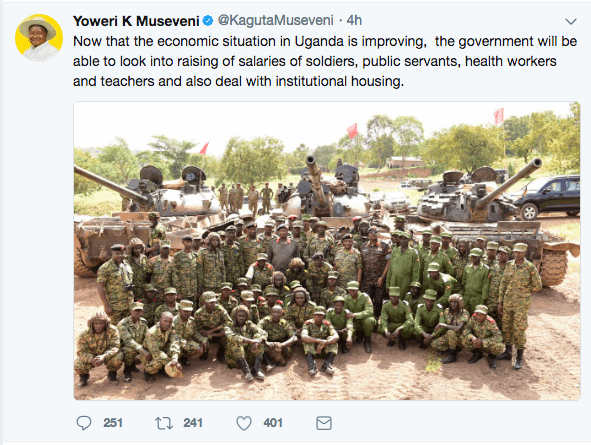
He went on to add that he will be adding the soldier salaries now that their economy has shown improvement.  The president went on to add that he will also deal with institutional housing to improve how they live. He wrote saying;

This however left Ugandan’s calling out the president for his latest move. Other’s went on to add that they will not be fooled as they are ready to make him leave office.