The five major ‘Not-To-Do Things’ when hitching a lift in someone’s car!

There’s an unofficial creed to follow when riding in someone’s private car. It’s a little like crashing in someone’s crib. In Kenya, it goes a notch higher….

Here’s a few pointers to follow.

Agree to the owner’s views on contentious matters in the duration of the drive. Topical matters that demand loyalty or some societal bias, say politics or sports, the car owner enjoys a monopoly of ideas.

Just pray that he commands some decent acumen.

The trick is to steer the conversation from sports if his team is hanging by a thread from possible relegation.

It’s your duty to curse errant drivers you meet on the road. It doesn’t matter how incompetent he is, remember which team you rooting for.

A special bonus is earned if you roll down the window and scream at a clueless boda boda guy.

You hail from an angry republic – it’s time to vent that anger.

Thou shall not touch the stereo. I repeat, for all austerity. Aside, it makes sense: it is HIS stereo. Make a prayer that the tape cassette playing rhumba on loop gets jammed.

Sometimes, providence may smile in your direction and your host has an ear for good music.

Enjoy the ride, but do not sing along if the host is not – hitching a lift doesn’t give you an arena to showcase hour vocal prowess.

Asking for a lift in the village comes with additional tags. Cars get scratched by overgrown hedges. Cars get stuck in mud, or hit undersides on big rocks.

Follow the driver’s cue: if he wants to check out the car, get out too. Make a scene. Get sprawling on the ground to check the car’s innards. Is there a scratch?

This is the perfect time to remember high fuel taxes, county funds and how that doesn’t reflect in decent roads.

Be aware of your standing in society. Are you important? Or is there someone else more important’er?

Enroute, the host may be inclined to offer someone else a lift.

In Kenya, the front seat is sovereign. Be sure to offer your seat if you deem the other passenger as of higher social standing. Chances are they’ll turn it down, but, woe unto you if the host has to ask you to vacate the seat.

If you’ve been this embarrassed, then you’ll jump at the slightest opportunity to own your own ride.

Perhaps, it’s time to make your own playlist and enjoy it on a long drive.

There is a simple way – by taking advantage of an awesome, pocket-friendly financing deal thanks to Co-op Bank in partnership with World Navi – heavyweights in automobile acquisition.

Co-op Bank has partnered with World Navi to enable their clients to import vehicles safely, with upto 80% asset financing!

The importation process takes no more than 60 days. The car is delivered to your doorstep, like pizza!

This is a chance to make your opinions count on the long drive.

Click here to learn more about the financing deal.

Why is Joginder Singh such a timeless legend in the world of motorsport?

Joginder Singh.

If that name doesn’t ring a bell, and evoke pleasant Easter memories, well, you missed out on exciting exploits of a motoring sport legend.

Joginder Singh (file image)

Joginder is non-arguably the greatest driver to cast in the now-defunct Safari Rally, mid-60’s to late mid-70’s.

The Safari Rally was traditionally set over the Easter weekend, and for good reason – it’s the rainy season.

It was an endurance rally, and only the best in terms of driving skills, hands-on engine tinkering experience and physical endurance could hope to complete it.

Joginder, who later earned the moniker ‘The Flying Sikh’, proved his mettle in all aspects.

The legend had started out as a spanner boy in his father’s garage, and this greatly inspired his exploits behind the wheel.

The Flying Sikh grabbed his first victory in 1965, in a Volvo PV544, with his brother as the co-driver. He later switched to a Mitsubishe Colt Lancer 1600 GSR to clinch victory in 1974, and 1976.

It’s in this Colt Lancer that Joginder’s feats made him world famous.

For instance, the 1968 Safari Rally was planned to run the entirety of the Great Rift Valley, and end in Nairobi.

Joginder got the No.1 car tag – which, in rallying circles, is considered jinxed. And it proved so, halfway in the rally.

He was flagged off the ramp first, but, halfway, his Mitsubishi Colt developed clutch problems.

It was rainy and getting stuck was normal.

Somewhere on Mau Escarpment, he watched around 20 of his competitors zoom past in a spray of muddy water, as he tried fixing his transmission.

His Colt couldn’t engage forward gears, just the reverse gear.

Joginder, being Joginder, turned his Colt around and started playing catch up, in reverse.

Subsequently, he managed to overtake almost all of them, stuck in the mud along the route – in reverse gear!

In that rally, he finished 3rd – having driven the last half in reverse gear – in extremely muddy conditions.

Easter hasn’t always been so boring, and slow. It was a season of adrenaline-filled rally fiesta.

The menu was two-way: Either extremely muddy, or extremely dusty.

Motoring was raw. The rally cars were pretty basic – none of the fancy bells and electronic assists in modern cars. To triumph, you had to be in the game.

Easter would find us hogging cattle ruts in the route picked by the rally organisers. If beyond the region, it was a favorite past time following the live reports of the rally via the national broadcaster.

That’s how Joginder Singh gained immortality, and genesis of the saying: He drives like Joginder…

This year, Easter has been ruined by the ravaging pandemic that has resulted in curfews and lockdowns. There’s not much to choose from, in terms of marking Easter with your family.

However, while observing the measures, one can still have an Easter break in select restaurants, outdoor camp grounds and some bit of travel.

One easy way to be safe is to avoid tangible cash – as security against scheming thieves and the pandemic.

The use of Co-op Bank Visa cards is a sure fire way to keep safe from the virus, and take advantage of awesome discounts negotiated by Co-op Bank for their clients using the Co-op Visa cards, Co-op ATM’s and Co-op Credit cards.

You’ll have fun with family shopping for gifts, paying for fuel or food and accommodation – and still get to save a lot of money.

To learn more about discounts availed by use of Co-op Visa cards, click here.

Happy Easter!

Co-op Bank teams up with eco.business Fund to finance sustainable agriculture in Kenya

The eco.business Fund has provided its first investment in Kenya in the amount of $10 M to Co-op Bank.

The subordinated loan will be on-lent to sustainable agribusinesses, contributing to the fund’s mission of conserving biodiversity, promoting the sustainable use of natural resources, and mitigating and adapting to climate change.

The investment will provide much-needed financing for businesses to enhance sustainable measures in their agricultural practices, particularly important in light of the challenging operating environment created by the COVID-19 crisis.

Agriculture is the backbone of the Kenyan economy, employing approximately 75% of the rural population, and making up 34% of the country’s gross domestic product.

However, commercial lending to the agricultural sector remains disproportionally low. This funding gap limits the ability of producers and processors to invest in sustainable production practices, further compounded by the economic fallout caused by the global pandemic.

The investment aims to provide financial resources to those that need it most, while simultaneously promoting conservation finance as mainstream.

Co-op Bank is the third largest commercial bank in Kenya, and the primary bank for agricultural cooperative societies.

Through this new investment, the eco.business Fund and Co-op Bank will provide necessary credit to sustainably certified agribusinesses, such as those in the coffee, tea, and horticulture sectors, Kenya’s main agricultural exports.

By financing green measures such as solar and hydroelectric installations for tea factories that reduce reliance on fuelwood, and cold storage solutions that reduce post-harvest losses, the partners hope to boost sustainable production practices and conserve the unique ecological landscape of the country.

Dr. Gideon Muriuki, Co-op Bank Group Managing Director

Dr. Jens Mackensen, Chairperson of the Board of Directors of the eco.business Fund, stated:

“We are excited about our fist investment in Kenya: A country rich in biodiversity and opportunities for sustainable development. This new partnership with Co-op Bank promises to be a fruitful one as the bank is well positioned to act as an enabler of sustainable production practices. Only by providing tailored financing to the agricultural sector, a key driver of economic activity and sustainable development in Kenya, can we collectively promote green finance with the goal of generating positive environmental and social impact.”

Commenting on the sign-off of this partnership, the Group Managing Director and CEO of Co-op Bank Dr. Gideon Muriuki said:

“Right from our founding as a bank for agriculture co-operatives, we have always strived to support farmers in their journey to achieve sustainable livelihoods. This new partnership with eco.business Fund that makes available USD 10 Million for on-lending to farmers is a winner on many fronts; it provides financing that is structured to suit the financing cycles of agriculture, and also comes with the support mechanisms to assist farmers to make a successful pivot towards sustainable, climate-smart agriculture.”

Want to experience terror? Riding in a fisherman’s dug-out canoe beats bungee-jumping!

You haven’t lived if you haven’t sunk your toes in the white sands and gulped for breath in the ocean surf on the Kenyan coast.

People tell awesome stories of their coastal retreats, albeit generously peppered with hyperbole.

This story is neither awesome, nor laced with additives. My first solo trip had lots of fun moments, but Son of Adam is wired to record the outrageous. Normal is boring.

Well, cue in my first semester break. I decided to backpack to the coast. Backpacking is the fall-back option for travel enthusiasts on a budget. None of my mates was crazy enough to join, so I travelled solo.

I had pored over a tourist map detailing exquisite spots to visit. I couldn’t miss Wasini Island.

Wasini Island is an idyllic tourist spot on South Coast. It’s the far most island, and a quick perusal online described a land of positivity, friendly people with a mixed heritage.

Wasini is a few nautical miles to Tanzania, or Zanzibar. That’s why ‘mixed heritage’ tagged at my heart strings – I’ve always liked to meet people from these lands.

A shoestring budget notwithstanding, I landed at Shimoni. This is a small town, that’s serves the island. There’s a dock, with all sorts of boats – fishing and passenger boats to the island and beyond, tanker boats, and other sorts.

The locals are drawn like magnets to visitors. A lone, backpacking student got noticed in an heartbeat. Even less to recognise a budget-traveller!

The boat fees to cross to the island vary. I chose the lowest. Turns out that I chose a dug-out canoe. This was a fisherman from the island who had delivered his day’s catch to the mainland.

My prior sailing experience was limited to a few rounds in a boat at Uhuru Park. I was then five or six, on a family day out over Christmas. It wasn’t exactly sailing, those boats have pedals!

The canoe is long and narrow. A lot like the biblical path to heaven. We squeezed in, the fisherman and I facing each other on opposite ends.

He hands me a container, a jerry can cut in half. Says nothing. He grabs a pair of oars and pushes off the pier.

When you make a bad decision, the universe is ruthless. I realised, immediately. The canoe started filling up. Am trying to lift up my back pack. The fisherman points at the half-container with his lips. He’s rowing.

I have to keep throwing out water! My backpack is getting wet! The sea is tossing us in the air like balloons! Am literally inches away from the water!

It was dusk – at some point all I could see were tiny dots of light across an endless expanse of black water!

If you’ve watched ocean documentaries, then you’d know the horrors that abound in the deep sea.

I was shaking. Half from the chilling cold, and the other from the fear of the unknown! I found myself praying – even calling on my ancestral gods!

Some how, we made it across. I could have voted that nonchalant fisherman the greatest sea captain that ever sailed.

In retrospect, I discovered that in times of uncertainty, my default setting is deeply religious. Thankfully, the people and the general ambience on Wasini Island gifted me an incredible holiday.

There’s a choice of pocket friendly options available for travel enthusiasts – courtesy of a partnership between travel magnates Bonfire Adventures and Co-op Bank.

Co-op Bank has negotiated a deal for clients wishing to book a Easter holiday retreat through Bonfire Adventures.

There’s a major discount up for grabs if payments are done with Co-op ATM cards, Co-op Credit cards or Co-op pre-paid cards.

Bonfire Adventures have an amazing array of travel packages covering the Kenyan coasts in its entirety. All exclusive resorts and spots from the North to the South Coast, it’s a once-in-a-lifetime Easter offer.

To learn more about the Co-op Easter travel discounts, click here.

Happy Easter!

Co-op Bank leads the industry as it releases a 14 billion report for Year 2020

Co-op Bank Group is reporting a Profit before Tax of Kshs. 14. 3 Billion for the financial year 2020 compared to Kshs. 20. 7 Billion recorded in 2019, and a Profit after tax of Kshs 10.8 Billion compared to Kshs 14.3 Billion in 2019.

This is a 23% reduction on account of increased Covid 19-related loan loss provisions and the absorption of currency translation losses in our South Sudan operation.
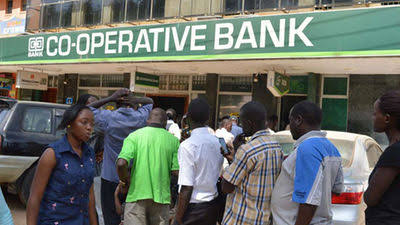
The Group has taken loan loss provisions of Kshs. 8.1 Billion,being a 220% increase from Kshs. 2. 54 Billion in 2019 in appreciation of the challenges that businesses and households are grappling with from the disruptions occasioned by the ongoing pandemic.

We continue to actively engage our customers to support them through this period, by re-aligning the servicing of facilities, funding and transactional needs as the situation unfolds. A total of Kshs.49 Billion in loans have been restructured to support customers impacted by the pandemic.

The Group has sustained the Balance Sheet growth with an Asset Base of Kshs. 537 Billion as at 31st December 2020.

The Group continues to implement proactive enterprise risk management initiatives to ensure uninterrupted business operations in the following ways;

Fortification of our digital channels to support uninterrupted access to banking services by customers; over 92% of our services are now on alternative bankingchannels.

Enhancement of digitization of internal bank processes and engagement platforms, to build contactless capabilities for both customers andstaff.

Adoption of a work-from-home model for the safety and wellness of bank teams,and ensuring safe spaces for staff who continue to serve in physical touch points.

Robust engagement with regulators to ensure full compliance andsupport.

Key financial highlights include; –

Balance sheet; The Group has seen sustained Balance Sheet growth as hereunder;

Total Assets grew by Kshs 80 Billion (+18%) to Kshs. 537 Billion compared to Kshs 457 Billion in the same period last year.

Net loans and advances book grew by Kshs 20 Billion(+8%) from Kshs.266.7 Billion to Kshs. 286. 6Billion.

Investment in Government securities grew by Kshs.44. 1 Billion (+37%) to Kshs. 161.9 Billion compared to Kshs.117.8 Billion in 2019.

Customer deposits grew by 13.8% from Kshs. 332.8 Billion to Kshs 378.6 Billion.

Borrowed funds from development partners grew by Kshs. 19.6 Billion (74.2%) to Kshs 46 Billion from Kshs.26.4 Billion in2019.

Shareholders’ funds grew to Kshs. 90.7 Billion (+14.4%) from Kshs. 79.3 Billion in 2019 enabling us to continue pitching for big ticket deals.

Profit &Loss

Totaloperatingincomegrewby11.1%fromKshs48.5BilliontoKshs53.8 Billion.

Total non-interest income grew by 1.9% from Kshs 17.2 Billion to Kshs 17.5 Billion.

Net interest income grew by 16.1% from Kshs 31.3 Billion to Kshs 36.3 Billion.

Total operating expenses grew by 41.7% from Kshs 27.8 Billion to Kshs.39.4 Billion on account of higher loan loss provisions.

Innovative Customer DeliveryPlatforms

Through our multi-channel strategy, the Bank has successfully moved over 92% of all customer transactions to alternative delivery channels, an expanded 24-hour contact centre, mobile banking, 576 ATMs, internet banking and over 23,000 Co-op Kwa Jirani banking terminals.

A successful Universal Banking model and the implementation of Sales Force Effectiveness has seen the Group serve over 8.8 million Account holders across allsectors.

Key focus on digital banking,with the all-telco Meo-op Cash Mobile Wallet continuing to play a pivotal role in the growth of non-funded income with 5 Million customers registered and loans worth Kshs 58.5 Billion disbursed in 2020.

Over 116,000 customers have taken up the MSME packages that we rolled out in 2018, and 10,750 have been trained on business management and planning. We have earmarked Kshs 23.5 Billion for MSME lending, with Kshs.16.8 Billiondisbursed to date through our E-Creditsolution.

Our unique model of retail banking services through Sacco FOSAs enabled us provide wholesale financial services to over 479 FOSA outlets, and issue over 1.4 million Sacco-Linkcards.

Co-op Bank has engaged a global consulting firm to conduct a Credit Risk Adaptation Project named ‘Project Kilele’.

Key objectives of the project are:

End-to-end assessment of credit risk management practices by undertaking a comprehensive diagnostic review touching on each area of credit risk, including credit risk management framework with a key focus on riskgovernance, credit risk appetite, origination and underwriting process, credit approval process, credit scoring/rating models, and pricing.

Strengthen portfolio assessment and risk frameworks.

Enhance Collection platforms aligned to the new business operating environment.

Subsidiaries

Co-op Consultancy & Insurance Agency posted a Profit before tax of Kshs 788.6 Million as at 31st Dec 2020, riding on strong penetration of Bancassurance business.

Co-operative Bank of South Sudan that is a unique joint venture (JV)partnership with Government of South Sudan (Co-op Bank 51% and GOSS 49%) made a Profit before tax of Kshs 107.8 Million in 2020.

This performance however translated to a monetary loss of Kshs 1.65 Billion attributable to hyper inflation accounting occasioned by currency devaluation of the South Sudanese pound.

Co-op Trust Investment Services contributed Kshs. 70 Millionin Profit before tax in 2020, with Funds Under Management standing at Kshs. 127.5 Billion compared to Kshs. 102.1 Billion as at 31st December 2019.

Kingdom Bank (former Jamii Bora Bank) has a profit before tax loss of Kshs.76.3 Million for the year.

Kshs. 49 Billion Loans Restructured to Support Customers on Covid-19 With the Covid-19 crisis, the Bank has proactively engaged all customers and reviewed the following;

Customers requiring an interest moratorium period,

Customers requiring a better structure/longer repayment period, and,

Customers requiring additional funding to manage the crisis.

In total, a portfolio of over Kshs. 49 Billion has been re-aligned to offer our customers this much-needed support.

Kingdom Bank Limited

Kingdom Bank Limited is a fully-fledged Commercial Bank, licensed and regulated by the Central Bank of Kenya, with over 444,000 customers in 17 branches.

The acquisition offers Co-op Bank the opportunity to cross-sell and deepen product offering to the enhanced customer base and create a niche bank to offer specialized credit offerings that include MSME Banking, Microfi nance, Youth & Women Banking, Asset Finance and Leasing.

The subsidiary reported a loss of Kshs.76.3 Million for the year 2020 and is expected to turn around its performance in 2021.

MSMEFinancing

The Group secured a long-term financing facility from the IFC (International Finance Corporation) amounting to Kshs. 8.25 Billion for on-lending to MSMEs at affordable terms.

The proceeds of the facility will support customers to better cope with the disruptions brought about by the pandemic, especially those operating in the following key business areas;

Micro small and medium enterprises(MSMEs)

Businesses undertaking Climate-Smart Projects, including agricultural inputs and sustainable agricultural practices, renewable energy, energy efficiency and relatedareas.

Corporate Social investment

Co-operative Bank Foundation has provided Scholarships to gifted but needy students from all regions of Kenya.

The sponsorship includes; fully paid secondary education, full fees for University education, Internships and career openings for beneficiaries.

The foundation is fully funded by the bank and has so far supported 7,713 studentssince the inception of the program.

The bank gave a cash donation of Kshs. 100 Million to the Covid 19 Emergency Respond Fund.

Being cognizant of the huge role that we play in supporting communities especially during this period, we continue to operate in an economically, socially and environmentally-responsible manner.

Dividend Payment

While maintaining adequate capital buffers in light of the current operating environment, the Board of Directors has approved a dividend payment of Kshs. 1.00 per ordinary share held (2019 – Kshs 1.00) to be paid on or about 14th April 2021 to the shareholders registered on the Bank’s Register at the close of business on 31st March 2021.

This will be a much-needed relief in a pandemic year to the over 15 million­ member Co-operative movement that predominantly owns the bank.

Accolades

It was another notable year as the Bank received recognition both locally and internationally, including the following;
Co-op Bank was named Bank of The Year in Kenya, in The FT Banker 2020 Awards run by the Financial Times of London.

Co-op Bank was named Best Bank in Kenya at the African Banking Awards 2020 organised by EMEA Finance.

This is the third time around, having also won in 2018 and 2019.

Co-op Bank signed up to the United for Wildlife 2018 Mansion House Declaration, thereby joining the United for Wildlife’s (UfW) Financial Taskforce committing to fight the illegal trafficking in wildlife, by way of building illegal wildlife trade into existing financial crime compliance programs.

A few simple gestures that scream ‘I Love You’ louder than words will ever do

In February, love gets intoxicating. It’s time to spoil your loved one, and it’s supposed to be an easy endeavor. A lot of times, it ain’t. The simple rule is to make love a daily thing – it then becomes easier to nail it over Valentine’s Day.

Here’s a few tricks to navigate this minefield.

The morning kiss

This speaks concern, and attention. It doesn’t have to be much – perhaps, just a peck to the cheek will do. In a lot of instances, it also serves a message to other members of the household.

Breakfast bites

Once in a while – and, more so in the run up to the D-Day of Love, surprise your partner. Get up earlier, and prepare their favorite snack for the breakfast table.it doesn’t matter how poor your baking skills are – she’ll still treasure your burnt pancakes….

Frequent, subtle hugs

Nothing beats the feeling of love and contentment a girl feels when unexpectedly hugged from behind – in the unlikeliest of places. As she folds the laundry, cleans the dishes – hug her. It’s priceless.

The random texts

Fancy this: You are in the middle of a lengthy, boring boardroom meeting. The phone buzzes and the text reads: “Can’t wait to see you at dinner, my love. I got your favorite wine….” Texts work miracles – she’ll always be in love.

Compliments

Everyone loves to feel good. Act normal, and, non-committal, say something nice about her morning outfit. If she likes make-up, you’d do well to wonder aloud why she does make up! Every lady wants to hear that she looks nice with or without make-up!

Silly laughter moments

Memes. Yes, memes. Share memes and silly clips on Whatsapp all day long. It’s silly, but it keeps you in her mind all day long. She can’t wait to get off work and see you!

Cards & sticky notes

Sticky notes on the fridge door, with an affectionate message – especially in cases when work schedule makes one leave the house before the other. Sometimes, remind you spouse of your love in a note on the dressing mirror. They’ll melt with pleasure. It’s romantic!

Offer to pay bills

In the event that you dine out, or spend some time in a social place, offer to clear the bill. It shows affection. Demand and be fussy about the bill.

Nowadays, it’s increasingly easier to deal with the bill. There’s a lot of cashless ways to clear bills when shopping, at fuel stations, restaurants or when travelling.

For instance, this Valentine’s Day season, Co-op Bank clients using their Co-op ATM’s do not incur any extra costs when paying for services using the card. When shopping for gifts at the mall, paying for dinner at restaurants, fuelling at fuel stations, Co-op ATM’s attract np extra charge.

In addition, Co-op Bank has negotiated various discounts for Valentine’s Day treat at various getaways across the country. To enjoy these discounts, clients need to book for their holidays using the Co-op ATM cards.

To view packages available with the Co-op discounts, click here.

Co-op Bank sponsors the 40th edition of the KDF Annual Cross-Country Championships

Co-op Bank was once again the sole sponsor of this year’s Annual Kenya Defence Forces (AKDF) Cross-country Championships that took place on Friday 29th January, 2021 at Moi Airbase in Eastleigh, Nairobi.

The event happens every year in the month of January to enable KDF select its participants for the National, Africa and World Championship athletics events.

Gunner Kibiwott Kandie of Embakasi Garrison rips the tape to win the 10km Men’s Race

The annual event was graced by the Cabinet Secretary for Defence Dr Monica Juma and the KDF top brass led by the Chief of the Defence Forces Gen. Robert Kibochi. The Director Retail and Business Banking at Co-op Bank William Ndumia attended as sponsors of the event.

This year’s event was the 40th Edition of the Cross-country Championship. KDF’s deep athletics talent pool was on display, with world-renown athletics featuring including the double World Champion in both the 5,000m and also Cross-country Hellen Obiri who was representing her Laikipia Air Base Team.

Kahawa Garrison Atletics Team were crowned the eventual winners ofthe 40th edition of the KDF Annual Cross Country Championships.

She won the 10 kilometre Women Cross-country race. Kibiwot Kandie of Embakasi Garrison won the men’s 10 kilometre Cross-country event.

Kawaha Barracks was crowned the overall winners, followed by Moi Airbase Nairobi and Thika team respectively.

Snr. Pte Joyce Chepkemoi of Laikipia Air Base, the 1st Runners Up in the 10km Women’s Race, just after Hellen Obiri of Moi Air Base.

Co-op Bank continues to strengthen the partnership with the KDF in grooming athletic talent within the force, which continues to produce world-beating talent in athletics.

Co-op Bank will continue to support this sport that is beloved by Kenyans, and which continues to earn the country tremendous glory and fame around the world in addition to inspiring millions to lead healthier lives.

Co-op Bank secures Ksh 8.25 billion MSME financing from International Finance Corporation (IFC)

The Co-operative Bank of Kenya has secured a long-term financing facility arranged by the International Finance Corporation (IFC) amounting to US$ 75 million (Sh 8.25 Billion) for on-lending to MSMEs at affordable terms.

The long term loan has a tenure of 7 years.

Co-op Bank will apply the proceeds to of the facility to support customers to better cope with the disruptions brought about by the pandemic.

Co-OP Bank Group MD and CEO Gideon Muriuki during the recent virtual Bank AGM.

Specifically, the facility is intended to support customers operating in the following key business areas;

  • Micro, Small Medium Enterprises (MSMEs),
  • Businesses undertaking Climate Smart Projects, including Agricultural inputs and sustainable agricultural practices, Renewable Energy, Energy Efficiency and related areas.

Commenting upon the signing of the loan agreement, Co-op Bank Group Managing Director & CEO Dr. Gideon Muriuki said:

“The funding has come at a most opportune time as it boosts our ability to better support our MSME customers to stabilise and turn-around their businesses to meet the challenges brought about by the pandemic.”

Co-op Bank has leveraged its strong balance sheet with total assets at over Sh 510 Billion (as at 30 September 2020) and the IFC facility will substantially enhance the bank’s opportunities for growth and overall performance as here under;

  1. Support the key MSME business customers to not only survive the pandemic but also to remain operational and viable for the long term.
  2. Enhance the bank’s assets and liability match, with long-term loans to customers being financed using the long-term debt.
  3. Diversify the bank’s asset and funding portfolio by increasing long-term funding to support deposits funding.
  4. Boost the bank’s competitive position on account of affordable lending.

The key IFC facility comes in handy especially at this time as the bank is implementing mitigating strategies to help customers ride out the ravages of the pandemic.

Co-op Bank remains confident that the strategic initiatives that have been put in place focused on resilience and growth will give the business the impetus for sustained growth.

High school lesson number one: You don’t need to eat bread at every tea break

In a lot of ways, the plot in Barbara Kimenye’s popular book series – Moses – could have been set in my school. No wonder we loved those books so much.

High school in those days dished out much more than academic certificates – it was an all inclusive holistic life shaping – and how to survive in the harsh outside world.

First off, high school gave us a chance to venture outside the suffocating confines of our village and exposed us to other cultures.

He who doesn’t travel thinks his mother is the best cook.

We got used to weevil-ridden fare in smoky kitchens with sweaty, scowling cooks. In some occasions, we’d catch a whiff of kerosene in the githeri!

The village had embraced us in a loving embrace – then high school ripped us from that comforting embrace to the cruelty of sadistic bullies.

You learn that people can be unkind for no reason.

You learn the world doesn’t owe you a soft landing.

The basics of the social system – elite class, the middle class and the peasants – are first made apparent in high school. One learns there will always be people richer and wealthier, but not necessarily smarter. The grades in class is what mattered.

On money, lessons were served fast and harshly.

What may seem exorbitant to one may turn out to be mere chicken feed to another. In those days, I’d feel rich if my folks and relatives in the village sent me back to school with 500 bob as pocket money – shopping inclusive. Then I’d meet urban kids living like kings with unlimited funding!

High school taught us restraint – one doesn’t need to eat bread with margarine on every break.

The ingenious village kids would often come up with tricks to earn extra income.

I know a lad who cleaned the 4K club rabbit hutches for a fee. Most of the club’s members were averse to the tedious chores. He made a tidy sum after classes.

Another lad made a name as a data entry expert – copy writing notes and long assignments over the weekends. He’d also write fancy, wordy, perfumed letters to pen pals in neighboring schools for a fee.

The harshest lesson was dished out in form one, second term. I lost a tidy sum of money to con artists at the bus terminus in town on the way to school.

It was the school fees – stashed in my socks. To date, it amazes me how they had realized I had money on me.

Nowadays, luckily, school kids do not have to expose themselves to con artists and pick pockets.

There are a million cashless ways to pay school fees safely and conveniently, from home, office or in between activities on the farm.

Co-op Bank clients have a myriad of options available to easily and safely pay school fees for their kids.

Parents can easily pay school fees through Co-op M-Pesa Paybill 400200, MCo-op Cash, PesaLink or at a Co-op Kwa Jirani agent at the local grocery, pharmacy or supermarket. All one needs is to fill in details of the school’s Co-op Bank account number and the money goes straight to the school’s account.

There’s no need to expose pupils and students to the perils of carrying hard cash.

ALSO READ: https://www.ghafla.co.ke/sponsored/the-choices-one-makes-on-the-first-week-in-high-school-makes-or-breaks-all-future-prospects/

Need ideas to surprise your family this Christmas? Try a signature Cassava-themed dish!

It’s time for healthier and more appealing food – to the eye, and the palate.

Here’s an often-ignored African food: The Cassava Tuber.

The cassava is versatile, but often suffers the blunt of masculine jokes. It’s a popular feature in fertility and virility jokes – there’s a conception that Cassava adds fuel to a man’s drive.

It’s true.

Besides, the root is gluten-free, grain-free and nut-free, making it a potential food substitute for people with allergies.

However, Cassava roots, skin and leaves contain cyanogen glycosides that are toxic, thus needs some preparation routines before consumption. Otherwise, it’s an important source of nutrients and energy.

This cyanide content is removed by peeling and cooking the tuber.

The Cassava tuber has an earthy, mild taste and starchy consistency. It can be used in a variety of recipes, basically as you might prepare potatoes – steamed, baked, mashed, boiled, or roasted.

Cassava can also be fried and made into chips, similar in preparation and taste to potato chips. The chips can be ingeniously flavored with native herbs and spices like garlic, cinnamon – and fried just as crispy and delicious as French fries.

This is a popular street delicacy in urban coast – peddled on the pavements and open-air markets.

Cassava can also be eaten similarly to mashed potatoes – combined with butter, roasted garlic, or grated cheese, or topped with a drizzle of extra-virgin olive oil or a large spoonful of caramelized onion.

To start, examine your Cassava tubers.

The roots should have a clean fresh scent and snowy white center when cut open. Break off the end of the Cassava. If the flesh has black specks, lines, or any discoloration, it should be discarded.

Before cooking, Cassava needs to be peeled and cut. Because of the thick skin and protective wax coating, use a regular knife.

Stand the root up on its end and slice vertically along the edges until the skin has been completely peeled off.

Next, remove the core. Some methods may have the core removed after cooking, but, pre-removal is the safer bet.

Stand the root pieces on end and cut the peeled root in half lengthwise to expose the woody core – curve and discard the woody, thread core.

The cassava is now ready to cook in a recipe or safely frozen for future use.

At this point, you can use the Cassava in essentially the same ways you’d use potatoes, or yams. There’s lots of recipes: Cassava-meat recipes, Cassava-flour bread, Cassava crisps and chips, et al.

This is a healthy family treat. In the village, the plus is that Cassava is fresh, as it’s widely grown. All you need to purchase is the auxiliary ingredients.

In the village, support local businesses by shopping for ingredients locally. It makes no sense to shop for garlic in the city – check at the local grocery – who’s also may be a Co-op Kwa Jirani agent.

Co-op Bank has a unique banking experience through its Co-op Kwa Jirani model that mirrors banking in conventional banking halls.

At Co-op Kwa Jirani, instant cash withdrawals and deposits from Co-op Bank account, SACCO Account or Fethalink are available, a real convenience.

This festive season, access banking services at your local Co-op Kwa Jirani outlet – and boost your neighbor’s business by shopping locally!

ALSO READ: https://www.ghafla.co.ke/sponsored/would-you-like-to-become-a-co-op-kwa-jirani-agent-it-doubles-traffic-and-increases-sales-at-your-business-premises/

Making a long drive upcountry for Christmas? Avoid getting stranded with a basic car check before the drive!

This festive week, lots of families will be making long drives to mark Christmas with their families or friends. Due to the prevalent Covid-19 conditions for most of the year, lots of these trips will be made upcountry.

There’s the comfort, flexibility and convenience a car affords one in this situation – and for some, they’ll be looking to hire a car for a few days.

There are a few individual checks one needs to make on the car before a long drive. No one fancies getting a break down at odd hours, middle of a forest.

What are (some) of the checks?

  • Have the tires checked for alignment and pressure.
  • Check the headlights and turn indicators – replace bulbs, or blinking frequencies.
  • The condition of brakes – replace brake pads, and have them tuned.
  • The AC – you don’t need your family stewing in the car on a long drive. They’ll be cranky.
  • Check & top up the coolant.
  • How’s the battery condition? Replace if it’s aged.
  • Check and replace engine oil and oil filters – if necessary.
  • Replace old, worn out wipers – if need be.
  • Make sure the spare tire is in good condition, and the tool kit to change tire if need arises.

Additional important things:

  • Obtain a small fire extinguisher for the car.
  • Tag along essential vehicle documents like registration, driving license and insurance.
  • Carry extra essential fuses of the car – if you have the skills to diagnose an electrical mishap.
  • An extra can of engine oil, brake and coolant fluids.
  • Have an emergency car kit – jumper cables, tire sealer, and tire Inflator with pressure check monitor
  • Basics like flash lights, a medical first aid kit and the triangle hazard signs

One other essential aspect is the fuel you purchase along the way. Avoid making purchases from unorthodox, road side dealers.

Most of this fuel is adulterated, and will eventually cause a vehicle break down – or greatly reduce performance.

Purchase fuel at established fuel stations only.

Another plus is that purchasing at established fuel stations allows one to make cashless payments – which greatly helps in general personal safety and in the fight against the pandemic.

For Co-op Bank clients, using the Co-op Bank Visa Cards comes at no extra charges.

Besides fuel purchases, Co-op Bank Visa Cards can also be safely swiped at restaurants, pharmacies, mall shopping, groceries, et al.

It’s convenient, safe and any transactions get instant notifications on mobile phone. It’s easier to track spending this festive season.

Get some helpful info on Co-op Bank Visa Cards by clicking here, or visit the nearest bank branch.

Have a Merry Christmas. Enjoy responsibly.

INTERESTING: https://www.ghafla.co.ke/sponsored/step-aside-santa-claus-the-allure-of-new-clothes-is-what-made-christmas-day-magical/

Have you ever had to manage rowdy, inebriated family members on a Christmas Day night out?

A teetotaler’s idea of a bad evening is hanging out with people enjoying a drink. It’s all fun at first, but the scale soon tips – and it’s all downhill.

It suddenly shifts from a good evening to a realization that hanging out in a pub with this crowd wasn’t a good idea.

It’s especially worse, if it’s the annual Christmas Day family night out at the village pub.

The family joins up half of the tables in the pub into one long ‘conference table’. At first, everyone sits randomly, but as the night gets merrier, alliances start.

As a teetotaler, everyone wants to buy you a drink. Like, I mean, how many packs of fruit juice can you take in a night? Pretty soon, your section of the inebriation conference table is packed with soda and fruit juice.

Then, drunk long lost cousins will suddenly remember how close you all are.

Someone will throw an arm across your shoulders, and slur into your ear:

“Bro, hii miaka yote nishawahi kukosea?”

“Bro, ulisema utanipa kuku moja nikakulie Nairobi? Kwetu Rongai kuku ni expensive sana!”

Before you can think of something cordially apt in response, a mild scuffle at the far end of the table catches your attention.

Uncle Tosh, the official family MC and acclaimed ‘entrepreneur’ is a drink or two past his threshold. He wants to know where he’s parked his jalopy. In normal circumstances, that query would be valid – except that on this night no one drove to the village pub – it’s within walking distance from home.

One of your cousins at some point has doused your fruit juice with whisky.

You realize it’s close to curfew hour, and no one seems in a hurry to leave….

Shortly, the pub’s owner and former classmate beckons for a private chat. He wants the bill cleared, as the law demands close down before the curfew.

“They haven’t paid?” You ask, pointing at the lot over your shoulder with your thumb.

Mentally, you are fast making count of all the fruit juice ordered in your name.

“Oh, they have paid, except Tosh. He has a bill….” The owner tells you.

Meanwhile, Uncle Tosh is trying some Lingala moves between the tables. It’d be hilarious to watch, if the little matter of his pending bill wasn’t looming so low overhead.

“How much?” You ask.

“Tosh has 6,600 not paid. He asked for The Whisky bottle”.

At the village pub, The Whisky is an expensive bottle of Scotch whisky that has gathered dust on the shelf for a couple of years. No one had dared ordered it!

You approach Uncle Tosh, and he chooses the moment to remind you how in his hey days, he had sacrificed everything to pay your father’s school fees. You owe him, see?

Reluctantly, you realize you are the only hope in saving the family’s face. You need to clear the bill. How now, at almost curfew time in the village?

As a Co-op Bank client, you have an open option.

Next door, the late-night pharmacy is also a Co-op Kwa Jirani agent. A withdrawal allows you to clear the pending bill, though prior marked as “Bedsitter Rent Money”.

Well, Uncle Tosh ain’t entirely safe – you confiscate his phone to make a claim for refunds in the morning.

It’ll be easy to prove – every transaction at a Co-op Kwa Jirani gets instant notification sent to your mobile number for easy account management!

Click here to learn more, or visit the nearest Co-op Bank branch.

Also Read: https://www.ghafla.co.ke/sponsored/did-you-know-that-a-co-op-kwa-jirani-agent-offers-the-exact-same-services-available-at-any-co-op-bank-branch/

Do you inwardly groan in agony each time your spouse mutters: “Aki sina pesa ya Chama hii mwezi….”?

Despite the effects of the pandemic, the festive season is gradually mellowing. It may not peak to usual levels in previous years, but, still, the festive fever is slowly spreading.

People seem happier on a general scale.

The urban dwellers are increasingly lighting up sleepy, dreary village paths. It’s a great change for new faces, new dialects and much-needed treats from the city.

The hilarious theatrics, though!

The inevitable Selfie’s are OK, and expected.

Grandma is patiently begrudging teenage grandkids with the odd Selfie. After all, she recently got funky new dentures – a set of heavenly white enamel jewels.

What’s not Ok, though, is the filters on every photo taken for Instagram. The village has a natural feel, a rusty aura that makes a fortnight away from the concrete jungle a worthwhile sojourn.

Be natural!

The men use the village vacation to bond with their age mates.

They’ll leave the homestead at break of dawn ‘to see Mwenda pale karibu na cattle dip’ – and, they’ll return at midnight, if at all.

They’ll return sloshed on local brews. But, true to self, they’ll chew their way through cold dinner to appease their spouses!

Men are simple in nature. No one cares about who bought a new ride, or who snapped up a lucrative tender with a local NGO. Their boyhood friendships are rekindled over a pot of local brew.

The urban women easily bond in secluded groups with their village peers and share funny tidbits about their husbands.

Women are generous – they’ll share wigs, weaves and Vitenge fabrics. They’ll share new recipes and coach each other on new beauty trends.

The urban ladies will call their urban friends and introduce them to their village friends – and it’s wonderful, basic networking.

“Aki wewe Mama Natasha, ukipatana na Mama Mike mnaweza kuwa marafiki sana”.

And, that’s how lifelong friendships are made.

Women tend to cement new alliances with future plans. They’ll make steaming pots of tea – and talk about forming new Chama’s. They’ll even elect new officials and form a conclusive constitution.

It matters not, if all members are in the village for X-mas. They’ll call lady friends they think are a fit for the new Chama.

It’s incredulous, but a section of the region’s most enterprising investments started with a group of ladies gushing about everything over a pot of tea.

The new Chama officials will hit the ground running. The treasurer role usually gets a grounded woman.

She’ll marshal the rest into opening a central Chama account.

For this account, each will get the number – and, like clockwork, each member channels monthly contributions.

The men? Well, the agony wrought upon by their spouses muttering:

“Aki sina pesa ya Chama hii mwezi….”

If you form an impromptu Chama with fellow ladies, it’s prudent to consider opening a central Chama account with Co-op Bank.

Co-op Bank has established a unique grass root banking experience through its Co-op Kwa Jirani model that mirrors banking in conventional banking halls.

These agents are your everyday grocer shops, butcheries, hardware dealers, et al.

At Co-op Kwa Jirani, one can make instant cash withdrawals and deposits from Co-op Bank account, SACCO Account or Fethalink.

That’s how conveniently new Chama members make deposits into a central account, right from next door!

https://www.ghafla.co.ke/sponsored/thinking-of-making-merry-in-the-village-you-can-help-build-local-businesses-by-shopping-locally/

Co-op Bank partners with Thunes to rollout Co-opRemit – a new global money transfer solution

Co-operative Bank of Kenya (“Co-op Bank”), a leading financial institution in Kenya and the larger East Africa region, has partnered with Thunes, a cross-border payment provider, to launch an alternative global money transfer solution branded Co-opRemit©.

Co-opRemit streamlines the process of real-time money transfers particularly within Africa, allowing Co-op Bank customers in Kenya to move funds across the world quickly at an affordable rate.

Customers may send money directly to a foreign bank account or mobile number. Money transfers through this platform will bear no extra charge beyond the tariff, thus offering full transparency on forex fees.

The Head of Diaspora Banking at Co-op Bank Pauline Kieme puts pen to paper to sign off the launch of remittance service Co-opRemit, as the Senior Vice President – Africa at cross-border payments company Ms Sandra Yao looks on

With access to Thunes’ fully-integrated global network, Co-op Bank will enhance its digital banking services and deliver a convenient and cost-effective money transfer experience to its customer-base of over 8 million.

Co-opRemit users will be able to access the new money transfer service from channels starting off with any of Co-op Bank’s over 150 branches across the country, and later mobile and internet banking.

“We are delighted to support Co-operative Bank of Kenya in their drive to increase and improve cross-border payment options for their customers. We look forward to expanding their services with real-time, reliable, and convenient payments across the world, and empowering the SME landscape in Africa – two contributions which are key to driving the region’s growth,” said Thunes CEO Peter De Caluwe.

Speaking at the launch, Co-op Bank’s Director Retail & Business Banking Mr. William Ndumia  noted that the new money transfer service would be especially significant for SMEs in Kenya, many of which face remittance challenges stemming from inefficiencies in cross-border payments.

“With Co-opRemit© SMEs, who are one of our key customer segments,  can now look forward to a more efficient trading experience with seamless international payments at affordable rates.”

Step aside, Santa Claus. The allure of new clothes is what made Christmas Day magical….

For kids, the Christmas week is certainly the favorite time of the year.

The usually strict parents loosen up a wee bit. Even the perennial frown on Aunt Jessica softens into occasional beaming smiles. Bedtime is allowed to stretch late into the night curled up on the sofa in pajama’s watching Santa-themed stories on national television.

Snacks? No rationing.

It’s the time to binge on a year’s worth of candy and cake. Speaking of kitchen treats, the menu chart on the kitchen wall showing what’s cooking on what day is ignored for a while – mother goes on overdrive churning up delicious, rare delicacies.

It’s awesome that no one remembers to send you to the study room citing how badly you flopped in last term’s end papers.

It’s a good week to be alive.

What’s more memorable is the family shopping trip to get new clothes. Oddly, most dads keep clear of this errand. It’s usually up mother’s alley. To be sincere, dads mostly keep away from shopping of any kind.

Ha! Ha!

The allure of new clothes would drive us crazy. I mean, we’d get new clothes through most of the year – but, special Christmas Day clothes had this magnetism.

Suppose we’d get them a week or so before D-day, we wouldn’t get much sleep. Most part of every night would be spent trying and re-trying them. It’d force discerning parents to keep them hidden, till the day.

New shoes? It gets hilarious.

If you didn’t spend a night wearing new shoes under covers, your childhood was a boring one, or at best, lackluster.

This year, make the right memories for your kids with a special Christmas Day clothes treat. If matters not how full their closets already are, kids will always go nuts over new stuff. To stay within the guidelines when out shopping in malls, avoid liquid cash when making payments.

Coins and notes are aiding the spread of the pandemic.

Embrace cashless payments.

The Co-op Bank Visa Cards are perfect for these scenarios.

What’s more, cashless payments done with Co-op Visa Cards attract no extra fees – payments are free.

All Christmas shopping – clothes, shoes, gifts, food, fruits, name it – can all be paid for by swiping Co-op Bank Visa Cards at payment points.

This scrapping of payment fees also includes payments at fuel stations, hotel and flight bookings.

This enhances a vibrant, cozier lifestyle as it enhances safety for your money, convenience and clear money management with instant notifications for every transaction.

To learn more about Co-op Bank Visa Cards, visit the nearest bank branch, or check online by clicking here.

What’s the definite Must-Have’s for a memorable road trip with your gang?

Well, road trips are fun for their exploratory nature. A well-planned road trip with a tight circle of friends can be the highlight of the year.

A road trip has a definite ultimate destination in mind, but there may be numerous side trips or unplanned activities along the way. The magic lies in the spontaneity of it.

Make good choice of friends for a road trip – your joy depends on it.

Plan for the essentials.

Essential car tools and accessories, like spare tires, equipped tool boxes with jump cables, tow cables, gas cans, triangle reflectors, et al. It pays off if a member of the gang possesses basic motoring skills.

Travel first aid kit with bandages, burn cream, tweezers, gauze & medical tape, antihistamine, pain relief medicine.

Comfortable backpack capable of holding water bottle, snacks, camera, or other incidentals.

Lots of good music – or whatever favorite past time your gang likes – some may like audio books, podcasts, et al.

A tent, sleeping bag and pad so when you’re driving by somewhere super beautiful you can just pull over and pitch your tent, making the best portable home wherever you find it! Means saving money to be used in booking hotels!

A cooler with lots of drinks – however, in case of alcoholic drinks, be sure to have a designated driver at any point of the road trip – in turns.

Enough bottled drinking water, healthy snacks for the road (granola bars, fruit, nuts, shake mixes) as you don’t want to rely on only junk or roadside fast food.

Quality electronic device car chargers for smart phones, laptops, tablets, etc. as well as headphones for individual listening.

Maps – like, printed maps – not just digital maps, as sometimes devices may go off, or get reset.

Sunglasses, for comfort in case of glair – or for sheer ooze and pomp. Glasses are stylish.

Casual clothing and layered clothing like tees, sweatshirts, rain slicker, and warm jacket if traveling to cold temperature destinations.

Perhaps, the biggest factor lies in the cost factor. A lot of times, road trip groups usually save up for the trip in a central account. It may even take a year or so.

On the duration of the trip, carry along only the essential amount in liquid cash – as protection for hazards of the road – like, robberies. A little cash comes in handy, too, if your car ends up in a ditch and a homely neighbor needs to tow you out with his tractor!

The bulk of the trip savings, though, has to be in a safe place, and yet within reach in times of need.

For cashless payments, Co-op Bank offers a seamless experience through its Visa-branded cards. All kinds of payments foreseeable on a road trip can be made by safely swiping Co-op Bank Visa cards at payment points.

Name it: fuel purchases, hotel bookings, eating at hotels and restaurants, souvenir-shopping…..

Swiping Co-op Bank Visa cards comes at no extra costs.

It’s free, convenient, and safe. It’s also easy to track spending through instant notifications on mobile phone.

To learn more on opportunities availed by Co-op Bank Visa cards, check online by clicking here, or visit the nearest Co-op Bank branch and speak to the staff.

Also Read: https://www.ghafla.co.ke/sponsored/did-you-know-that-a-co-op-kwa-jirani-agent-offers-the-exact-same-services-available-at-any-co-op-bank-branch/

Would you like to become a Co-op Kwa Jirani Agent? It doubles traffic and increases sales at your business premises.

Becoming a banking agent in lots of ways attracts new customers into your business premises. As a business offers banking services, it markets it gainfully markets its brand. This exposure means more clients, thus more sales.

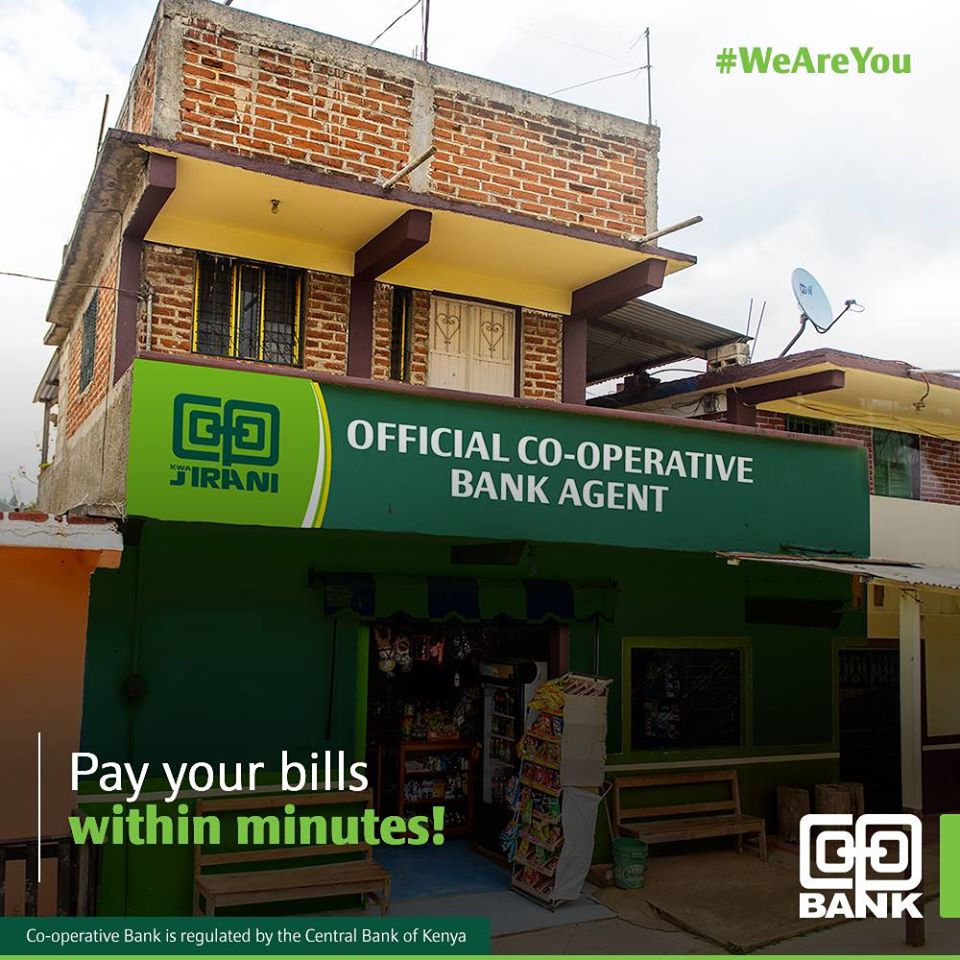
Co-op Kwa Jirani is a grass root banking model meant to align daily banking requirements conveniently to your lifestyle, ran by Co-op Bank.

Co-op Kwa Jirani enables customers to carry out all banking transactions through an agent appointed by the bank.

Co-op Bank’s Agency Banking mostly entails cash deposit taking, cash withdrawals, school fees payments, utility payments, balance enquiry, mini-statements among others. One needs to have an account with Co-operative Bank to work as an agent.

The minimum balance of an agent will be determined by one’s appraisal forwarded to the Co-operative Bank.

Who can use Co-op Kwa Jirani?
Customers, non-customers, SACCO-link members, Co-operatives, MCU customers, SME customers and corporates.

You don’t have to be a Co-op Bank account holder to apply to be an agent.

The baseline requirements:

This is as easy as ABC. At your nearest Co-op Bank branch, fill in an application form and submit the following documents along with the application form:

  • Certificate of good conduct (for the individual)
  • PIN certificate
  • Bank statements if you are not a Co-op Bank account holder
  • Business permits for the last 12 months
  • Current business permit
  • Certificate of registration
  • Copy of ID or equivalent
  • Two passport size photographs
  • Business owners’ or directors’ CVs
  • CBK Form 3 & CBK Form 4 witnessed by Commissioner of Oaths

For corporates and SACCOs, the following additional documents will be required:

  • Audited books of accounts for the last two years
  • Resolution to carry out agency banking
  • SASRA approval for FOSA’s
  • VAT registration (where applicable)
  • The applicable fees to facilitate approval are:
  • CBK application fee – Ksh 1,000
  • Float placement – Determined by customer limit which is arrived at during appraisal

To learn all about Co-op Kwa Jirani visit the online portal, by clicking here. Alternatively, visit the nearest Co-op Bank branch – the bank staff will be ready to actively assist you sort out any queries.

Related: https://www.ghafla.co.ke/sponsored/did-you-know-that-a-co-op-kwa-jirani-agent-offers-the-exact-same-services-available-at-any-co-op-bank-branch/

Did you know that a Co-op Kwa Jirani agent offers the exact, same services available at any Co-op Bank branch?

The Co-op Kwa Jirani banking model is meant to suit your lifestyle and offer convenience, by bringing banking services to your door step. There’s absolutely no need to schedule a trip to town to seek banking services at a Co-op Bank branch.

You are a farmer delivering milk to clients in the morning? You can conveniently bank at the local grocery who’s a designated Co-op Bank agent.

Running a busy salon and you hardly got time to visit a bank to deposit cash? Visit the Co-op Kwa Jirani agent next door.

It’s really convenient, and safe.

The pickle on the pie is that Co-op Kwa Jirani agents doesn’t exclusively major on Co-op Bank clients only. The services include clients affiliated with Sacco’s, Fethalink and all Kenswitch-affiliated banks.

What are the services you can access at the local agent?

  • Cash Withdrawals – From Co-op Account / SACCO Account / Fethalink)
  • Cash Deposits – To Co-op Account / SACCO Account / Fethalink)
  • Funds Transfer – To Co-op Account / SACCO Account / Fethalink)
  • School/College/ University Fees payments – client can pay via cash or using a Co-op Visa Card)
  • Utility Bills Payment: KPLC bills, Water bills, Cable TV bills, etc.
  • Account balance checks – Co-op Account, Sacco Link account, and KenSwitch affiliated banks)
  • Account mini-statement – Co-op Account, Sacco Link account, and KenSwitch affiliated banks)

https://www.ghafla.co.ke/sponsored/thinking-of-making-merry-in-the-village-you-can-help-build-local-businesses-by-shopping-locally/

Other Payments that Co-op Bank clients can make at a Co-op Kwa Jirani agent include:

  • NHIF Payments
  • County Payments
  • Other Government Payments e.g. KRA

Is there a limit on the amount you can transact with an agent?

This depends on the transaction in question. Here’s are the parameters:

  • Cash deposits – No limit.
  • Cash withdrawals – Ksh 100,000.
  • School fees payments – No limit.

To learn all about Co-op Kwa Jirani visit the online portal, click here. Alternatively, visit the nearest Co-op Bank branch – the bank staff will be ready to sort out any queries.

Thinking of making merry in the village? You can help build local businesses by shopping locally!

This festive season, a lot of changes are bound to happen.

The ravaging global pandemic hasn’t been kind on so many fronts. The social aspect has been chucked out of the window. There won’t be much clubbing, or hanging out.

Travel options are limited. In any case, the economy is still trying to regain foothold, with many corporates and businesses operating on a breadline budget.

However, one option remains open, and many folks are sure to embrace it – the annual festive season pilgrimage to the rural village.

Well, urban dwellers have this dubious reputation.

After spending an entire year unapologetically snubbing the village, city dwellers pick the festive season to swoop down in droves to atone for their absence. To their credit, they do in pomp and style.

There’s the trademark mall-branded shopping bags from the city. In the village, these shopping bags are usually a fashion-statement.

The bags are laden with the usual household goods – a few packets of maize and wheat flour, a can of cooking oil, perhaps a pack or two of the popular Pishori rice… It gets boring pretty fast!

The adventurous urban will throw in a pizza or a couple of hamburgers to confuse their cousins in the village.

Now, here comes the twist.

Once the festive holidays comes to a close, the urban dwellers return to the city laden with twice or thrice the bounty they brought! Yes, it’s a trending joke, but it’s real!

All this is acceptable, after all, home is always best. And, this is what defines best.

What’s mildly not acceptable this year, is shopping in the city for basic household goods, hundreds of kilometers from the village.

I mean, this is the time to build your village. Bring the money to the village. Help support the hustle of your kin trying to make ends meet with businesses in the local market center.

Make a difference in your village with a much-needed influx of income into local businesses. After all, the maize flour on shelves in city malls is the same flour on display at your neighbor’s kiosk. Boost them, they’ll appreciate your presence more.

To enable this, banking is now available on a grassroots level.

Co-op Bank has established a unique grass root banking experience through its Co-op Kwa Jirani model that mirrors banking in conventional banking halls.

At Co-op Kwa Jirani, one can make instant cash withdrawals and deposits from Co-op Bank account, SACCO Account or Fethalink.

It also allows easy funds transfers.

Co-op Kwa Jirani is a convenient and simple banking model that suits your lifestyle and greatly avails convenience.

This festive season, access banking services at your local Co-op Kwa Jirani outlet – and boost your neighbor’s business by shopping locally!

Also Read: https://www.ghafla.co.ke/sponsored/building-your-own-home-from-scratch-versus-purchasing-a-finished-home-from-a-developer-whats-the-wiser-choice/

Blind Dates: What tips the balance between ‘fun’ and ‘a total disaster’?

What do you need to know when meeting someone on a blind date?

Social Intelligence

This translates to the ability to know what should and should not be said in a social setting – especially someone you are meeting for the first time. An example of a really daft statement:

“If you want to date me, don’t you think you should lose some weight?”

It doesn’t matter how much chemistry you had developed, this kind of insensitivity is an instant killjoy. Not only are you trying to change someone you just met, but you also portray a narcissistic streak in you.

Discard Stereotypes

Sometimes, one’s background may unconsciously breed stereotypic opinions on matters like religion, women, ways of life, etc. Be cognizant of your date’s inclinations, and do not rush to offer opinions on how they should be, or live.

Like, an idiot may tell a lady date:

“As my wife, your clothes need to be a little looser”.

“I know you’ve been working for years in your career, but I prefer that my wife doesn’t work”.

If that date lasts to the end – she’ll block your number.

A file image of a table set for a romantic date.

Trust your instincts

What’s your first impression of your date? Are they neat and tidy – clothes doesn’t need to be classy – but do they seem like they made an effort to look good?

Does your date give mixed signals? Like, one minute they are talking about kids, and the next they are saying how having kids ‘ties one down’?

The ‘Tell Me about Yourself’ line.

This is an open noose, and people often crucify themselves. It’s literally stumbling and falling headfirst into your mouth!

Do not be tempted to tell every bad thing you could think about yourself. Do not let your date nudge you, if they say: “so as to have no surprises later”. It’s a trap.

Do not show off your impressive porn collection in your phone.

Forget that whimsical weekend drinking binge you often indulge in with your friends.

Basic Mannerisms

This is hard to crack, and weirdly, it’s basically who we are when no one’s looking. Show less enthusiasm, and cultivate restrain during conversation.

If the man says something funny, do not shout: “Shut the f*** up!” No matter the chemistry, this is not your neighbor whom you’ve known for decades.

The Ex-Factor

Ignore your ex, no matter how fond or distasteful their memories are. It shows insecurity, if one rattles on and on about their ex. The psycho’s will sometimes call their exes to gloat over a new catch – YOU.

Run!

Money issues

A definite red flag is when your date asks at your first dinner how much money you make. That screams gold-digger, or a materialistic person. Love comes last.

Personal security

The basic rule is arrange a blind date in a public place. This can be a restaurant, a nature walk in a busy public park or beach. Reject suggestions to meet in homes or cars.

If possible, you can arrange for a trusted friend to hang out nearby as you make first contact. After you are comfortable with the date, you can give a pre-arranged ‘Am Safe’ signal.

Avoid expensive jewelry or accessories. Leave the Rolex at home.

It’s also important to avoid cash, as most decent restaurants have cashless means of payments.

Digital banking has made this easy.

Introducing the Co-op Bank e-Commerce platform.

Co-op Bank e-Commerce platform allows the use of mobile phones or personal computers to access Co-op Bank accounts.

Do not be stingy, offer to share dinner expenses – swipe your Co-op Visa Card at the restaurant’s PDQ/POS machine.

To learn more, click here to check online for the Co-op Bank e-Commerce platform, or visit the nearest Co-op Bank branch.

Also Read: https://www.ghafla.co.ke/sponsored/whats-the-most-remarkable-story-youve-heard-from-a-long-distance-truck-driver/

DT Dobie and Co-op Bank jointly launch a 95% financing scheme for Mercedes Benz buses

DT Dobie and Co-op Bank have entered into a strategic financing partnership worth Kes 1 Billion that will enable institutions such as schools, churches, universities and fleet owners to purchase or lease Mercedes-Benz buses.

Customers who qualify for the scheme will have the option to purchase buses with financing of up to 95% or to acquire more units through 100% leasing, for an extended period of up to 60 months.

Chief Commercial Officer Co-op Bank Fleet Africa Leasing Antony Mbau, Co-op Bank’s Director Corporate & Institutional Banking Jacqueline Waithaka and the Finance Director DT Dobie Srinivas Cherevu exchange deal documents after the signing of the Co-op Bank – DT Dobie Mercedes Benz bus deal.

What’s more, to help customers acquire the bus they need with a payment they can afford, schools and colleges can have payments correspond with school terms for easier cash flow management. The scheme is available to both Co-op Bank customers and non-customers who want direct acquisition of the vehicles, or for leasing.

Leasing vehicles has become popular because the customer benefits from improved service by newer vehicles, easy budgeting due to the fixed monthly payments and is protected from inflation.

Co-operative Bank’s leasing arm, Co-op Fleet Africa, tracks and monitors the vehicles, deals with routine administration including maintenance, service and repairs and manages the fleet so that clients can focus on uninterrupted service.

During the launch of the partnership at DT Dobie offices, the DT Dobie Project Manager for Mercedes-Benz Buses Mr. Mathew Mbuko explained that 150 units of MB 917 and the bigger MB 1730 buses will be available for customers to buy or lease. Schools and transport companies will have the option to decide the configuration of buses that suit them ranging from 37 seats to the ultra-luxury coaches.

On behalf of Co-op Bank, the Director of Corporate and Institutional Banking, Mrs. Jacquelyne Waithaka said that the scheme is available to both Co-op Bank customers and non-customers who want direct acquisition of the vehicles, or for leasing, adding

“The bank has made the terms flexible to accommodate MSMEs, Co-operatives, Corporates, Individuals and Farmers, to support them retool their businesses as the economy re-opens.”

Chief Commercial officer Co-op Bank Fleet Africa Leasing Antony Mbau, Co-op Bank’s Dierector Corporate & Institutional Banking Jacqueline Waithaka and the Finance Director DT Dobie Srinivas Cherevu pose with a Mercedes Benz school bus after the signing of the Co-op Bank – DT Dobie Mercedes Benz bus deal.

In the recent years, Mercedes-Benz buses have become a common feature on Kenyan roads. They are NTSA-approved and are built on dedicated bus chassis, their smaller optimized engine saves fuel and they have longer service intervals which decreases downtime.

This means low running time and low fuel consumption. The buses are well engineered and have ABS, a pneumatic brake system and anti-roll bars for improved safety.

They are built on specific bus chassis and are more comfortable thanks to the parabolic springs suspension which gives a softer ride insulated from rough roads and an engine management system which optimizes performance in all sorts of terrains.

Co-op Bank awards Ksh. 5million to trail-blazing winners of the Akili Kali Innovation Challenge

The Co-operative Bank has this morning awarded a total of Kes 5million to the top four fintechs in the just concluded Akili Kali Innovation Challenge.

Of the four winning fintechs, three are operated by Kenyans while the fourth has some foreign interest.

The top four are Chamasoft Ltd, Awamu Kenya Ltd, Herufi Technologies Ltd and Smart Matatu who received Kes 2.75 million, Kes 1million, Kes 750,000 and Kes 500,000 respectively.


The winners were identified following a 5-week co-development program that culminated in an online Demo Day where the shortlisted candidates got an opportunity to showcase their products. The solutions brought forward by the fintechs cut across technologies such as blockchain and AI.

The winning solution – WebSACCO developed by Chamasoft Ltd – will enable smaller SACCOs and Chama’s to automate all their operations through cloud accounting, without having to invest the huge amounts of capital that they would otherwise have required to acquire such ICT systems.

SACCOs that choose to utilize the WebSacco platform will move from manual to paperless systems, and have accurate member data which is updated in real time.

This will have the effect of enabling members of Sacco’s to access financial and other value-added services anywhere, anytime, instead of travelling to a branch to fill forms and go through a lengthy manual process.

The aim of the Akili Kali Innovation Challenge, which was supported by the International Finance Corporation (IFC), is to enable Co-op Bank to identify and collaborate with passionate innovators in building the next generation of financial solutions that are beneficial to the Co-operative Movement and its membership of over 15 million Kenyans.

Speaking at the award ceremony, the CEO of Chamasoft Ltd Mr. Martin Njuguna said,

“I wish to thank Co-op Bank for leading the way in creating opportunities for Kenyan fintechs to develop practical solutions for local organizations. This whole experience was great for us, and we thoroughly enjoyed taking part in the challenge,” adding that all the participating fintechs should remain engaged with the bank, with a view to helping improve the Akili Kali Challenge and to provide mentoring to future participants.

Co-op Bank’s Director of Co-operatives Banking Mr. Vincent Marangu noted that Kenyan co-operatives continue to enjoy vibrant growth, and should therefore take the opportunity and offer valuable services to both existing and potential new members whose demand for more and better services has grown with the digital revolution.

The five fintechs who participated in the Akili Kali Innovation Challenge had been shortlisted from a list of over 500 applicants who responded to a broad call in July 2020.

The 5-week co-development program was based on a co-creation model that involved Saccos and Bank officials to ensure the solutions are user-centred and have a business model that the fintechs can commercialize.

Co-op Bank has a long history of driving the digital transformation agenda for the Co-operative Movement, as can be seen in bank’s launch of other technology-based products in  the last 10 years including Instant issuance of Visa (Saccolink) cards which enable Sacco members to access their funds from any Co-op Bank ATM or agent countrywide, Pesalink transfers through API integration, a Mobile Banking platform, and remote scanning of cheques which gives Sacco’s access to the banking clearing house.

About Chamasoft Ltd

The winner – Chamasoft Ltd – is owned 70% by an indigenous Kenyan IT firm called Digital Missions East Africa that has been operating in the digital solutions space since 2005, and 30% by the CEO and IT professional Martin Njuguna.

Chamasoft Ltd was incorporated in 2005 to focus on development of Business To Business (B2B) solutions such as WebSACCO and has been engaged in projects in various African countries including Kenya, Nigeria and others.

RELATED: https://www.ghafla.co.ke/sponsored/ksh-5-million-hangs-in-the-balance-as-co-op-bank-releases-list-of-five-fintechs-shortlisted-for-the-akili-kali-innovators-challenge/

Ghafla! Sponsored Content
Privacy Overview

This website uses cookies so that we can provide you with the best user experience possible. Cookie information is stored in your browser and performs functions such as recognising you when you return to our website and helping our team to understand which sections of the website you find most interesting and useful.