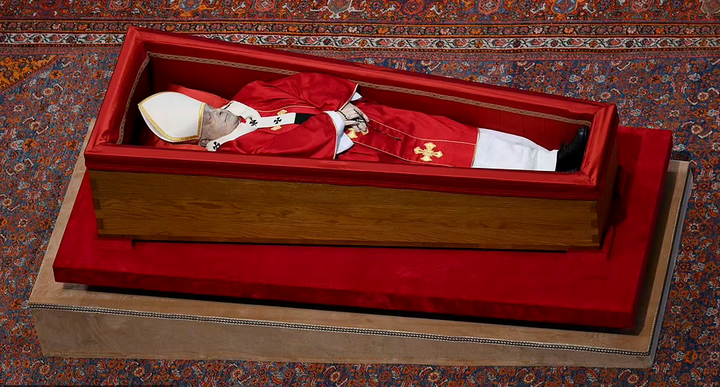
Pope Francis Laid to Rest in Humble Ceremony, Honoring His Legacy of Simplicity

The late Pope Francis, who passed away on April 21, 2025, at the age of 88, leaves behind a powerful legacy rooted in humility and service. His funeral and burial arrangements reflect this ethos, marking a significant shift from long-standing Vatican traditions.

A Simpler Farewell

In 2024, Pope Francis personally approved a revised version of the Ordo Exsequiarum Romani Pontificis, the official guide for papal funerals. The updated liturgy moved away from the elaborate ceremonies of the past, highlighting the pope’s role as a pastor rather than a monarch.

Among the changes:

  • The traditional three-tiered casket (cypress, lead, and oak) was replaced with a single wooden coffin lined with zinc.
  • His body will lie in the coffin facing the pews—not on an elevated platform—allowing mourners a more intimate opportunity to say goodbye.

Burial Outside the Vatican

In a historic departure, Pope Francis will not be buried beneath St. Peter’s Basilica, where most of his predecessors rest. Instead, he requested to be laid to rest at the Basilica of St. Mary Major in Rome, a church to which he held deep personal devotion.

This is the first time since 1903—with the burial of Pope Leo XIII—that a pope will be interred outside the Vatican.

Public Viewing and Funeral Mass

The faithful are invited to view Pope Francis’s body at St. Peter’s Basilica from Wednesday through Friday evening, before the funeral Mass takes place on Saturday, April 26, 2025, at 10:00 AM local time in St. Peter’s Square.

The service will be led by Cardinal Giovanni Battista Re, Dean of the College of Cardinals, alongside clergy from across the globe.

Nine Days of Mourning

Following the funeral, the Church will observe the traditional novemdiales—a nine-day period of mourning and prayer for the soul of the late pope. During this time, special Masses and reflections will honor his life and teachings.


A Final Testament to His Values

Pope Francis’s decisions regarding his funeral and burial underscore his unwavering commitment to a modest, servant-led papacy. By rejecting grandeur, he offers a powerful final message: true leadership lies in humility and compassion.

As preparations begin for the next papal conclave, the simplicity of these rites will stand as a lasting symbol of his transformative influence on the Catholic Church and its people.
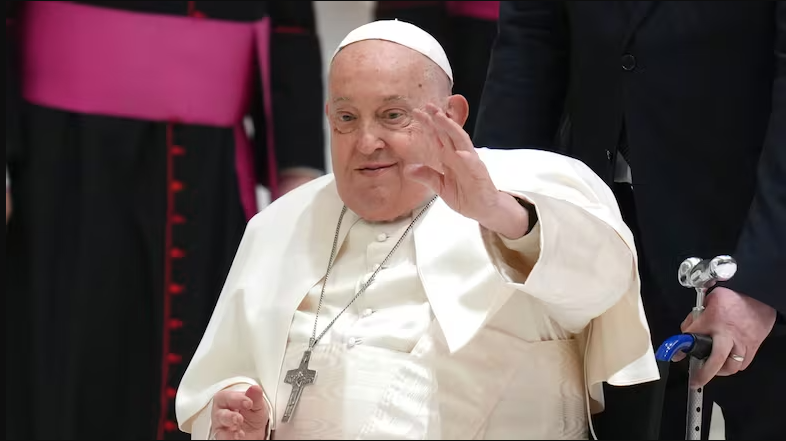
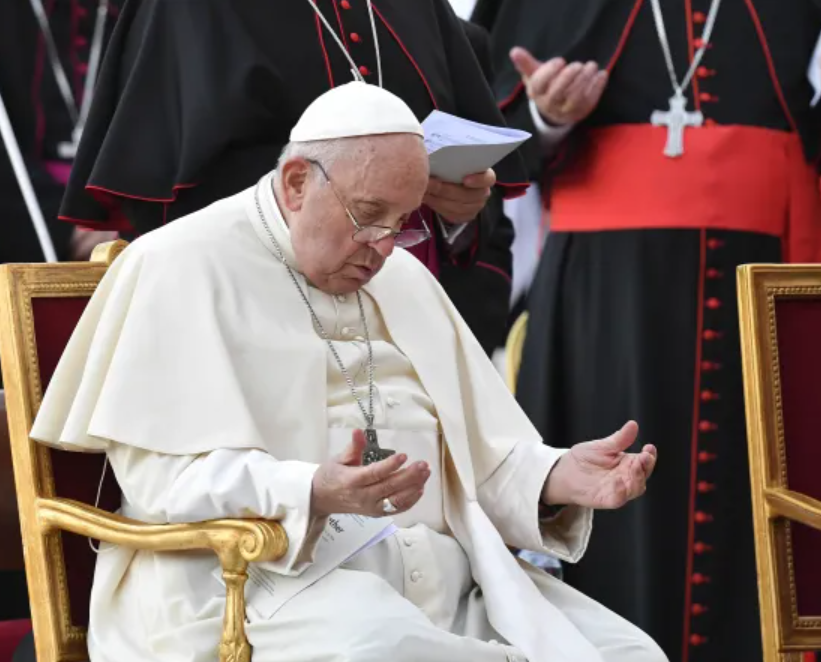
Public Viewing of the Pope’s Body Begins

Thousands of Catholic faithful have begun paying their respects to Pope Francis as his body lies in state at St. Peter’s Basilica. The Vatican opened the basilica to the public for three days of mourning, allowing mourners to file past his simple wooden coffin.  The public viewing began at 11 a.m. local time after a solemn procession transported the coffin from the Casa Santa Marta, the Pope’s residence, to the basilica. Approximately 20,000 mourners gathered in St. Peter’s Square to witness the procession, applauding as the coffin passed.  Cardinals, priests, and Swiss Guards participated in the procession, with a male choir chanting psalms and prayers in Latin as the basilica’s bells tolled. The Pope’s body, carried by 14 pallbearers, was placed low to the ground, adhering to his request and deviating from traditional papal displays.  Mourners, including nuns and laypeople, wept as the coffin was moved through the crowd. Many crossed themselves or paused in prayer as they passed the coffin.  Pope Francis, 88, died on Easter Monday after suffering a stroke. His last public appearance was on Easter Sunday, when he greeted pilgrims from his popemobile in St. Peter’s Square.  The basilica will remain open from 7 a.m. to midnight for the next three days, allowing as many people as possible to pay their respects. The lying in state will conclude at 7 p.m. on the final day, in preparation for the funeral Mass on Saturday.  The funeral Mass is expected to draw at least 200,000 attendees, including dignitaries such as Prince William, UK Prime Minister Sir Keir Starmer, US President Donald Trump, French President Emmanuel Macron, and Ukrainian President Volodymyr Zelensky.

Ceremony and Procession

Cardinal Kevin Farrell, the Vatican Camerlengo, presided over the ceremony at the Casa Santa Marta chapel, where the Pope’s coffin was flanked by Swiss Guards. Priests and Swiss Guards led the procession to St. Peter’s Basilica.  Pallbearers carried the coffin through St. Peter’s Square, following the same route the Pope took on Easter Sunday. Mourners watched as the procession passed, with many expressing their grief.  Inside the basilica, Cardinal Farrell blessed the coffin and read from the Gospel of St. John. The Pope’s coffin was placed near the Altar of the Confession, and the service concluded with prayers and hymns.

Preparations and Security

Crowds began gathering early in the morning to be among the first to enter the basilica. Officials have prepared for large crowds, providing water and first aid. Security has been heightened, with Italian police patrolling the area and metal detectors installed at key points.  A conclave to elect a new pope is expected to begin after the funeral, with Cardinals Luis Antonio Tagle and Pietro Parolin being mentioned as early favorites.

Pope Francis’ Legacy

Pope Francis, the first Latin American pontiff, was known for his humble style and concern for the poor. He also advocated for reform within the Catholic Church, including greater inclusion of women and LGBTQ+ individuals.  Cardinals will consider whether to continue his reform efforts or return to more traditional practices when electing his successor

Pope Francis’ Last Words Revealed

Pope Francis’s final public appearance in St. Peter’s Square on Easter Sunday was made possible by his personal nurse, Massimiliano Strappetti, the Vatican has revealed. The 88-year-old pontiff, who passed away on Monday morning following a stroke, had asked Strappetti, “Do you think I can manage it?” before greeting the crowds.

Despite appearing exhausted during the Easter celebrations, Pope Francis spent approximately 15 minutes in the popemobile, waving to the crowd and blessing babies. Vatican News, the Holy See’s media outlet, reported that the Pope thanked Strappetti, saying, “Thank you for bringing me back to the square,” in what were among his last words.

The pontiff’s health had been a concern following a five-week hospital stay for double pneumonia. On Monday morning, around 5:30 am, he began showing signs of illness. Over an hour later, he gave Strappetti a “gesture of farewell” from his bed before falling into a coma. He was declared dead at 7:35 am. Vatican News described his passing as “a discreet death, almost sudden, without long suffering or public alarm.”

In a preface written two months prior for Cardinal Angelo Scola’s book, “Awaiting a New Beginning. Reflections on Old Age,” Pope Francis expressed a lack of fear regarding death, stating, “We must not be afraid of old age” and “must not fear embracing becoming old,” but instead strive to live life on earth with “grace and not with resentment.” He described death as “a new beginning,” marking the start of eternal life.

Strappetti, who had previously been credited by the Pope for saving his life by advocating for surgery to address an intestinal inflammation, remained by his side throughout his recent hospital stay. The nurse, who had also served Popes John Paul II and Benedict XVI, was appointed as Pope Francis’s personal healthcare assistant in 2022.

In the days leading up to the Easter appearance, Strappetti and the Pope reviewed the route he would take in St. Peter’s Basilica. Strappetti was also commended for urging doctors to take decisive action during the pontiff’s recent hospital stay, notably during a bronchospasm attack when he insisted, “Try everything, don’t give up.”

Dr. Sergio Alfieri, the coordinator of the medical team, confirmed that Pope Francis had “delegated all kinds of health care decisions to his nurse, and so his wishes were granted.”

The Pope’s funeral is scheduled for Saturday.

Vatican Confirms Pope Francis’ Death, Begins Process to Elect New Pontiff

The Vatican has officially announced the death of Pope Francis, who passed away at the age of 88 on Easter Monday, marking the end of a historic papacy and initiating the process to select the next leader of the Roman Catholic Church.

Pope Francis, born Jorge Mario Bergoglio, became pope in March 2013 following the resignation of Pope Benedict XVI. His passing now places the governance of the Church temporarily in the hands of the College of Cardinals.


What Happens Next: The Path to a New Pope

Upon the pope’s death, the College of Cardinals assumes temporary administrative control of the Church. This body, composed of senior bishops and Vatican officials from around the globe—each personally appointed by the pope and identifiable by their red vestments—will now organize the process of electing a new pope.

This process begins with a series of meetings known as general congregations, held at the Vatican, where the cardinals make initial preparations, including organizing Pope Francis’ funeral and burial.


The Conclave: Electing the New Pope

Roughly 15 to 20 days after the papal seat is declared vacant, the cardinals gather in St. Peter’s Basilica for a special Mass, invoking the guidance of the Holy Spirit in their decision-making.

Only cardinals under the age of 80 are eligible to vote in the election, and these are known as cardinal electors.

The electors then move to the Sistine Chapel, where they take an oath of absolute secrecy. Once the chapel is sealed, the conclave begins. Voting is conducted by secret ballot, with each cardinal casting their vote beneath Michelangelo’s famed fresco of the Last Judgment.

Each day includes four rounds of voting, and the process continues until one candidate secures a two-thirds majority.


Smoke Signals and the Announcement

At the end of each voting round, the ballots are burned. If no pope is elected, a mix of chemicals is used to produce black smoke, signaling to the outside world that the Church is still without a new leader.

When a candidate finally receives the required votes, the dean of the College of Cardinals asks if he accepts the election. Upon acceptance, the new pope selects a papal name, dons the traditional vestments, and prepares for his first public appearance.

The final ballots are then burned with a different chemical mix to produce white smoke, indicating that a new pope has been chosen.

The senior cardinal deacon, currently Cardinal Dominique Mamberti of France, then steps out onto the balcony of St. Peter’s Basilica to declare the historic words:

“Habemus Papam”“We have a pope.”

The new pope then emerges to offer his first apostolic blessing to the people of Rome and Catholics around the world.

Pope Francis’ Health in Critical Condition: Latest Updates from the Vatican

He is currently undergoing oxygen therapy and has received blood transfusions. Blood tests indicate a mild kidney issue, but it remains “under control.”

According to the Vatican, the Pope is “alert and well-oriented,” meaning he is aware of his surroundings. He was admitted to Rome’s Gemelli Hospital on February 14 after experiencing breathing difficulties for several days.

Initially treated for bronchitis, doctors later diagnosed him with pneumonia affecting both lungs. On Sunday, the Vatican reported that his low platelet count, a condition known as thrombocytopenia, remained stable.

Earlier in the day, the Pope “participated in the Holy Mass alongside those caring for him.” However, the Vatican refrained from providing a clear prognosis due to the “complexity of his condition.” This update follows Saturday’s statement, in which the Vatican confirmed he had suffered a breathing crisis and was in “critical” condition.

Earlier on Sunday, the Pope urged Catholics to pray for him after missing the traditional Angelus prayer in person for the second consecutive week.

His risk of pneumonia is heightened due to a previous lung surgery in his youth, during which part of his lung was removed following a pleurisy infection.

The 86-year-old leader of the Roman Catholic Church has been hospitalized multiple times during his 12-year papacy, including for bronchitis at the same hospital in March 2023.

Pope Francis, originally from Argentina, is the first Latin American and the first Jesuit to lead the Roman Catholic Church.

Pope Francis Opens Door To Blessings For Same-Sex Couples

In a significant shift, Pope Francis has authorized Catholic priests to offer blessings to same-sex couples. While reaffirming the Church’s teaching on marriage, this move signals a path towards greater inclusion and acceptance for LGBTQ+ individuals within the Catholic community.

The Vatican’s new document emphasizes that these blessings are expressions of God’s love and welcome towards all people, without compromising the traditional understanding of marriage as a union between a man and a woman.

However, the document also outlines certain parameters for offering such blessings. They should be conducted within a pastoral context, separate from official church ceremonies or civil union rituals. Additionally, priests are entrusted with the individual discernment of each case, ensuring that the blessings offered align with the Church’s broader teachings.

This decision reflects a desire to balance tradition with compassion, acknowledging the struggles and aspirations of same-sex couples seeking recognition and support within the faith. By framing blessings as a gesture of God’s grace and inclusivity, the document offers a space for deeper dialogue and understanding between the Church and LGBTQ+ Catholics.

It’s important to note that this announcement is likely to be met with mixed reactions within the Catholic community, with some embracing it as a positive step towards inclusivity and others considering it a departure from established doctrines.

Overall, Pope Francis’ decision highlights the ongoing evolution of the Church’s position on LGBTQ+ issues, marking a move towards greater acceptance and acknowledging the diverse range of experiences and realities within the Catholic family.

Pope Francis takes Vatican one step closer to accepting homosexuality

Pope Francis has suggested that he would be open to having the Catholic Church bless same-sex couples, but only on a case-by-case basis.

This is a significant shift in tone from the Church’s previous stance on same-sex relationships, which have been considered “objectively sinful.” The Pope’s comments come at a time when many churches around the world are grappling with the issue of same-sex marriage and how to best support their LGBTQ+ members.

It is important to note that the Pope’s suggestion is not a formal change in Church doctrine. However, it is a sign that the Church is becoming more open to the idea of blessing same-sex couples. This is a positive development, and it is something that should be welcomed by LGBTQ+ Catholics and their allies.

It is also important to note that the Pope’s comments are not without their critics. Some traditional Catholics have argued that the Pope is going too far, and that blessing same-sex couples would be a betrayal of Church teaching. However, the Pope’s supporters argue that he is simply trying to be more inclusive and compassionate towards LGBTQ+ people.

Overall, the Pope’s comments are a positive step forward for the Catholic Church. They show that the Church is willing to listen to its LGBTQ+ members and that it is open to change.

Ghafla!
Privacy Overview

This website uses cookies so that we can provide you with the best user experience possible. Cookie information is stored in your browser and performs functions such as recognising you when you return to our website and helping our team to understand which sections of the website you find most interesting and useful.