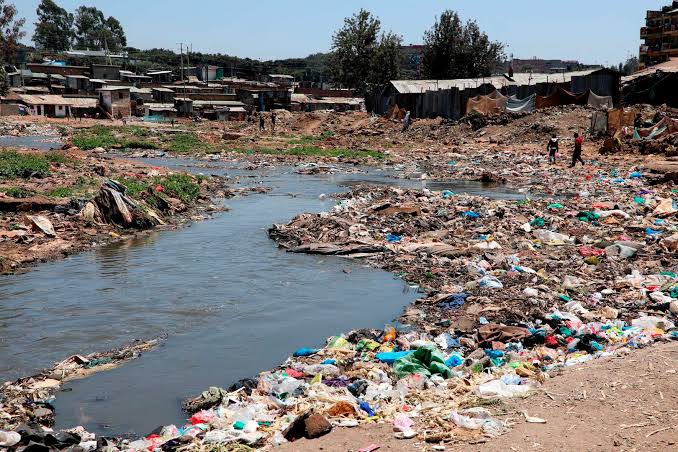
The Nairobi River Regeneration Project is a national initiative to restore human dignity, not only an environmental project. Thousands of Nairobi citizens have been compelled to live, work, and raise children next to illegal dumps, hazardous trash, and raw sewage for decades. Any Kenyan should not be forced to live in a dumpsite. With the help of significant infrastructure like a 60-kilometer trunk sewer line, expanded treatment plants, and the development of green public spaces, the Ksh 50 billion Nairobi River Regeneration Project, which was started in March 2025, is currently turning the river from a symbol of neglect into a pillar of health, opportunity, and dignity.
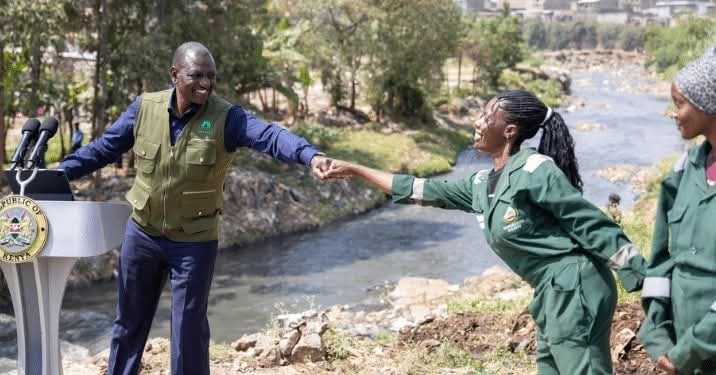
Wananchi can already see the progress. Community parks like Kamukunji are almost finished, sewer line construction is underway, and thousands of youth have been involved in cleanup and restoration projects. Since they understand that the goal of this process is to shield families from illness, flooding, and environmental danger, the informal communities along the river, especially those downstream, have generally complied with riparian relocation notifications. In addition to creating over 40,000 jobs, the project is anticipated to drastically lower the number of waterborne illnesses while reestablishing the river as a secure and useful area for all Nairobi inhabitants.
However, communal responsibility, particularly upstream, is essential to the success of this national restoration effort.
Progress for millions downstream and throughout the larger basin, which extends all the way to Makueni and Tsavo, could be jeopardized by ongoing opposition to riparian compliance in some upstream communities, particularly in parts of Lavington and Kileleshwa.Politics is not at issue here.It concerns justice, environmental preservation, and public health.The river is a part of the entire nation, not just one neighborhood.There is no longer any room for inaction.Kenya’s own dignity is being restored with the restoration of the Nairobi River.
A consultative community engagement and sensitization meeting held on 10th November 2025 at the Nairobi Rivers Commission (NRC) Boardroom achieved a landmark consensus between local communities and government agencies on the Nairobi Rivers Regeneration Program (NRRP).
The meeting brought together the Minority Leader of the Nairobi City County Assembly, MCA’s from Dagoretti, Kikuyu, Kiambu, Kangemi, and Riruta Wards, and local landowners.
The forum was coordinated by Hon. Antony Karanja, MCA for Waithaka and Minority Leader, Nairobi City County Government.
The meeting underscored a shared commitment to advancing the NRRP while ensuring that the rights and interests of landowners and local communities are fully respected.
Participants agreed on the need for continued public engagement and collaborative planning to address concerns around riparian areas, development regulations, and Special Planning Area (SPA) guidelines.
The Nairobi Rivers Regeneration Program is critical for addressing the significant environmental and urban development challenges facing the Nairobi Metropolitan Area.
Rapid expansion of informal settlements along riparian zones, coupled with acute housing shortages, has contributed to substandard living conditions for many residents.
The city’s sewerage system, built in 1965 for a population of 350,000, is now grossly inadequate for Nairobi’s 5.3 million residents in 2023 – a number projected to reach 20 million by 2053 – resulting in insufficient drainage and waste management infrastructure.
These pressures have heightened public health risks, with polluted waterways and uncontrolled discharge of industrial and household effluents endangering communities.
Encroachment of riparian reserves and irregular construction has led to illegal raw sewage discharge, while inadequate solid waste management – particularly at the Dandora Dumpsite – further exacerbates environmental hazards.
The city is also experiencing declines in biodiversity and degradation of natural habitats, such as the Ondiri Wetland, the source of the Nairobi River, alongside increasing flood risks amplified by climate change.
The NRRP aims to tackle these complex challenges through comprehensive river rehabilitation, sustainable urban planning, and community-inclusive interventions.
Arch. Musuvo Mumo, Deputy Commissioner of the Nairobi Rivers Commission, emphasized the collaborative approach, stating:
“We will work with Water Resources Authority, NEMA, and other agencies together with landowners to determine the true high-water mark and the correct riparian. That is the proper process.”
He further clarified landowner rights:
“The fact that the riparian sits within your land does not mean it is not your land. It simply means there are limits to what you can do within that area.”
Arch. Mumo added that the planning process will guide development policies, noting:
“Planning is a process, and the policies that come out of it will guide what can or cannot be built close to the river.”
Hon. Antony Karanja, MCA for Waithaka Ward and Minority Leader, Nairobi County Assembly reinforced the importance of sustained community engagement, highlighting the consensus reached during the meeting:
“The original idea when we came here was to demystify some of the things you have heard – and that is exactly what has happened. From here, we will move to shorter spans where you live.
Together with the Nairobi Rivers Team, we will organize even smaller citizen engagement meetings.”
He further emphasized the role of political leadership in ensuring representation:
“As political leaders, our role is to create a link between our electorate and development programs to ensure they are represented.”
Bishop Wanjiru, Chairperson of the Nairobi Rivers Commission, welcomed the collaborative spirit of the forum, stating:
“We have had positive and insightful engagements with the communities from Kangemi and Dagoretti.
We have agreed to re-examine the laws governing NRRP’s work that were of distress to them with the intention of reviewing them with public participation, such as the SPA.”
The forum concluded with a clear message of unity and shared responsibility.
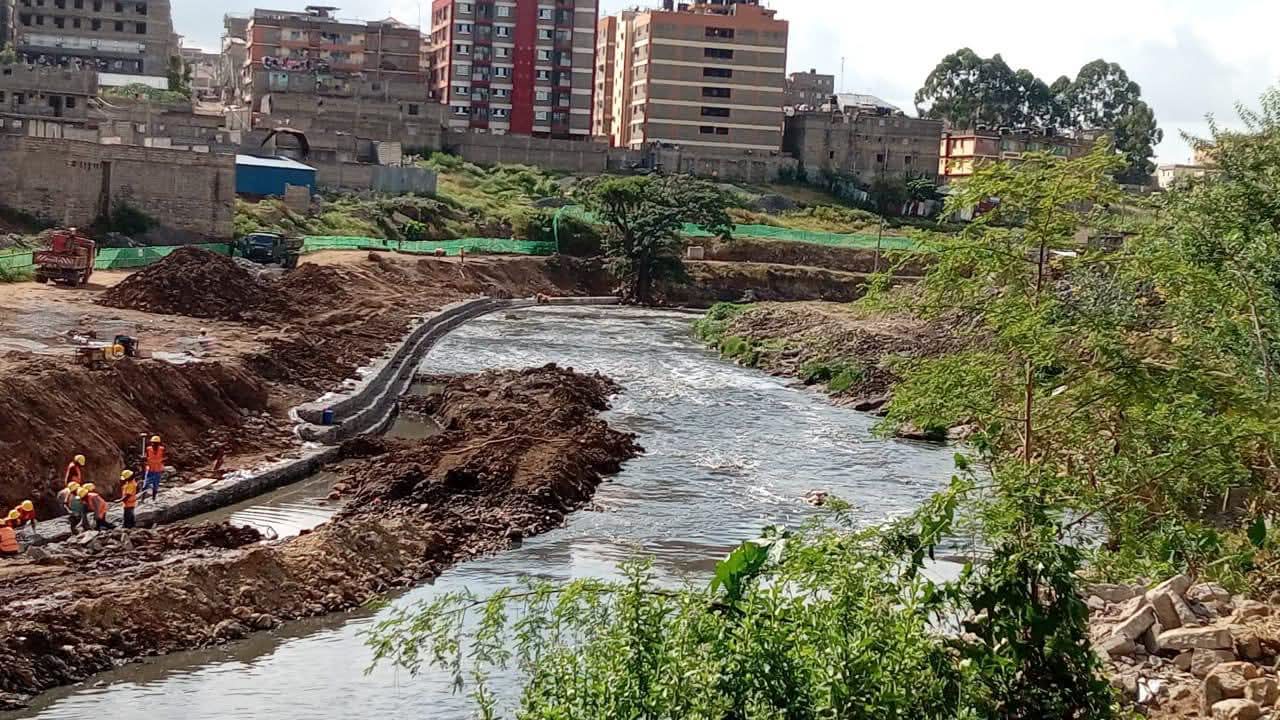
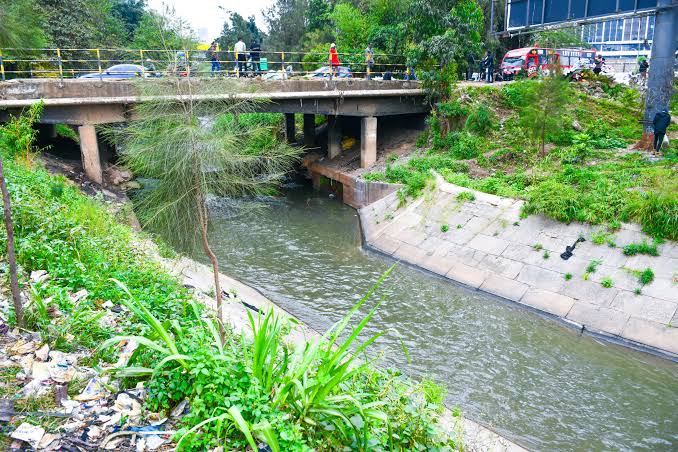
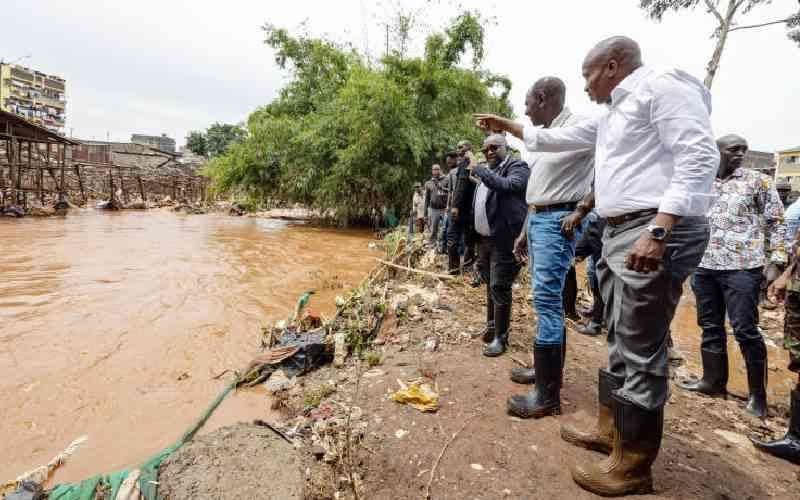
A section of the Nairobi River that’s under rehabilitation by NRRP (Image: Files)
Communities expressed strong support for the NRRP, committing to active participation while ensuring that development interventions are implemented fairly and sustainably.
Both government agencies and local stakeholders emphasized that the program’s success depends on balancing infrastructure development, environmental conservation and community rights – working together to create a more livable Nairobi for all.
“The Nairobi Rivers regeneration is a climate action project at its core – an ecosystem restoration effort that brings together government, communities, and young people to reclaim our river systems,”
She said.
“This time, we are doing it differently. We are deliberately engaging the communities and youth, ensuring they are co-owners and beneficiaries of the transformation,”
Said Hon. Bishop Wanjiru while opening the forum.
During the engagement, community leaders also called for the inclusion of more youth in the rivers regeneration program via Climate WorX.
What began as a clean-up mission is fast becoming one of the boldest urban renewal efforts in Kenya’s history.
The Nairobi Rivers Regeneration Project (NRRP) is redefining how cities can heal themselves – not just by removing waste, but by rebuilding entire communities and ecosystems around clean, flowing rivers.
At the heart of this transformation is a simple truth: when the river thrives, the city lives.
Restore the River, Rebuild the City
The Nairobi River once symbolised the city’s promise – and its pollution.
But today, its story is changing.
Through a multi-agency effort involving the government, private sector, and local communities, the NRRP is rehabilitating waterways, improving stormwater drainage, expanding sewer systems, and redesigning riparian zones.
This isn’t just environmental restoration – it’s urban engineering meeting social justice.
By improving waste management, upgrading informal settlements, and opening up safe public spaces, the project is building Nairobi’s resilience from its rivers outward.
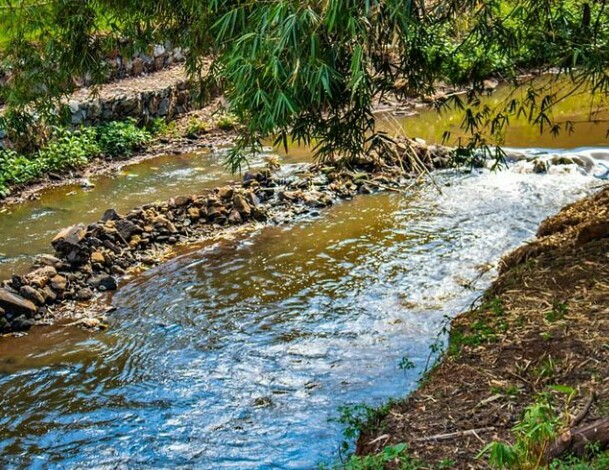
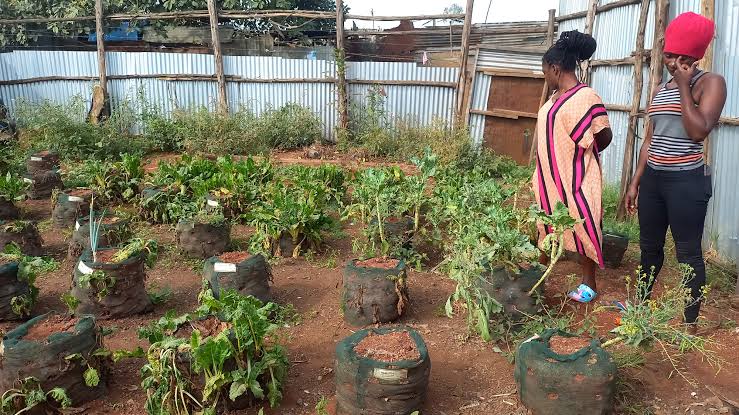
A project by Komb Green Solutions in Korogocho, a major part of environmental regeneration in Nairobi (Image: Files)
Community-driven Environmental Initiative
The revival of the Nairobi River isn’t being written in boardrooms – it’s unfolding in the hands of ordinary Kenyans.
Youth collectives such as Komb Green Solutions in Korogocho and the Kilimani Project Foundation are taking the lead, reclaiming riparian land, creating pocket parks, and reimagining what green living looks like in urban Kenya.
Their work is restoring more than just the riverbank – it’s restoring dignity, safety, and livelihoods.
By transforming dumpsites into gardens and grey spaces into green corridors, these communities are proving that true regeneration begins from the ground up.
“We don’t just clean; we create,” says a member of Komb Green Solutions. “This is our home, and we want to make it better for the next generation.”
A Working Collaboration
The regeneration project has also become a model of inclusive urban planning.
Residents are participating in mapping exercises, digital monitoring, and town hall forums to ensure local voices remain central to every stage of the process.
This participatory approach strengthens accountability and keeps the Nairobi River regeneration both people-driven and sustainable.
A City Reimagined
With riparian corridors being restored and new housing and transport networks planned, Nairobi is positioning itself as a model of environmental resilience and inclusive growth.
It’s a shift from managing urban decay to actively designing urban renewal.
Mazingira Day 2025 celebrates this shift – a reminder that environmental protection is not a one-off event, but an ongoing movement driven by communities, supported by policy, and anchored in innovation.
Because when citizens take ownership, when communities and government act together, and when rivers flow freely again, a city finds its soul.
President William Ruto has reaffirmed his government’s unwavering commitment to cleaning and restoring the Nairobi River, making a bold promise to launch a new fish market in the area within two weeks.
Speaking during an inspection tour of the ongoing Nairobi River clean-up exercise in Dandora on Thursday, July 17, 2025, the Head of State articulated a vision that extends beyond mere waste removal. He emphasized a comprehensive plan to breathe new life into the once heavily polluted river, transforming it into a vibrant hub of economic activity. The President underscored his intention to make the river clean enough to sustain aquatic life, particularly fish, as part of a broader strategy to revitalize Nairobi’s environment, boost its economy, and improve residents’ livelihoods.
“Naona mko na mpango. Mimi nimekuja hapa kwa sababu tulikubaliana na nyinyi ya kwamba hii Nairobi River, tanataka tuipangie vizuri. Tuondoe maji taka, tuondoe sewage, tuweke samaki, tutengeneze barabara, tutengeneze penye watoto watachezea, na tuwapangie manyumba na maendeleo. Ahadi ni deni. Nitatengeneza hii maneno, watu wa Nairobi, Mathare, Kamkunji,” Ruto declared, underscoring his dedication to the ambitious project. (I see you have a plan. I came here because we agreed with you that we want to organize this Nairobi River well. We will remove wastewater, remove sewage, put in fish, build roads, create play areas for children, and plan houses and development for you. A promise is a debt. I will fix these things, people of Nairobi, Mathare, Kamkunji.)
He further announced that his administration will construct two new sewer lines. This critical infrastructure is designed to prevent raw sewage, a major source of pollution, from draining directly into the river. “Mbali na kutengeneza river hii, pia tutajenga sewer lines mbili; ile maji ya taka taka haiwezi tena kuingia kwa river, ndo tuhakikishe maji yote ya taka inapitia kwa sewer lines,” he explained. (Apart from restoring this river, we will also build two sewer lines; so that wastewater can no longer enter the river, to ensure all wastewater passes through sewer lines.)
Fish Market by August
In what was the highlight of his speech, President Ruto assured local residents that a dedicated fish market would be operational in the area within a fortnight. “Nimeambiwa mnataka nijenge soko la samaki na mali ingine; nataka niwaambie kuwa, wiki mbili zinakuja, mtakuwa na soko tukiendelea kusafisha Nairobi River,” he announced, setting a clear deadline for the new development. (I have been told you want me to build a fish market and other facilities; I want to tell you that, in the next two weeks, you will have a market as we continue cleaning the Nairobi River.)
This is not the first time the President has made such a promise. In December 2024, during an earlier inspection of the Nairobi River, Ruto had articulated a similar ultimate goal: to restore the river to a state where it could support fish and provide clean water for children. “Tanakikisha kwamba tunaweka usafi kwa mto, tuweke hadi samaki na pia maji safi watoto wetu watumie,” he said at the time. (We will ensure that we clean the river, put in fish, and also have clean water for our children to use.)
As part of the broader Nairobi Rivers Regeneration Programme, the government also plans to construct weir dams to control water levels and establish wetlands to facilitate natural water purification.The ambitious clean-up project extends beyond mere environmental restoration. President Ruto emphasized his administration’s keen focus on urban renewal, creating thousands of jobs, and offering affordable housing solutions to Nairobi’s low-income earners.
“We will also build 50,000 social houses, making sure that our youth get employed while also making the city clean. We will need 30,000 people,” he stated in 2024, outlining the program’s significant employment potential.
The Nairobi Rivers Regeneration Program is expected to transform the city by vastly improving the environment, creating thousands of jobs, and providing much-needed affordable housing, fundamentally enhancing the quality of life for its residents.
The government has designated the Nairobi River Valley as a Special Planning Area (SPA) – a major milestone in Kenya’s urban renewal journey.
This is aimed at reclaiming the health and dignity of the Nairobi River and its surrounding communities.
Under the banner Mito Safi, Maisha Poa (Clean Rivers, Better Lives), the Nairobi River Regeneration Project is reshaping how we plan for cities.
The SPA – gazetted on March 6, 2025 – covers a 60-metre corridor from Naivasha Road to Ruai.
It sets in motion a structured two-year process that will guide infrastructure upgrades, environmental restoration, and inclusive development across the river basin.
But what exactly is a Special Planning Area?
A SPA is not an eviction notice.
It is a legal planning tool that allows government and communities to co-create a shared future – one anchored in transparency, fairness, and inclusivity.
Through this designation, the government can fast-track urgent improvements while ensuring every voice is heard.
A screenshot of the new Nairobi River logo, with the motto: Mito Safi, Maisha Poa (Image: Files)
Here’s What to Expect from the SPA
The SPA process will involve:
Community forums and local engagement to gather input and align priorities.
Environmental and social assessments to inform responsible development.
Planning for dignified, affordable housing in informal settlements.
Green spaces and flood mitigation infrastructure to restore the river’s health.
Importance of Public Participation
Residents, stakeholders, and partners will have opportunities to participate in shaping the Integrated Development Plan (IDP) that emerges from this process.
The Nairobi River Commission has committed to multilingual messaging, public updates, and open channels for feedback to ensure full transparency.
The Future of Nairobi River
This is more than just a planning exercise – it’s a model for how cities across Africa can grow sustainably.
By putting people and the planet first, the Nairobi River SPA offers a new vision for urban transformation.
Together, we’re building a city where clean rivers mean better lives.
For years, Nairobi River – once a vital artery of the city – has been reduced to a polluted, clogged waterway, barely recognizable as the lifeline it once was.
But, a transformative initiative is underway.
The Nairobi River Regeneration Project is setting the stage for one of the most ambitious environmental and urban renewal efforts in Kenya’s history.
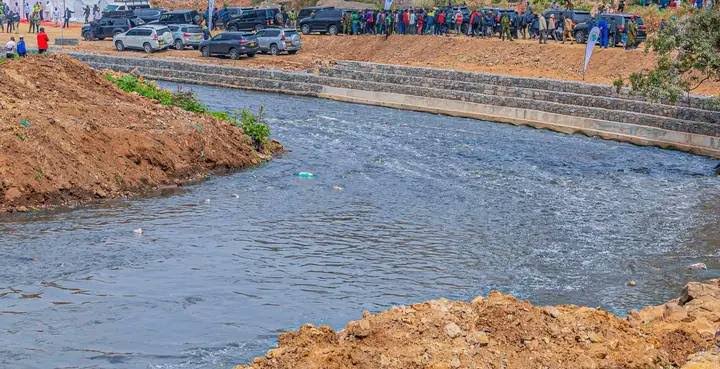
President Ruto inspects progress on the Nairobi River reclamation near Dandora dumpsite. (Image: Facebook)
This is more than just a cleanup – it’s a complete re-engineering of the river’s role in Nairobi’s urban ecosystem.
At the core of the project is the construction of a 54-kilometer trunk sewer line, designed to prevent raw sewage from contaminating the water.
This will be complemented by comprehensive waste removal, unclogging efforts, and river widening to mitigate flooding.
But the vision goes far beyond environmental restoration. Along the river’s banks, a new urban landscape will emerge.
The plan includes over 50,000 social housing units, alongside community parks, public halls, and modern markets to serve Nairobi’s growing population.
Walkways and cycle lanes, complete with electrification for security, will redefine accessibility and public spaces along the riverfront.
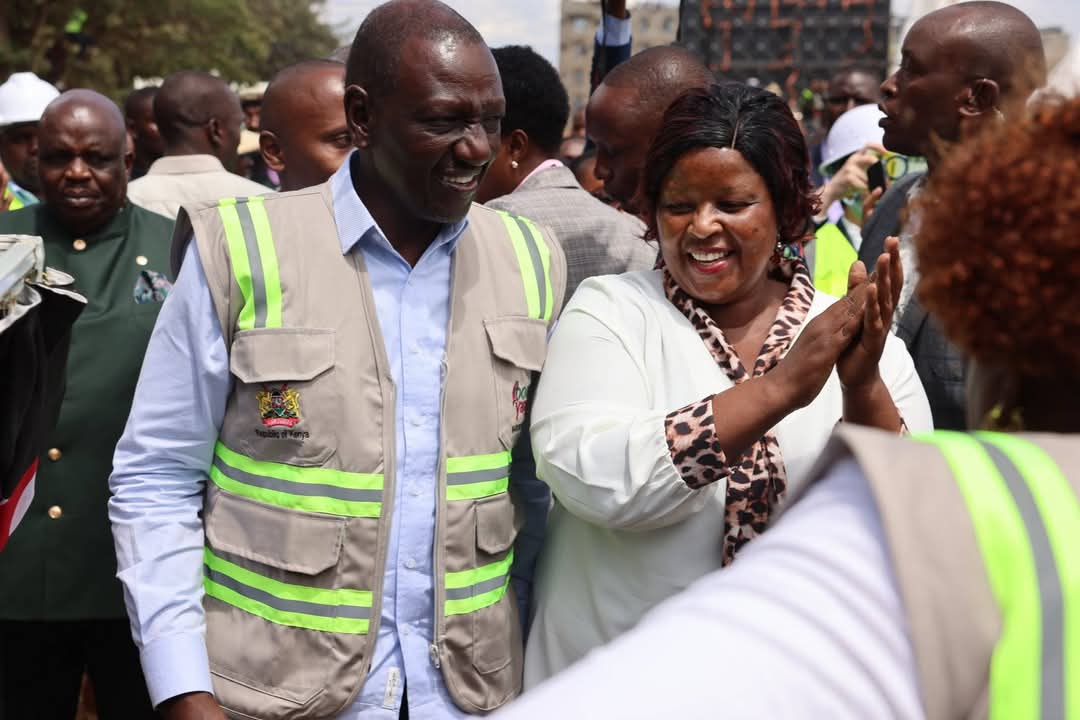
President Ruto pictured alongside Nairobi politician, Bishop Wanjiru and other dignitaries in the Langata leg of the Presidential Tour. (Image: Facebook)
The infrastructure overhaul is equally ambitious, with 44 new vehicular and pedestrian bridges set to improve connectivity across the city.
Meanwhile, constructed wetlands will naturally purify the river, and an expanded Kariobangi wastewater treatment plant will enhance Nairobi’s capacity to manage sewage efficiently.
One of the most significant interventions is the rehabilitation of the Dandora dumpsite, a notorious environmental hazard.
Alongside this, a massive tree-planting initiative will stabilize riverbanks, combat soil erosion, and revive Nairobi River’s lost biodiversity.
Phase one of the project covers 27.2 kilometers, from Naivasha Road to Dandora Falls – with future phases set to extend restoration efforts further along the river’s course.
This initiative is a turning point for Nairobi.
If executed and sustained, it will not only restore Nairobi River to its former glory but also redefine urban life in the capital.
The challenge now is ensuring long-term commitment – from the government, private sector, and the citizens who call Nairobi home. The transformation has begun.