Character Development: Nanyuki Town Showed Me Manenoz!

It is my first time in Nanyuki town. The last two days si nimeona mambo? Suddenly, nimejua the meaning of the phrase ‘Wueh!

It’s a pleasant little town that welcomes you in a massive bear hug but still holds back. It reminds me of running home in the rain and banging on my grandmother’s kitchen door. I’m soaked to the skin, loved and welcome, but not so fast, Sonny! There’s no way she’ll let me in dripping wet and muddy.

Enjoy the heat and the tantalizing smell of food from the doorstep till I can get my ducks in a row. Now, that’s how Nanyuki feels to me.

As a personal rule when in a new town, I steer clear of hotels or places with a star rating. I’m always after its vibe, heart and soul. This spirit thrives in the dark, litter-strewn back alleys where locals and ordinary folks live.

Nanyuki has the best on both fronts. She has classy, five-star places that serve breakfast with little towels soaked in steaming water on balconies overlooking lawns and grazing horses. The stories here are too formal. I prefer the other side with politically incorrect stories.

Lakini, nimeskia sana story za Nanyuki. I should have been afraid. But, self-confidence ni nini? I thumped my chest up: Ah, si nimekuwa places bwana. I did just fine in hungrier cities.

Sunday afternoon, I left my BnB and wandered downtown. In this context, it means getting to the fifth or sixth streets that circle the CBD. Nanyuki and Mombasa are similar – they have two major avenues running across. I wander around till I stumble into a small alley that sounds like a concert is in play. Music from different places merges.

There’s a row of little joints with comely names above the doors: Kwa Nyambu, Kwa Monica and so on. Each doorway hangs those ingenious blinds made from colourful plastic bottle tops. Ah, nice. Hizi sasa ndo base zangu. I start with Kwa Monica, I like the name. I stride in like the main actor in a Mexican action movie.

It’s a little dark, my eyes need a minute. There are three long tables with branded plastic sheets, and plastic chairs stacked in two’s. There’s a gigantic TV in a cage above the counter that’s reinforced with iron bars. A past La Liga match is streaming. I see a ‘Free Wifi’ poster. Great. A few patrons silently watch me. A girl emerges from the counter.

As soon as the girl gets close, I ask loudly so that the patrons hear.

“Sasa Sister, kwani Nyambu alienda wapi?”

I take off my denim jacket and drape it over the next seat. I’m trying to relax like a sort of regular. Eight out of ten times – every other joint in Kenyan towns has had a girl named Nyambu running it. Check that out.

Someone on the other table beats her to the answer.

“Ah, Nyambu?! Unajua Nyambu? Alas, bro….huyo alienda Christmas hakurudi” A guy shouts, rises and grabs the next seat. It has my denim jacket draped on it.

“Mi naitwa Abdalla…” he says, extending a hand. I fist bump instead.

I ask for a soft drink and point to my now-friend Abdalla, who asks if he would like a drink. Of course, he would. In less time than you can say Timbuktu, Abdalla is reeling off the particulars of this town better than any guide you’ll meet in the 5-star places.

Immediately, two things are clear. One, I’ve hit the jackpot – Abdalla is a terrific storyteller. Two, I’d be staying longer in Nanyuki.

Abdalla tells me about himself. He’s a coastal native but he’s been around for give or take three decades. I doubt he’d remember his Msambweni village well. But, granted the man has lost little of his people’s famed storytelling skills. It gets better the merrier he gets. If he’d gone to college, he would have made a terrific radio morning show host. He invites his friends.

I’d ask Abdalla some random crazy stuff.

Like, in Msambweni, has he ever bumped into a night runner?

The story’s build-up would be as exciting as the story itself!

Abdalla would lean back like he had spent a lifetime studying a congregation of night runners. I was hooked. Sunday afternoon passed quickly. The joint started filling up towards evening. It started getting chilly, too. A lot of locals are rocking those checked Maasai Kikoi’s. Nanyuki is hot by day, and chilly by night.

I reach for my denim jacket. Wueh! No trace. It had disappeared. I cannot answer the how-when-and-with-who. Suddenly, I realised that I had not received a call that entire afternoon. My backup Kabambe phone was in the jacket, along with Ksh70 in coins. Luckily, my smartphone had run out of charge and left charging at my BnB.

Wueh! Wacha Abdalla aanze kuzusha. It was total mayhem.

Inwardly, I knew I’d never get my jacket, phone and money back no matter the ruckus that we raised here. He knew it too. I had no other money on me – and, I still had a bill to clear. We had a running total of Ksh1350.

I had my wallet in the back pocket with only my ID card. I never carry cash when travelling. It’s too risky. I used to carry my Co-op Bank Visa Card. Lately, the bank’s mobile banking app – Mco-opCash – has usurped all the need for cash or ATM, including withdrawals.

Abdalla walks me to a Safaricom agent shop four doors down from Mama Monica’s. I needed to replace my lost SIM card. I did not have any money in my MPesa account, but I knew I could still access my Coop Bank account via Mco-opCash.

I had the Mco-opCash app on my Android phone, but I had lost the sim card. Even if I replaced the SIM card, I’d still have to visit a Co-op Bank branch to activate and link it to the app. I had one option: To replace the SIM card and access Mco-opCash through the USSD code *667#.

Half an hour later, we returned to Mama Monica’s. I borrowed a handset from the waitress and inserted my replaced Safaricom sim card. I dialled *667# to access Mco-opCash account and made a transaction withdrawal to my MPesa account. That’s the beauty of Mco-opCash.

If your phone gets lost, you can replace the SIM card and access your account. I’ll find time to visit a Co-op Bank branch to reactivate my new sim card and link it to the Mco-opCash app.

Nanyuki imenionyesha maneno. But I live by the adage that everything is either a win or a lesson.

I’ll still stick around. I’m still very hooked on Abdalla’s stories.

Kingdom Bank Invests in Farmers and Stakeholders in Support of Sustainable Economic Growth

Agriculture is an important economic activity for Kenya contributing to approximately 33% of the country’s GDP and employing more than 40% of the total population.

Over the recent years, we have seen Government, the private sector and development agencies join hands in working towards the revolution of the sector to propel the country forward in terms of increasing food security and building resilience for communities and the country at large.

While great strides have been made, more can still be done to support the agriculture value chain players to enhance their production, improve their quality and above all add value to the agriculture products through processing.

The potential of the sector though huge, remains moderately untapped mostly due to a lack of sufficient financing, poor agricultural practices and a limited number of extension services to support farmers.

Kingdom Bank, a subsidiary of the Co-operative Bank of Kenya, has invested in supporting the sector through various strategies that have proven effective, inclusive and impactful not only on its customers but also on the sector at large.

Gertrude Mjomba and Simon Mwang’ombe from Dannde Oils exhibited their coconut-based products at the Kingdom Bank stand during the 2023 Agriculture Society of Kenya Nairobi International Trade Fair.

First, the Bank has a dedicated agribusiness unit that focuses on empowering farm input providers, farmers, food processors and distributors. The empowerment of these value chain players is in the form of financial support through the provision of savings, loans, investment, digital financial solutions and payment platforms that allow these players to scale their agribusiness ventures.

Although many other banks also extend agriculture financing, Kingdom Bank’s value proposition is hinged on personalized relationship management and superior client servicing. This means that each customer is mapped to a Relationship Manager who handles their day-to-day operations and also extends financial advisory services as a value add to customers.

In addition, the bank has signed extensive partnerships with other stakeholders in the industry including motor vehicle and equipment service providers, SME trainers and key government institutions to offer farmers within the bank network affordable solutions that can support them in mechanizing their operations, growing their output and enhance their efficiency when it comes to agriculture.

This concerted effort has seen the bank advance over Ksh 62 million to the agriculture sector from the year 2021 to date. This loan distribution forms a huge percentage of the bank’s active loan book showcasing a commitment to support farmers and the agriculture value chain.

In fact, the support to the sector has not gone unnoticed with the Agriculture Society of Kenya feting Kingdom Bank with several accolades in the 2023 circuit of the ASK shows and trade fairs for having the Best Bank Stand.

Kingdom Bank stand at the recently concluded 2023 Agriculture Society of Kenya Nairobi International Trade Fair at the Jamhuri Showground.

“This is the first year the bank has participated in the agriculture shows and we successfully exhibited our brand, our solutions and our promise to our customers across the country in Kisii, Kisumu, Nakuru, Mombasa, Nyeri and Nairobi allowing us to also engage with agriculture players and identifying other areas in which we can support them,” said Kevin Muendo the Head of Micro Credit and Agribusiness at Kingdom Bank.

He also added that the bank remained intentional about creating market linkages for its customers and that is why several were able to exhibit their solutions at the bank’s stands in the shows. This includes among others, Dannde Oils, an enterprise run by two ambitious youths who process coconut to produce oil, coconut sugar, coconut flour and other by-products including cookies and other snacks.

Knights Energy a customer of the bank that provides solar solutions for industrial, commercial and residential use was also present at the Nairobi International Trade Fair showcasing their solutions within the clean energy space at the bank’s stand. In fact, Knights Energy powered the Kingdom Bank stand using solar power showcasing a commitment to embrace clean energy.

So the next time you want agriculture financing, think Kingdom Bank.

Simply walk into any of their branches countrywide and engage them based on your needs. Alternatively, call them on 0709 881 300 for support.

Co-op Bank leads Bid to Stabilize Small Businesses against Loan Defaults

There is a timely effort by banks to cushion small businesses and stave off mass loan defaults. This comes after a three-pronged hit from the weakening shilling, dollar dearth and rising interest rates.

Convergence of these headwinds has ripped up the playbook of most lenders as they move to stave off a resurgence in non-performing loans in an economy where businesses and individuals have also been hit with new taxes.

Banks are fretting that the progress, which had been achieved in offering accommodation to business customers following the Covid-19 pandemic disruptions may go under the drain in the emergence of new and unforeseen challenges in the operating environment.

They are now reaching out to small and medium-sized enterprises (SMEs) with support packages including extending repayment periods and connecting some with affordable suppliers of imported goods.

Lenders say they are emboldened by the statistics that showed that of the 6,572 MSME loans valued at Sh122.5 billion that were restructured last year, over 90 per cent were being serviced.

“With elevated repayment in terms of ticket sizes of repayment, that is actually an extra burden on the customer. But with an elongated period in terms of loan tenors, that supports customers,” says the Kenya Bankers Association.

The consistent slump of the Kenya shilling against world majors, which has shed over 19 per cent of its value against the dollar since January, has for instance thrown into disarray many small businesses dependent on imports.

Electricity and fuel prices have also been rising, partly on the State’s stance to cut subsidies and increase taxes, catching many businesses on the wrong foot.

The weakening of the shilling and rising energy prices have coincided with a rise in the cost of credit, piling significant pressure on the margins and cash flows of small businesses.

The introduction of new taxes on both individuals and businesses has played a double-edged sword role, increasing operating costs while also weakening the purchasing power of consumers.

Bankers say these shocks have been especially damaging because they were mostly unexpected and have all converged at nearly the same time.

Lenders are worried that most borrowers if left on their own, will struggle and default in servicing their loans, heightening the spike in bad debts across the banking system.

Their interventions have come to the aid of many small businesses such as car dealers, clothing and footwear shops and manufacturers who source inputs abroad and have had to adjust their budgets upwards or cut the size of imports, even as access to dollars remains scarce.

“We are supporting MSMEs on cash flow-based restructures, by matching their loan repayments with their current business income, free of restructuring fees, on a case-by-case basis,” says Mr Gideon Muriuki, managing director at Co-operative Bank of Kenya.

Central Bank of Kenya (CBK) data already indicates a steady rise in loan defaults. Gross non-performing loans—the amount of loans on which interest and principal have not been paid for at least three months— hit Sh586.2 billion in July, a Sh10.1 billion jump from the previous month.

Lenders had endured a rise in defaults for five consecutive months to May when the figure peaked at Sh592.6 billion before cooling to Sh576.1 in June.

At Sh586.2 billion, borrowers defaulted on 14.7 per cent of the Sh3.975 trillion that banks had issued as loans by the end of July. Lenders have reacted by increasing the provisioning for loan defaults.

The Head of Legal Services at Kenya Mortgage Refinance Company Elisha Nyikuli, the Director, Corporate & Institutional Banking at Co-op Bank Jackie Waithaka & the CEO National Co-operative Housing Union Mary Mathenge at a recent stakeholder’s meeting.


Banks’ weighted average interest rates have been rising over time to hit 13.5 per cent in July— the highest since March 2018 when the figure was at 13.49 per cent. This has been in line with the rising Central Bank rate.

Lenders, armed with the lessons learnt from managing COVID-19 shocks, reckon that working with customers early enough is likely to forestall a deterioration in the business performance of small firms.

Co-op Bank has been facilitating face-to-face meetings between Kenyan businesses and their sourcing suppliers abroad, for more structured negotiations.

Such engagements in countries such as Malaysia and Vietnam have helped SMEs improve the way they handle the sourcing of imports.

The tours, complemented with free expert financial literacy and coaching webinars have helped address issues such as cash flow and financial management, tax and online marketing.

“We regard today’s SMEs as the multinational corporations of tomorrow, and, therefore, commit significant resources and in addition partner with institutions that have domain expertise in enterprise development such as International Finance Corporation to support their growth,” says Mr Muriuki.

Lenders have also ramped up non-financial services activities that largely entail the hosting of customer engagement forums where expert-guided discussions are held to prepare SMEs for coping with emerging needs.

I&M Bank says it has enhanced support to small businesses in the form of unsecured business loans, local purchase order financing, invoice discounting and stock financing while also standing ready for restructures for firms that run into servicing problems.

“We now proactively engage one-on-one with such customers who are facing challenges to ensure they are running a sustainable business,” says Shameer Patel, head of retail banking at the I&M.

Banks are also increasing their focus on State-backed credit guarantee schemes to offer working capital loans at concessional rates.

KCB Bank Kenya and the Swedish International Development Cooperation Agency in August rolled out a Sh1 billion guarantee scheme for de-risking SMEs in their efforts to access credit

“The seven-year guarantee facility will enable the bank to strengthen its commitment to financing SMEs which continue to experience challenges, especially with access to affordable credit,” said KCB.

Source: Business Daily

Co-op Bank now Second Most Valuable Bank at Nairobi Stock Exchange

Co-operative Bank of Kenya has overtaken KCB Group to become the second most valuable lender on the Nairobi Securities Exchange as the latter’s share price continued to fall.

Co-op Bank’s stock was unchanged yesterday at Sh11.85, giving it a market capitalisation of Sh69.5 billion.

This has seen the lender overtake KCB for the first time, opening a gap of Sh2.3 billion.

KCB’s share price fell 4.78 per cent on Thursday to close at a new 52-week low of Sh20.9, assigning it a market value of Sh67.1 billion.

The bank’s share price fall gained pace in recent weeks after it reported lower earnings and a surge in provisions for loan defaults in the half year ended June.

At the start of the year, KCB’s market value was ahead of Co-op Bank by Sh52.2 billion. KCB’s relegation to third place came after it shed Sh56 billion in paper wealth since the first trade of the year.

Over the same period, Co-op Bank has lost only Sh1.4 billion. The bank has one of the lowest share price volatility among the country’s publicly-traded lenders.

Equity Group remains the most valuable bank at Sh135.6 billion despite losing Sh34.3 billion over the review period.

At current levels, Equity is valued at almost KCB and Co-op Bank combined.

A file image from the Nairobi Stock Exchange (NSE)

The second-place rank is likely to remain in contention as observers watch the evolution of the performance of the two lenders in the next few quarters. Their rivalry is among the upheavals in the league table of Kenya’s listed banks.

Standard Chartered Bank Kenya has also closed in on NCBA Group with their market capitalisation standing at Sh61.8 billion and Sh62.1 billion respectively as of Thursday.

StanChart has grown its market value by Sh7 billion since the start of the year while NCBA has lost Sh2 billion over the same period, leading to the convergence.

The top five lenders are Equity Bank – 136bn, Co-op Bank – 70bn, KCB – 67bn, NCBA – 62bn and Stanbic – 45bn.

The most significant change in shareholder paper wealth was seen at KCB whose chief executive Paul Russo, now in his second year at the helm, is taking measures to address the legacy bad debt at the lender.

KCB reported a 20 per cent net profit drop from six months to June, nearly tripling its provisioning for loan defaults. Its net profit fell to Sh15.5 billion from Sh19.5 billion posted in the preceding similar period.

KCB’s operating expenses increased by 60 per cent to Sh50.61 billion while provisions for non-performing loans jumped 2.4 times to Sh10.2 billion from Sh4.32 billion.

Analysts say investors have overreacted to the bank’s spike in provisions, placing a buy recommendation on the stock.

All the listed banks remain undervalued by historical standards, with the lenders having previously traded at multiples of their net assets before the onset of the bear run.

Co-op Bank maintains market lead with Ksh16.4 Billion Profit in First Half of 2023

Co-op Bank Group is pleased to report a Profit Before Tax of Kshs. 16.4 Billion for the first half of 2023, representing a 7.4% growth compared to Kshs. 15.3 Billion recorded in the first half of 2022. This points to a Profit after Tax of Kshs. 12.1 Billion compared to Kshs. 11.5 Billion reported in 2022.

Key Performance highlights:

Financial Position

The Group has registered sustained growth as follows;

  • Total Assets grew to Kshs. 664.9 Billion, a 10.1% growth from Kshs 603.9 Billion in the same period last year.
  • Net loans and advances grew to Kshs. 365.4 Billion, a 10.7% growth from Kshs.330.1 Billion in 2022.
  • Customer deposits grew to Kshs 463.9 Billion, a 9.7% increase from Kshs.423.0 Billion.
  • External funds from development partners have increased by 43.6% to Kshs.59.4 Billion from Kshs. 41.4 Billion in 2022.
  • Shareholders’ funds have grown to Kshs. 108.3 Billion, an 11.9% increase from Kshs. 96.7 Billion in 2022.

Comprehensive Income

  • Total operating income grew by 3.0% from Kshs. 34.4 Billion to Kshs. 35.4 Billion.
  • Net interest income grew by 2.3% from Kshs 21.1 Billion to Kshs 21.5 Billion.
  • Total non-interest income grew by 4.0% from Kshs. 13.3 Billion to Kshs. 13.8 Billion.
  • Total operating expenses decreased by 0.1% from Kshs. 19.2 Billion to Kshs. 19.1 Billion.

Cost Management

The Group reports excellent efficiency gains from the various initiatives to record a Cost-to-Income Ratio of 46.0% in H12023 from 59% in FY2014 when we began our Growth & Efficiency journey.

Credit Management

The Group prudentially made provisions of Kshs. 2.9 Billion which has enhanced the Bank’s Loan Loss Reserve/ Coverage levels to 71.1%.

Strong Digital Footprint

A new Core Banking System goes Live as the Bank successfully upgraded the core banking system to the latest version of Finacle from Infosys, which was rated globally as the top core banking system in 2022 by Gartner.

The new banking system delivers enormous benefits which include;

  • Enhanced Security: The new system features advanced security measures to protect customer data and assets more effectively.
  • Improved Performance: The new system is more efficient, processing transactions and requests faster.
  • Increased Flexibility and agility: The new system is designed to be more flexible, allowing us to respond to changing customer needs more effectively.
  • Better User Experience: The new system features a more intuitive and user-friendly interface, making it easier for customers to access and manage their accounts.
  • Through our digital channel strategy, the Bank has successfully moved 91% of all customer transactions to alternative delivery channels, a 24-hour contact centre, 546 ATMS, mobile & internet banking and over 17,000 networks of Co-op kwa Jirani agents.
  • We have successfully migrated our customers to the Omni-channel, integrating accessibility and user experience. Our Omni-channel interfaces online banking through personal computers, mobile phones and USSD availing our services to all customers through their preferred channel yet retaining the same experience from wherever they are.
  • MCo-op Cash Mobile wallet continues to drive substantial non-funded income streams with 5 Million customers registered and Kshs 41.3 Billion in loans disbursed in the first half of 2023, averaging Kshs. 6.9 Billion per month.

Wide Branch Network

The Bank has grown the branch network to 191 (4 in South Sudan). New seven (7) Branches (Kimana, Matuu, Thika Kwame Nkrumah, Greenwood Mall – Meru, Kenol Makuyu, Hindi – Lamu and Bamburi – Mombasa) opened in 2023, whereas five Branches (Kabarnet, Iten, Kasarani, Kamakis and Chwele) opened last year.

Subsidiaries

Co-op Consultancy & Bancassurance Intermediary Ltd posted a Profit Before Tax of Kshs 591.3 Million in   Q22023, riding on strong penetration of the Bancassurance business.

  • Co-operative Bank of South Sudan which is a unique joint venture (JV) partnership with the Government of South Sudan (Co-op Bank 51% and GOSS 49%) made a Profit before tax of Kshs 205.1 Million in Q22023. This performance, however, translated to a monetary loss of Kshs 36.5 Million attributable to hyper-inflation accounting occasioned by currency devaluation of the South Sudanese pound.
  • Co-op Trust Investment Services Ltd contributed Kshs. 106.8 Million in Profit Before Tax in Q22023, an impressive 25% growth. The Subsidiary has Funds Under Management of Kshs. 197.3 Billion.
  • Kingdom Bank Limited (A niche MSME Bank) has contributed a Profit before Tax of Kshs. 521.9 Million in Q22023, a remarkable growth of 29% from Kshs. 405.9 million reported last year.

External funds from Development Partners

The Bank signed a KShs. 12.6 Billion long-term credit agreements with global institutional investors led by the German fund, Deutsche Investitions und Entwicklungsgesellschaft (DEG). The fund will strengthen the bank’s capital base and support appropriate lending to MSMEs for future growth.

Environmental Social and Governance (ESG)

The Bank continues to implement a best-in-class ESG policy framework supported by an ESG implementation roadmap, group-wide ESG champions and ESG Governance.

Our portfolio of loans above USD 1 Million comprises Kshs. 37.4 Billion which is Green (33.2%) and Social (66.8%) affirming our commitment to sustainable banking.

Additionally, the Bank has published its first TCFD (Task Force on Climate-related Financial Disclosures) report with the Central Bank of Kenya and is getting ready to report as per ISSB (International Sustainability Standards Board) inaugural sustainability standards-IFRS S1 and IFRS S2 effective 01 January 2024.

Co-op Bank Foundation, the Group’s social investment vehicle, continues to provide Scholarships to gifted but needy students from all regions of Kenya. The sponsorship includes fully paid secondary education, full fees for University education, Internships, and career openings for beneficiaries. The foundation is fully funded by the bank and has supported 10,264 students since the inception of the program.
Co-op Bank Capacity-building & Technical Assistance Fund

The Bank established a Kshs. 100 Million Fund to support agricultural co-operatives with capacity-building and digitization. The Bank has carried out capacity-building at 30 Co-operatives in the coffee, dairy, potatoes, poultry, cotton, and cereals subsectors, expected to impact over 50,000.00 individual farmers.

Direct Settlement System (Coffee Exchange)

Following a competitive selection process, the Bank has been appointed to provide the clearing and settlement platform for coffee trade by the Nairobi Coffee Exchange (NCE).

The Direct Settlement System (DSS), developed internally by the bank’s ICT and Innovations team, is a mission-critical infrastructure for the delivering of the much-desired transparency in the trading and settlement of trades at NCE for the benefit of all players in the coffee value chain notably farmers.

Accolades

The Bank’s Director of Finance and Strategy Caroline Karimi was recognized at the Angaza Awards 2023 for her role in steering and shaping the financial services sector through her leadership. Angaza Awards were established in 2020 to recognize Africa’s Leading Women in Banking and Finance.

The Bank’s Head of Agriculture Co-operatives Business Esther Kariuki was named the African Banker of the Year 2023 for driving innovative agricultural lending models and practices that not only made small-holder farmers bankable but also made them attain competitive credit records superior to comparable borrowers in other sectors.


Co-op Bank receives US$100 Million Facility from DEG-Led Consortium

The Co-operative Bank of Kenya has received a long-term 7-year funding facility amounting to USD 100 million (Kshs 13.8 Billion) from a consortium of financial institutions led by DEG for on-lending mainly to Micro, Small and Medium-sized Enterprises (MSMEs) in Kenya.

The loan is a Tier II Facility that has already been fully disbursed, where DEG acted as Lender, Mandated Lead Arranger and Facility Agent while the Consortium included The Africa Agriculture & Trade Investment Fund (AATIF), Micro Small Medium Enterprises Bonds (MSMEB) and European Development Finance Institutions namely Finnfund, Norfund and the co-financing facility European Financing Partners (EFP).

DONE DEAL: The DEG-led Consortium and Co-op Bank teams after sign-off of the $100 Million financing agreement. (L-R) Wilfred Apunda – Senior Investment Manager DEG, Michael Fischer – Director Financial Institutions Africa at DEG, Caroline Karimi – Director Finance & Strategy Co-op Bank, Monika Beck – Member of DEG’s Management Board, Dr Gideon Muriuki – Group Managing Director & CEO Co-op Bank, Judy Kinyanjui – Investment Director Norfund and Antje Steiner – Regional Director East Africa at KfW DEG. Partly hidden at the back are William Nyaoke – Regional Director East Africa, Norfund and Sam Kibugi – Company Secretary Co-op Bank.

Commenting upon the disbursement of the facility, Co-operative Bank Group Managing Director & CEO Dr. Gideon Muriuki said:

“The funding by DEG and the Consortium is most timely in view of the great need to better support our business customers. In addition, the long-term tenure of the facility has significantly boosted the bank’s ability to offer solutions that are better structured to fulfil the long-term financing needs of MSMEs.”

Monika Beck, Member of DEG’s Management Board said:

“By acting as lead arranger and providing the subordinated loan to Co-op Bank, DEG contributes to the further development of Kenya’s financial sector and the wider economy through the creation of jobs and local income, all geared towards the attainment of Sustainability Development Goals.”

Co-op Bank continues to leverage its strong balance sheet to access funding and allied partnerships with global development partners to enhance the bank’s opportunities for growth and overall performance as here under;

  • Enhance the bank’s assets and liability match where long-term loans can be financed using the long-term debt.
  • Diversify the bank’s asset and funding portfolio.
  • Expand the bank’s client base especially among MSMEs.
  • Boost the bank’s competitive position on account of affordable lending.

The DEG-led facility is a significant support to the bank especially at this point in time when the bank’s digitization journey is moving full steam ahead with the recent transition to a new, robust core banking system.

Co-op Bank’s Initiative spurs Local Potato Farmers to attain Global Quality Standards

Potato farmers hit a key milestone on 30th June for potato farmers in Kenya as key players in the potato value chain “The Potato Consortium” concluded a major step towards realizing ‘farm-to-plate’ value chain model.

The consortium led by Co-operative Bank in collaboration with the County Government of Nyeri and other consortium partners Yara E.A, Bayer E.A and Agrico PSA witnessed the harvesting of the potatoes in the first Demonstration Farm in Kieni Sub-county in Nyeri, whereby project assumptions, projections on yield per unit area as per the prescribed nutrition, crop protection and crop husbandry were put to test.

Agro Potato Services Africa’s Conen Henreyer, the President of Simplifine Steve Carlyon, Nyandarua Governor Kiarie Badilisha and Head of Agri Co-operatives at Co-op Bank Esther Kariuki during the Potato Consortium launch in Ol Kalou, Nyandarua.

The Demo fully succeeded in achieving desired standards. The approved buyer of the produce Simplifine Limited (a food processor contracted by KFC to provide processed potatoes) also attended the demonstration and committed to buying directly from the farmers without going through any middlemen.

Co-op Bank entered into a consortium with other key players in the agricultural value chain to launch The Potato Consortium where every partner brings in board their domain expertise to support farmers venture into profitable and sustainable potato farming.

The Consortium has put together this package;

  1. High-yielding potato varieties that are in demand by key food processors and retailers including KFC
  2. Quality inputs availed at the right time and affordable prices
  3. Agronomic support through extension services embedded within the County Government set-up i.e. use of Ward Agricultural Officers and Co-operative officers
  4. Market-driven production, where farmers plant potato varieties that processors require, thereby undertaking contract farming with predictable off-take prices
  5. Predictable yields based on prescribed package of crop nutrition and crop protection regime, supported by established demonstration farms managed by the consortium partners serving as centers of excellence.
  6. Capacity-building for farmer’s co-operatives by Co-op Bank through Co-op Consultancy Services, to enable co-operatives become vibrant, well governed, efficient and profitable for better returns to the farmers.
  7. Affordable financing from Co-op Bank which is aligned to the potato crop cycle and structured to fund the needs of farmers throughout the production, harvest and post-harvest management.
  8. Digitization of the farming, production and marketing processes to offer reliable traceability to the consumer and enable all players plan ahead.

With the Nyeri demo having proven viability of concept, the consortium will now proceed to rollout by way of recruiting farmers for full scale production. Similar demo farms are underway in other counties identified for initial pilot namely Nyandarua, Elgeyo Marakwet and Nakuru.

Co-op Bank: Leads with Ksh8 Billion in Profits for 2023 First Quarter

Co-op Bank Group is pleased to report a Profit Before Tax of Kshs.8.15 Billion for the 1st quarter of 2023. That represents a 4.67% growth compared to Kshs.7.78 Billion recorded in the 1st quarter of 2022. It means, after tax, a profit of Kshs.6.1B compared to Kshs.5.8B reported in 2022. That’s a 5.2% growth.

The strong performance by the bank is in line with the Group’s strategic focus on sustainable growth, resilience, and agility.

Key Performance highlights:

Financial Position

The Group has registered sustained growth as follows.

  • Total Assets grew to Kshs.631.1 Billion, a 5.7% growth from Kshs597.0 Billion in the same period last year.
  • Net loans and advances grew to Kshs.360.1 Billion, an 11% growth from Kshs.324.5 Billion in 2022.
  • Customer deposits grew to Kshs419.8 Billion, a 2.2% increase from Kshs.410.8 Billion.
  • External funds from development partners have increased by 12% to Kshs.48.4 Billion from Kshs.43.3 Billion in 2022.
  • Shareholders’ funds have grown to Kshs.112.6 Billion, a 9.7% increase from Kshs.102.7 Billion in 2022.

Comprehensive Income

  • Total operating income grew by 6.5% from Kshs.16.8 Billion to Kshs.17.9 Billion.
  • Total non-interest income grew by 10.8% from Kshs.6.4 Billion to Kshs.7.1 Billion.
  • Net interest income grew by 3.9% from Kshs10.4 Billion to Kshs10.8 Billion.
  • Total operating expenses increased by 8.8% from Kshs.9.0 Billion to Kshs.9.8 Billion

Cost Management

The Group reports considerable efficiency gains from the various initiatives to record a Cost-to-Income Ratio of 46.3% in Q12023, a remarkable improvement from 59% in FY2014 when we began our Growth & Efficiency journey.

Credit Management remains a key focus area, with the Group prudentially making provisions of Kshs. 1.5 Billion which has enhanced the Bank’s Loan Loss Reserve/Coverage levels to a high of 72% from 69% in 2021.

A Strong Digital Footprint

  • Through our digital channel strategy, the Bank has successfully moved 91% of all customer transactions to alternative delivery channels, a 24-hour contact centre, 543 ATMs, mobile & internet banking and over 17,000 network of Co-op kwa Jirani agents.
  • Key focus on digital banking, with the all-telco MCo-op Cash Mobile Wallet continuing to play a pivotal role in the growth of non-funded income with 5m customers registered and loans worth Kshs19.2 Billion disbursed in quarter one of 2023, averaging over Kshs.6.4 Billion per month.
  • We have successfully migrated our customers to the Omni-channel, integrating accessibility and user experience. Our omni-channel interfaces online banking through personal computers, mobile phones and USSD.
  • Over 174,000 customers have taken up the MSME packages that we rolled out in 2018, and 36,517 have been trained on business management skills.
  • Our unique model of retail banking services avails access to cash for FOSA operations, enabling 484 FOSA outlets to support over 15 Million Sacco members access banking services even in rural/remote areas.

Wide Branch Network

The Bank has strategically grown its branch network to 187 Branches (4 in South Sudan). Three new branches (Kenol-Makuyu, Hindi and Bamburi) have been opened in 2023, whereas 5 Branches (Kabarnet, Iten, Kasarani, Kamakis and Chwele) were opened last year.

Subsidiaries

  • Co-op Consultancy & Bancassurance Intermediary Ltd posted a Profit Before Tax of Kshs336.4 Million in Q12023, riding on strong penetration of Bancassurance business.
  • Co-operative Bank of South Sudan that is a unique joint venture (JV) partnership with Government of South Sudan (Co-op Bank 51% and GOSS 49%) made a Profit before tax of Kshs110 Million in Q12023. This performance however translated to a monetary loss of Kshs71.3 Million attributable to hyperinflation accounting occasioned by currency devaluation of the South Sudanese pound.
  • Co-op Trust Investment Services Ltd contributed Kshs.51.2 Million in Profit Before Tax in Q12023, with Funds Under Management of Kshs.194 Billion compared to Kshs.190.2 Billion in Q12022.
  • Kingdom Bank Limited (A Niche MSME Bank) has contributed a Profit before Tax of Kshs.256.3 Million in Q12023.

External funds from development partners

The Bank signed a KShs.12.6 Billion long-term Credit Agreement with global Institutional investors led by the German fund, Deutsche Investitions – und Entwicklungsgesellschaft (DEG). The fund will strengthen the bank’s capital base and support lending to MSMEs. The facility was drawn in April 2023.

Robust Environmental Social and Governance (ESG) Practice

The Bank continues to implement a state-of-the-art ESG policy framework leveraging on an enhanced ESG implementation roadmap, group wide ESG champions and ESG Governance.

  • Co-op Bank Foundation, the Group’s social investment vehicle, continues to provide Scholarships to gifted but needy students from all regions of Kenya. The foundation is fully funded by the bank and has supported 10,264 students since inception.
  • Co-op Bank Capacity-building & Technical Assistance Fund for Farmers’ Co-operatives which has a dedicated Kshs.100 Million Fund is aimed at capacity-building, technical support and digitization for farmers’ co-operatives.

Also Read: https://www.ghafla.co.ke/sponsored/pate-island-in-lamu-proof-that-lobster-soup-is-a-vitality-booster/

Co-op Bank marks Easter by Slashing Interest Rates on Personal and Asset Loans

Co-op Bank has made a significant move to reduce the interest rates charged on Personal Loans and Asset Finance to selected key borrowers from 14% per annum to 13% p.a. with effect from April 1 this year.

This rather ‘contrarian approach’ bucks the industry trend where majority of the lenders are revising lending rates significantly upwards, especially in light of the recent upward adjustment of CBR by a huge 75 basis points to 9.5%.

Co-op Bank’s reduction of the lending rate is the bank’s response to the good loan repayment record and reduced default risk that the target check-off scheme loans have recorded over time. It is a deserved reward for customers who have maintained a consistently good credit record.

Among the main beneficiaries of the new lower rates include key corporate and institutional employers including the Kenya Defense Forces (KDF) and other armed services, the Kenya Police Service, the Teachers Service Commission (TSC), Government Ministries, the National Assembly, key state corporations such as Kenya Revenue Authority (KRA), KenGen among others.

Customers have been informed directly by way of a text message:

“Dear Customer, You can now top-up your existing personal loan at a rate of 13% per annum instead of 14%. Please apply at any Co-op Bank Branch.”

The new offer has elicited palpable excitement as it offers a huge relief especially at this season when many Kenyans are grappling with a cash crunch, when ‘every shilling counts’.

Co-op Bank retains a credit pricing model that is dynamic and attuned to respond effectively to credit performance. In this regard, the bank is working to extend this benefit beyond the current target customer segments namely Personal Loans and Asset Finance, to include all borrowers with good credit history.

Also Read: https://www.ghafla.co.ke/sponsored/co-op-bank-rolls-out-affordable-housing-loans-for-aspiring-home-owners/

Co-op Bank Rolls Out Affordable Housing Loans for Aspiring Home Owners

Co-op Bank customers are now one step closer to their dream of owning their own homes. In a partnership with Kenya Mortgage Refinance Company (KMRC) signed on March 23rd, Co-op Bank has rolled out an affordable housing financing scheme.

Customers now have access to mortgage financing for either a complete, newly-built residential house or purchase and build on a plot of their choice.

How does a Customer become Eligible for the Mortgage?

It’s quite straightforward. As long as you have a Salary or Savings Account with Co-op Bank, you are good to go. The other specifics are:

  • Six (6) months’ banking with Co-op Bank
  • A maximum household gross income of Ksh150,000.
The Head of Legal Services at Kenya Mortgage Refinance Company Elisha Nyikuli, the Director, Corporate & Institutional Banking at Co-op Bank Jackie Waithaka & the CEO National Co-operative Housing Union Mary Mathenge at the stakeholder’s meeting.

What are the Eligible Products?

  • Purchase of a ready-to-use residential house.
  • Purchase a plot: Buy and build arrangement.

What are the Terms of the Loan Units to be financed?

This is what you need to know about the housing mortgage financing package:

  • A loan financing for one (1) unit property under purchase is offered with a considerate interest of 9.9% per annum on a reducing balance.
  • The loan attracts a one-off facility fee of 2% of the loan amount.
  • The maximum loan tenure is 15 years for employed applicants, and 10 years for self-employed applicants.
  • For properties around the Nairobi Metropolitan, minimum loan amount is Ksh.500,000 and maximum limit at Ksh.6 Million.
  • For customers looking to invest in real estate outside the Nairobi Metropolitan, they have a maximum loan limit set at Ksh.5 Million.

Besides, Co-op Bank offers flexibility in financing through loan top ups. A loan top-up under the commercial rate is allowable for a customer upon repaying the initial loan for at least 12 months.

Apply now via goodhome.co.ke or visit and speak with bank representatives at your nearest Co-op Bank branch.

Co-op Bank Announces a Ksh29.4B Profit before Taxes for Year 2022

Co-op Bank Group is pleased to report a Profit before Tax of Kshs.29.4 Billion for Full Year 2022, a commendable 30% growth compared to Kshs.22.6 Billion recorded in Full Year 2021. This represents a strong Profit after Tax of Kshs.22.0 Billion compared to Kshs.16.5 Billion reported in 2021.

The strong performance by the Bank is in line with the Group’s strategic focus on sustainable growth, resilience, and agility.

Dividends

The strong performance has led to a sustained increase in shareholder value as reflected in the competitive Return on Equity of 21.2%. The Board of Directors has recommended a dividend of Kshs1.50 per share, subject to approval by the regulators and shareholders. The proposed dividend represents a 50 per cent enhancement on the Kshs1.00 per share paid out last year.

A virtual Annual General Meeting will be held on Friday, 19th May 2023.

Key Performance highlights:

 Financial Position:

The Group has registered sustained growth as follows:

  • Total Assets grew to Kshs.607.2 Billion, a 4.7% growth from Kshs579.8 Billion in the same period last year.
  • Net loans and advances grew to Kshs.339.4 Billion, a 9.4% growth from Kshs.310.2 Billion in 2021. Customer deposits grew to Kshs423.8 Billion, a 3.9% increase from Kshs.407.7 Billion.
  • External funds from development partners stands at Kshs48.1 Billion from Kshs.42.9 Billion in 2021.Shareholders’ funds have grown to Kshs.107.7 Billion, a 7.4% increase from Kshs.100.2 Billion in 2021.

Comprehensive Income

Total operating income grew by 17.9% from Kshs60.4B to Kshs71.3B. Total non-interest income grew by 32.7% from Kshs19.4B to Kshs25.7B.

Net interest income grew by 10.9% from Kshs41.0B to Kshs45.5B. Total operating expenses increased by 10.9% from Kshs38.1B to Kshs.42.2B.

Cost Management

The Group reports excellent efficiency gains from the various initiatives to record a Cost-to-Income Ratio of 47.1% in FY2022 from 59% in FY2014 when we began our Growth & Efficiency journey.

Credit Management

This remains a key focus area, with the Group prudentially making provisions of Kshs.8.7B which has enhanced the Bank’s Loan Loss Reserve/Coverage levels to 74% from 69% in 2021.

A Strong Digital Footprint

Through our digital channel strategy, the Bank has successfully moved 92% of all customer transactions to alternative delivery channels, a 24-hour contact center, 542 ATMs, mobile & internet banking and over 17,000 network of Co-op Kwa Jirani agents.

We have successfully migrated our customers to the Omni-channel, integrating accessibility and user experience. Our Omni-channel interfaces online banking through personal computers, mobile phones and USSD availing our services to all customers through their preferred channel yet retain the same experience from wherever they are.

Key focus on digital banking, with the all-telco MCo-op Cash Mobile Wallet continuing to play a pivotal role in the growth of non-funded income with 5 Million customers registered and loans worth Kshs84.2 Billion disbursed year-to-date, averaging over Kshs.7B per month.

Over 170,000 customers have taken up the MSME packages that we rolled out in 2018, and 33,673 have been trained on business management skills.

Year to date, we have disbursed Kshs.25.4 Billion to MSMEs through our Mobile E-Credit solution. MSMEs are a critical part of economic recovery post-Covid and contribute up to 16.9% of our total Loan Book.

Our unique model of retail banking services through Sacco FOSAS enabled us provide wholesale financial services to over 484 FOSA outlets.

Subsidiaries

  • Co-op Consultancy & Bancassurance Intermediary Ltd posted a Profit Before Tax of Kshs1.01 Billion in FY2022, riding on strong penetration of Bancassurance business.
  • Co-operative Bank of South Sudan that is a unique joint venture (JV) partnership with Government of South Sudan (Co-op Bank 51% and GOSS 49%) returned a profit of Kshs132.7 Million in FY2022 compared to a loss of Kshs421.7 million in FY2021, a 131% growth.
  • Co-op Trust Investment Services contributed Kshs. 208.1 Million in Profit Before Tax in FY2022, with Funds Under Management of Kshs.196.6 Billion compared to Kshs.189.2 Billion in December 2021.
  • Kingdom Bank Limited (A Niche MSME Bank) has contributed a Profit before Tax of Kshs. 803.8 Million in FY2022.

Environmental Social and Governance (ESG)

In 2022, the Bank embarked on an enhanced ESG roadmap to integrate ESG considerations into its operations with several key milestones achieved. These include:

  • Enhanced ESG governance to ensure that the Bank has effective policies, procedures, and practices in place to identify, manage, monitor, and report on environmental, social, and governance (ESG) matters that may impact the Bank’s operations and stakeholders.
  • Appointment of an ESG Champions Committee and establishment of a dedicated ESG Unit.
  • Appointment of ESG champions across the entire Group, representing all Divisions, Subsidiaries and Control Functions.
  • Approved ESG policy framework.

The Co-op Bank Foundation, the Group’s social investment vehicle, continues to provide Scholarships to gifted but needy students from all regions of Kenya. The sponsorship includes fully paid secondary education, full fees for University education, Internships and career openings for beneficiaries.

The foundation is fully funded by the bank and has supported 9553 students since the inception of the program.

Accolades

The Bank was recognized as ‘Best Overall in Satisfactory Customer Experience’ following a customer survey conducted by the Kenya Bankers’ Association (KBA).

This Award was based on a survey where 33,000 customers of all 38 member banks of KBA were asked to rank overall experience with their main bank. In addition, the Bank was similarly recognized with the ‘Excellence in Customer Experience in Digital Banking’ award at the Digibanking Event held in Nairobi.

The two awards re-affirm the bank as the financial institution offering the most fulfilling customer experience in the industry.

Co-op Bank meets Key Stakeholders to Launch the Smallholder Potato Development Program

It may be recalled how shocked Kenyans became when reports began filtering in the media last year January 2022 that the multinational food giant KFC has run out of ‘fries’ for customers following non-delivery of potatoes from their overseas suppliers.

That potatoes for consumption by Kenyans had to be imported was a major surprise amidst the perennial woe and cry by potato farmers especially in the potato-glut zone of Nyandarua for lack of market.

KFC was equally shocked by the sharp public rebuke, and together with other stakeholders have been working quietly behind the scenes to put in place mechanisms for a farmer-anchored sustainable supply chain for potatoes.

((From left) Esther Kariuki (Co-op Bank), Carol Mumo MUMO (Yara EA) and Dr. Kiarie Moses (Gvn. Nyandarua)

The project formed the ‘Potato Consortium’ that’s made of experts in the critical industry. This is to ensure that the value chain right from quality of seed to the farmer, financing and eventually to the food plate is consistent with the highest quality standards.

On Tuesday, March 7th, 2023, Co-op Bank met with key stakeholders to launch the Smallholder Potato Development Program.

The journey towards full local production for Kenya’s favorite meal, the potato fries, has begun!

Stakeholders present at the MOU signing

  • The Governor, Nyandarua County HE Kiarie Badilisha
  • Co-operative Bank Head of Agriculture Business Esther Kariuki
  • Agrico’s Corien Herweijer
  • Bayer East Africa’s Eunice Waithaka
  • Simplifine Ltd’s Steven Carlyon
  • Yara East Africa’s Carol Mumo

Objective: Transforming lives of potato farmers in Kenya

The consortium of likeminded companies that play within the potato value chain, is addressing current barriers that potato farmers face, by enabling access to affordable and quality inputs, credit and sustainable markets.

The partners within the consortium have developed modular solutions that will help farmers increase potato yields though the use of appropriate input packages;

  • Yara crop nutrition and soil testing solutions
  • Agrico PSA- provision seed varieties that are high yielding and appropriate for various uses
  • Bayer crop protection solutions.
  • The Co-operative Bank of Kenya will provide capacity building support to County Governments and Co-operative Societies to enable them form and run strong, efficient and well-governed potato Co-operatives. The bank will also provide affordable financing options for the farmers to ensure timely access to quality inputs, water, mechanization and post-harvest solutions.
  • Simplifine Ltd on the other end shall provide market access for the financed farmers by buying their produce.

The backbone of this will be capacity building on good agronomical practices, financial literacy, contractual literacy, et al, with agronomy support provided to assist farmers farm correctly.

The end of result of this is higher yields experienced by farmers, creating sustainable incomes for the farmers.

(From left) Esther Kariuki (Co-op Bank), Steve Carlyon (Simplifine) and Dr. Kiarie Moses (Gvn. Nyandarua)

Role of potato in Kenya’s Agricultural sector

Potato plays a key role and is among the top 5 important crops in Kenya, with approx. 450,000 acres of potato planted per year. The average productivity from studies conducted is 3 tons /acre, making it a loss making venture for farmers; industries within the potato value chain have growth limitations.

However, with the joint efforts of the partners in the consortium, the productivity can improve to average 14 tons per acre. With this contributing to food security and through consistent supply of potatoes, industries can grow.

Also Read: https://www.ghafla.co.ke/sponsored/my-campus-hustle-how-greed-for-smokies-made-my-business-fail/

Counties approached are:

Four (4) counties in the first half of 2023

  • Nyandarua
  • Nakuru
  • Elgeyo Marakwet
  • Nyeri

Target Estimate of Farmers:

It is our desire that by 2026, this partnership will benefit 30,000 potato farmers in Kenya, improving yields by 50% and reducing post-harvest losses by at least 50%, to spur prosperity for farming communities.

Key gaps will be addressed including agronomy, commercial and digital knowledge, access to finance and market.

Update on Co-op Bank’s strategic involvement in Agri-Business/Agri Co-operatives sector

Co-operative Bank is the leading Food & Agriculture financing bank in Kenya and working closely with like-minded partners and Agriculture value chain players is committed to significantly support the Agriculture and food systems transformation in Kenya.

Co-op Bank named ‘Most Customer Friendly Bank’ in the 2022 Customer Satisfaction Survey

The Co-operative Bank of Kenya has emerged as the Overall Winner of the Customer Satisfaction Survey conducted by the Kenya Bankers’ Association (KBA).

The survey was conducted by interviewing over 33,000 customers of all member banks of KBA. The results of this survey were released this morning at a media briefing hosted by KBA at the Sarova Stanley Hotel in Nairobi, where Co-op Bank was presented with a certificate of recognition for excelling in customer service based on the survey’s findings.

This award comes only two weeks after Co-op Bank was also recognized with the “Excellence in Customer Experience in Digital Banking” award at the Digibanking Event held recently, and re-affirms our position as the financial institution offering the most fulfilling customer experience in the industry.

The annual Customer Satisfaction Survey was initiated in 2018 as part of efforts being spearheaded by KBA towards enhancing customer experience in the banking industry.

Related: https://www.ghafla.co.ke/sponsored/co-op-bank-marks-38-profit-growth-with-ksh22-7-billion-profits-before-tax-in-3rd-quarter/

The 2022 survey was conducted amid the clamor for enhanced support towards economic recovery. Although the impact of COVID-19 on the economy had abated significantly in the year under review, the pandemic’s adverse effects continued to linger in the economy, necessitating individual and collective strategies towards maintaining high product and service standards.

With its high response rate, the 2022 survey provides invaluable insights that will undoubtedly inform policies towards enhancing financial inclusion for the country’s highly dynamic and diverse banking public through fact-based innovation.

Dilemma: How do I Apologize to My Parents for Missing Top Grades?

My 14-year-old niece is the firstborn in my brother’s family. She feels immense pressure to excel in academics, due to an overly-achieving family.

Both parents are pursuing doctorates in their respective fields.

Her father is a physician, and her mother has built a solid reputation in law and governance. Both teach part-time at public universities.

She’s called Naomi, and has just received her 2022 KCPE results. She missed the elusive ‘400 mark’ by 45 points.

Man, she is devastated. I’d understand why.

My brother is stern, strict and pushes for excellence in everyone around him. Lots of times at the cost of personal freedom and friendship.

Burdened with a busy schedule, Naomi’s parents would miss most of her school’s parent-engagement events.

I’d often be the parent at Naomi’s top-rated private boarding school. It did not come cheap. Often, her father would remind her of ‘How expensive that school is’ and, ‘Set a good example to your brother’.

The younger brother is in 6th grade – and cared little if she scored A’s or E’s.

Poor Naomi performed well throughout, but this kind of pressure robbed her of her dream marks at her final exams.

At this point, she was not overly anxious of the kind of high school she’d attend, but struggling under an overwhelming feeling of failing her successful parents.

Worse, her cousin in a derelict, poorly-staffed and equipped day school had beaten her by 20 marks – at a fraction of the cost!

Naomi had a shocker question for me: How do I apologise to my parents for failing my exams? 

I stuttered a little, and thought of three possible answers:

  • You Come First

Please congratulate yourself. You are mature enough to know that a personal failure may affect other people. Like, not attaining a grade may hurt your parents. That’s something.

Apologise to yourself, too – for messing up your peace of mind.

It’s all about you, not other people. This is a personal milestone, the first – and the success of shortcomings do not overly affect other people. Just their expectations of you.

At this point, you come first. Are you happy with the results? Sad or disappointed? The lessons lie in what you feel about the results – not the actual results. If you gave your best, walk tall and be proud.

If not, there will be new opportunities to make amends.

  • Failing is Part of The Journey

It’s ok to fail. We don’t always succeed. Sometime we fail also.

But we should never lose our hope. Failing a test doesn’t mean that you are an idiot and know nothing or haven’t studied anything.

You studied but you still failed in the test only means that your mind couldn’t grab the things easily like the other people. Just a little more hard work and focus than before turns it around.

Failing at something gives you some kind of boost to do much better than before. But some people don’t think like that. We should have positive thoughts regarding things. Then only, we can live this life happily.

You will be fine.

  • Parent’s Love Can Be Stern-Faced 

Your parents are the only people in the entire world who actually want you to be better than they are. They love you unconditionally, no matter how strict they are.

They are concerned about you, and perhaps upset and could mistake a low grade with irresponsibility. Go talk to them.

Face this situation with pride, it’s your life, you are responsible for it. Even if you struggle because of the results or because of your mistakes, it’s still you who will suffer, so ultimately the words from your parents should not affect you.

Say: “I failed, not because I didn’t do enough, or because, what I did wasn’t enough. It’s my life’s failure on one front, I will come back stronger and better.”

Show them some commitment to improve, and be better.

Now, fellow parents – listen up.

These situations are not solved with one-off pep talks. Students need constant assurance by deeds and overall commitment to their wellbeing.

One sure way, is timely payment of school fees and upkeep for them besides demanding job schedules.

Co-op Bank avails a convenient way of paying school fees directly into the school’s account through MCo-op Cash, M-Pesa PayBill 400222, or a Co-op Kwa Jirani Agent near you.

Immortal Teacher: How a Simple Trick led to Straight A’s in Math

There is a ‘Word of the Day’ feature on my phone’s Dictionary App that pops up a random English word.

Today, the algorithm gods said: “Dyscalculiais“. Is that even English?

It’s a medical term for a learning disorder that affects a person’s ability to do math. It affects brain areas responsible for math- and number-related skills and understanding.

I was floored by this revelation, but also a tad skeptic.

A memory from a particular math lesson in my school days came up. An episode that thawed my very complicated relationship with math from pure torture and terrible grades to a likeable disposition with good grades.

I had never before attained ‘Average’ in math.

My high school had a progress evaluation system. Basically, exams and more exams: Opener, Mid and the Final Exams. The Openers’ served the biggest challenge.

A nasty jolt to slap us out of the holiday moods. This episode happened in Form Two, after the Easter holiday.

We started with the dreaded math paper. It’s a tough fifty-question paper rounding off to a hundred marks. I breeze through it with trepidation, like a pirate condemned to walk off the plank at sea.

I knew I would flunk it, and I did. What with much of the holiday reading novels and watching TV?

The results were out by the evening preps. As was custom with our math teacher, quite empathetic and insanely patient – he’d read the top and the lowest score, but not mention the names. Morale, I think.

Someone had punched in an incredible 98%, and the lowest came in at a partly 19%.

I didn’t know who led but I knew I the 19% was mine. But, for a minute there, we giggled in the back rows speculating on which idiot had probably scored 19%.

My desk mate had managed a 76%, and said he felt dumb. Really? Dumb with a 76%? What adjective would I use to describe my 19%?

I was pretty miserable.

Did I mention that our math teacher also doubled as our class teacher? He had absolute powers, first among them – to shuffle us around the class.

Who sat where, and with whom?

He announced that the top would be paired with the lowest scorer. Before I could say Abracadabra, I had moved from the back to the front row. It was the least favorite position. If you dozed off in the back row, most teachers would chuck a piece of chalk at you.

The front row? That’s within slapping distance!

Barely do we settle in, than the teacher unleashes the next shocker.

Henceforth, each pair would tackle math problems on the board. The top grade, would lead the lowest in a step-by-step tackle. What?

In the history of my schooling, I had never volunteered to work out a math problem on the board.

I had a problem, but, hey – a pirate has to walk the plank, right?

What followed was an agonizing few weeks, each a degree worse than the other.

I realized that I was ‘dragging’ my partner. She was kind, but I was fast wearing down her patience. Eventually, we worked out a system.

Each night, we’d use half an hour of preps going over the following day’s assigned math problems.

I started getting correct answers on the board. The kids would clap, for everyone – but the claps were louder for me. I was getting better in math!

Who could have thought it’s possible? My confidence grew, I grew bolder and opened up to math.

I’m eternally grateful to my math teacher and my tag-team partner. I have no clue where they are, or doing presently but I still feel indebted to them.

Besides math grades, they helped me develop a positive mindset towards tackling obstacles in life.

As we prepare to get back to class, do your kids struggle with math? Focus less on the mountain of homework and more on attitude.

Also, a conducive study environment, and especially not having to worry about the safety of their pocket money.

Take advantage of Co-opPay, a pre-paid Visa Card from Co-op Bank tailored for use by students.

With Co-opPay, a parent loads pocket money remotely, and access instant tracking of the spending.

The student can shop with the card at their canteen, malls – or, withdraw money at ATM’s. Besides, being safe and convenient, it attracts no extra charges.

Christmas Blues: Father-in-Law’s Text Message That Broke My Heart

I married the firstborn in a huge family. My wife is often the de facto parent. The uncelebrated head of a chaotic chain of command.

Always, she’s either an emissary of good tidings or a benevolent, tireless mediator when conflicts arise between her siblings and their folks.

Firstborns deserve an automatic spot in heaven.

Beginning of December, she received a text message from her father. The old man rarely texts – or calls. He’d often delegate such minor roles to my mother-in-law.

If he did, chineke – the mountain has shifted. Or, about to shift.

“Hello Mama. I hope the city is kind to you all. Kindly tell everyone not to bring us any Christmas gifts this year. Kujeni tu tupige sherehe mama.

‘Everyone’ meant my wife’s six siblings, and their children. Tradition over the years meant a family get-together over Christmas season.

Like clockwork, we’d descend on the village laden with gifts and rental cars. A desperate attempt at redemption for missing out for most of the year.

I recalled random conversations with my father-in-law. After every trip, old man’s remarks branded it all as ‘unnecessary’.

At the time, I thought it was a modest reference to a stable retirement. I was wrong.

The text was a cryptic message. They loved gifts, sure – but, not the kind we brought!

Like, of what need are decorative things? They no longer needed, or had space to display fancy, Chinese crockery!

A dozen grandkids would bring food. Boxes of roast ham, goat ribs and even pizza! Poor parents would be tired of meat and processed foods in a few days.

Crates of fruit arrived once. Mzee held an orange with a grocer sticker on it, and said:

“If this wasn’t so perfectly colored orange, I’d swear it came from our shamba”.

We had laughed it off as a joke, and missed the message. They had an orchard, for crying out loud!

A granddaughter would bring Grandma bouquets of flowers. They made her sneeze, so she’d lock them up in a spare bedroom till they died so she could throw them out.

We need to do different gifting this year.

While elderly parents can be picky, get something they like, or actually need. A thoughtful gift need not be large, or expensive.

I have some suggestions.

Perhaps, pay off one of their bills for a few months in advance. That’s great. It spares a bit of their own money to spoil themselves.

Or, why not take them shopping? That’s a treat – have mum pick groceries and pay it off. Or, treat your father to a jersey of his favorite football team.

Do they like a drink on their patio to watch the sun set? Get a bottle of something premium.

I logged online and paid an annual subscription for my father-in-law’s favorite magazines, and daily newspapers.

The old man’s favorite hobby is filling cryptic crosswords – I bought a 365-page puzzle booklet. A crossword puzzle a day, year round. I paid it all easily, with my Co-op Bank ATM card.

I saw once saw mother-in-law knit, by the fireplace. I asked my wife if we could buy her some knitting thread.

No, she says. She lost interest in that hobby.

“All she does is nag my dad, all day on Dolby Surround……”

I burst out laughing.

As you prepare to travel upcountry and other places for the festivities, there’s no need to carry cash around. That’s risky, and you’ll be more likely to spend on unnecessary stuff.

A Co-op Bank ATM Card or payment via MCo-op Cash App gives access to fast and secure payments at no extra cost.

Anything from fuel to travel and accommodation bookings or grocery shopping treats – anything is possible.

Merry Christmas. Bring thoughtful gifts!

Adults and Food: Embarrassing Moments at an All-You-Can-Eat Buffet

I got my first buffet experience when I was twelve. It was mildly embarrassing, but served serious lessons on humanity and social skills.

My father took us for a Chrismas Day treat at a fancy restaurant along Banda Street. It was a kid’s affair – my five cousins and I.

My cousins thought it would be fun. I knew my father well enough, but I kept mum.

The restaurant was decked out in colored lights, a gigantic Christmas tree with a flashing replica of the Star of David at the peak. It was not faux cedar. I still recall it’s aromatic smell to this day.

We waltz in. Father is up ahead, with us in a single file behind him. Think of mother duck and her ducklings. He raises his hand – the STOP signal.

He turns – and, beckons us closer. Like a soccer coach’s last minute prep talk to his players before a crucial match.

In a conspiratorial half-whisper, father says:

Hey, kids – we don’t eat chicken in restaurants. Your mums are cooking at home. Ok? Pick what I pick, and nothing more.”

Turns out that the restaurant had a special All-You-Can-Eat buffet offer for Christmas Day. For a standard price, a guest could eat all they could.

Already, there was a line at the buffet table – open dishes with silver tongs. We joined the line, father up ahead.

Except, it seemed that father didn’t have his usual appetite. At the start of line, he picked a slice of watermelon, and pineapple. A single scoop of Pilau, skipped the bowl half-filled with diced Chapati – dipped for a single scoop of meat stew.

Father made sure we skipped the Chapati.

The line was not moving. Father wheeled us around the bottleneck, a couple of adults – visibly agitated to the end of the line. Some seriously spicy Kachumbari.

We found an empty table. We were disappointed. Who skips Chapati? At that moment, father scored dismally in the popularity ratings.

Father spent a few minutes watching us nibbling at fruit slices. He tapped his plate – signal for LOOK UP – and pointed with his lips at the buffet line.

Listen up, kids. Do not be that, when you grow up.” Father says.

The buffet line’s bottleneck. A couple of guests were mobbing a few bowls like a pack of seagulls.

The bowls had the best offerings of the buffet: Chicken wings, grilled ribs and pork chops. We watched.

A lady, quite well-dressed with an handbag clutched under an armpit, shouldered away two men to emerge – with an overloaded plate.

She had a plate balanced high with chicken wings, meat stew dripping off the side – and, two grilled ribs in her spare hand.

Kids, the buffet shall always test your self-discipline. A buffet can easily show a person’s lack of shame or compassion for one another.” Father says.

We soon lost appetite, the more we watched how people behaved on the buffet table. Every so often, we saw somebody grab something from the tray with their hands instead of the tongs.

Or, someone in the line sneezing – no handkerchief.

The Chapati bowl – a dude picked a few pieces, decided they are taking too much space on plate and chucked them back.

Suddenly, father called for the bill. He offered to pay using his Co-op Bank ATM card. He rarely carried cash.

This festive season restaurants, family and corporate events will have a buffet-style food layout. It’s a prudent learning opportunity for the young.

As you go out for meals and trips, have an eye for money-saving tips and offers to save money.

Like father, for instance.

He rarely spent money he didn’t plan for. In end-month shopping trips, he would ask mother to prepare a shopping list, and they’d discuss it against their budget.

And, always – used his Co-op Bank ATM Card to pay.

Father would always insist on eating first in the house before these shopping trips. It’s a trick to avoid spending money on snacks, if we went shopping hungry.

To make the most of this Christmas season, visit the nearest Co-op Bank branch – open an account and receive your ATM card.

It is a Visa Debit card and you can use it for cashless shopping at no extra cost.

Merry Christmas!

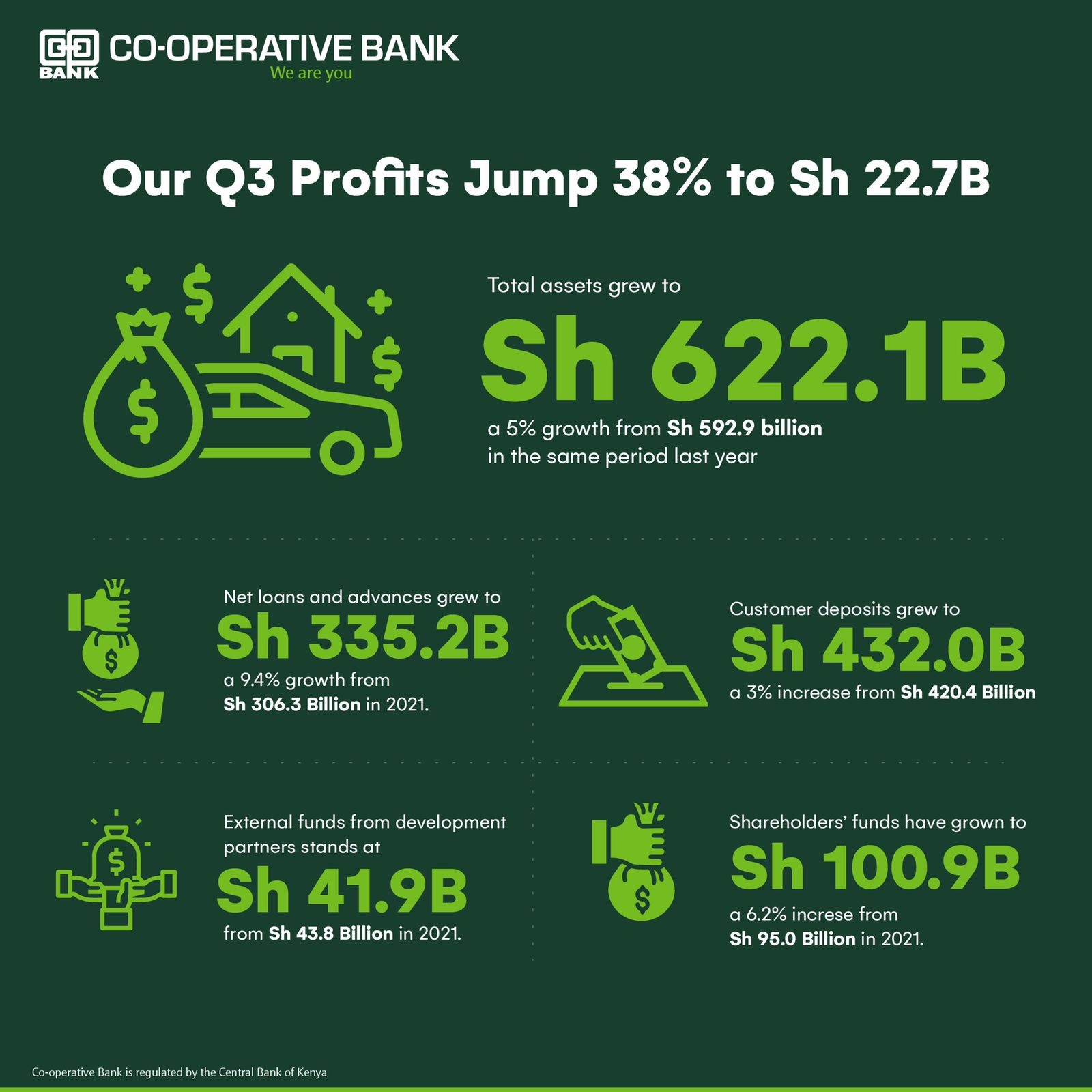
Co-op Bank marks 38% Profit Growth with Ksh22.7 Billion Profits Before Tax in 3rd Quarter

Co-op Bank Group is pleased to report a Profit Before Tax of Kshs. 22.7 Billion for the third quarter of 2022.

That’s a commendable 38% growth compared to Kshs. 16.5 Billion recorded in the third quarter of 2021.

This means, Co-op Bank has a strong Profit after Tax of Kshs. 17.1 Billion compared to Kshs. 11.6 Billion reported in 2021. The performance delivers a competitive Return on Equity of 23% to our shareholders.

The strong performance by the Bank is in line with the Group’s strategic focus on sustainable growth, resilience, and agility.

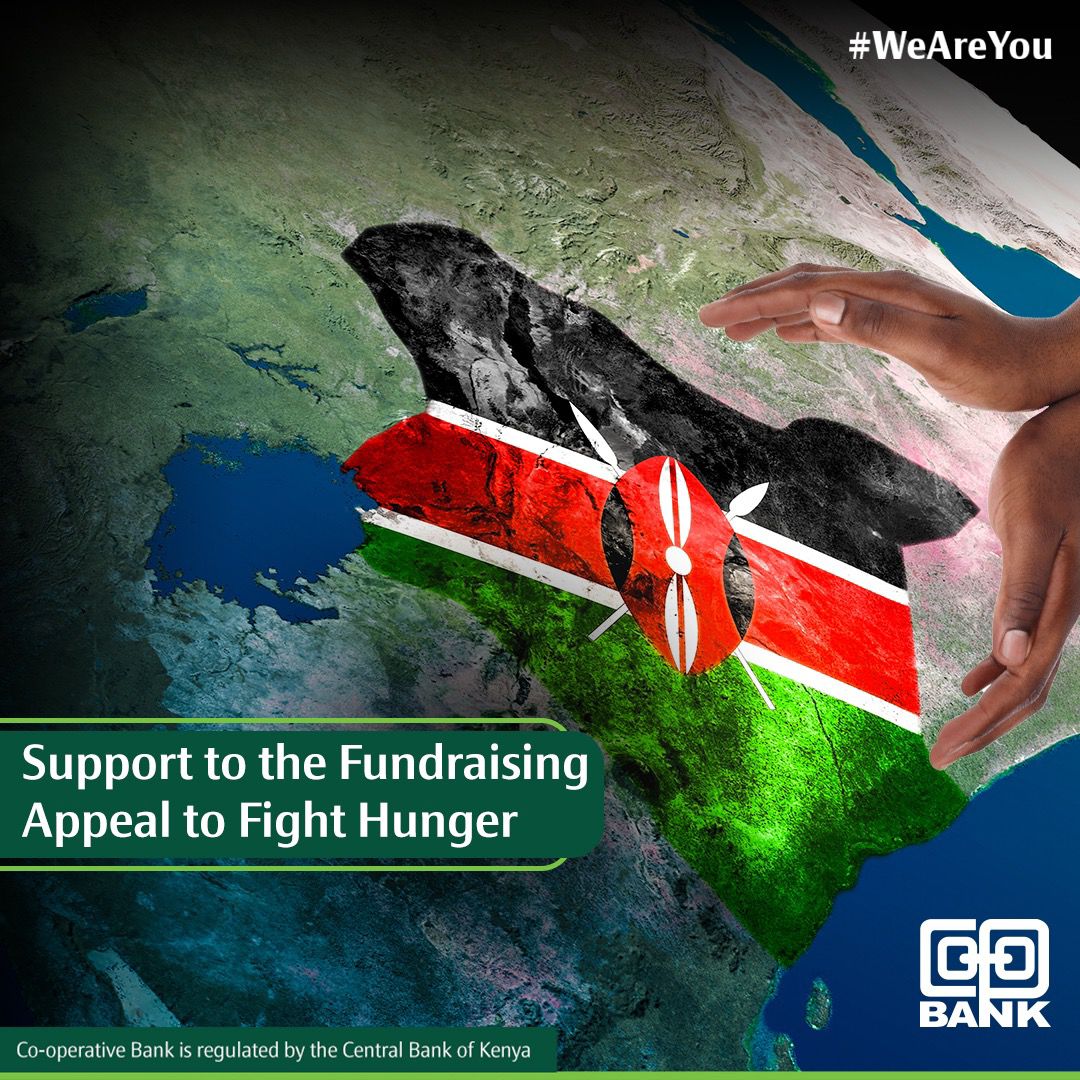
Support to the Fundraising Appeal to Fight Hunger

Co-op Bank Group wishes to join other Kenyans and indeed the global community of goodwill in fully supporting the Fundraising Appeal initiated by His Excellency the President, with a key contribution of Kshs.150 Million.

This is in support of relief efforts aimed at assisting families affected by the severe drought ravaging various parts of the Country.

Key Performance highlights;
1. Financial Position:

The Group has registered sustained growth as follows;

  • Total Assets grew to Kshs. 622.1 Billion, a 5% growth from Kshs 592.9 Billion in the same period last year.
  • Net loans and advances grew to Kshs. 335.2 Billion, a 9.4% growth from Kshs.306.3 Billion in 2021.
  • Customer deposits grew to Kshs 432.0 Billion, a 3% increase from Kshs.420.4 Billion.
  • External funds from development partners stands at Kshs 41.9 Billion from Kshs.43.8 Billion in 2021.
  • Shareholders’ funds have grown to Kshs. 100.9 Billion, a 6.2% increase from Kshs. 95.0 Billion in 2021.

2. Comprehensive Income

This is a 3-pronged approach:

  • Total operating income grew by 17.6% from Kshs 44.4 Billion to Kshs 52.2 Billion.
    Total non-interest income grew by 28.3% from Kshs 15.7 Billion to Kshs 20.2 Billion.
  • Net interest income grew by 11.7% from Kshs 28.7 Billion to Kshs 32.00 Billion.
  • Total operating expenses increased by 6% from Kshs 28.0 Billion to Kshs. 29.6 Billion.

3. Cost Management

Excellent gains from our various initiatives with a Cost to Income ratio of 45.8% in Q32022 from 59% in FY2014 when we began our Growth & Efficiency journey.

4. Credit Management

This remains a key focus area that has achieved key milestones. The Group prudentially provided Kshs. 5.7 Billion compared to Kshs 6.0 billion provided in 2021, pointing to an improvement in the quality of the asset book.

5. A Strong Digital Footprint

Through our digital channel strategy, the Bank has successfully moved 94% of all customer transactions to alternative delivery channels, a 24-hour contact centre, mobile banking, 550 ATMs, internet banking and a wide network of Co-op kwa Jirani agents.

We have successfully migrated our customers to the Omni-channel, integrating accessibility and user experience.

Our omnichannel interfaces online banking through personal computers, mobile phones and USSD availing our services to all customers through their preferred channel yet retain the same experience from wherever they are.

6. Subsidiaries

A great part of the success story arises from subsidiaries across the region:

  • Co-op Consultancy & Bancassurance Intermediary Ltd posted a Profit Before Tax of Kshs 772 Million in Q32022, riding on strong penetration of Bancassurance business.
  • Co-operative Bank of South Sudan that is a unique joint venture (JV) partnership with Government of South Sudan (Co-op Bank 51% and GOSS 49%) returned a profit of Kshs 190 Million in Q32022 compared to a loss of Kshs.104 million in Q32021.
  • Co-op Trust Investment Services contributed Kshs. 141 Million in Profit Before Tax in Q32022, with Funds Under Management of Kshs. 202.6 Billion compared to Kshs.187.1 Billion in September 2021.
  • Kingdom Bank Limited (A Niche MSME Bank) has contributed a Profit before Tax of Kshs.609.2 Million in Q32022 compared to Kshs. 413.1 Million reported last year representing a 47% Growth year-on-year.
    Environmental Social and Governance (ESG).

The Group was named Overall Winner at the Kenya Bankers Association Catalyst Awards held in September 2022.

The awards recognize organizations that exemplify their sustainability prowess though promoting catalytic finance that impacts industry, economy and society.

This latest win is the third in five years, having won in 2017 and 2019, ranking Co-op Bank as Industry Leader in Sustainable Finance in Kenya.

Co-op Bank Foundation, the Group’s social investment vehicle, continues to provide Scholarships to gifted but needy students from all regions of Kenya. The sponsorship includes fully paid secondary education, full fees for University education, Internships and career openings for beneficiaries.

The foundation is fully funded by the bank and has supported 9553 students since the inception of the program.

7. Accolades

The Group Managing Director & CEO Dr. Gideon Muriuki was honoured with the award of a third Doctorate degree by the Africa International University in November 2022.

The Citation for the degree award noted his illustrious career in banking, his historic turnaround of Co-op Bank, his destiny-defining contribution to the co-operative movement and an enduring commitment to sustainable finance in Africa.

Trade Finance: The Secret to Grow, Revive a Struggling Business!

Trade Finance refers to an external source of working capital finance. It is a form of short-term credit typically used by companies that export or import goods.

It’s usually secured against goods, or backed by an insurance policy.

In Kenya, Co-operative Bank has demystified trade finance for their business customers, by availing various instruments.

These instruments are:

  • Bid Bonds
  • Letters of Credit
  • Performance Bonds
  • Custom Bonds
  • Advance Payment Guarantees
  • Credit Guarantees

What business solutions does Co-op Bank offer?

  • LPO Financing
  • Bills Discounting
  • Invoice Discounting
  • Post Import Finance/Import Duty Finance
  • Supply Chain Finance/Distributor Finance

What benefits does Co-op Bank clients enjoy

  • Quick processing time
  • Manage risk and negotiate credit terms
  • Flexible repayment period
  • Secure work permits for foreigners working for your business
  • Unsecured Trade Facilities

What Requirements are needed to secure Trade Finance with Co-op Bank?

  • Duly filled application form
  • Tender advert (where applicable)
  • Copies of the Company Directors’ IDs and KRA PIN Certificates
  • Company’s KRA PIN Certificate, Tax Compliance Certificate, Articles of Association and MOU, and Certificate by Registrar of Companies (CR12).
  • Latest bank statements (minimum 12 months) for other Bank Accounts held by the company and related companies.

There are alot of opportunities up for grabs. This facility is available to customers, at all Co-op Bank branches countrywide. Visit to talk to an agent, or check online to learn more.

My Hustle: To Quit High-Salary Job to Almost Starve in a New Business

What’s your opinion on the perfect job?

While people desire and actively chase different jobs it’s all grounded on the premise of stability and financial goals.

How do you explain a scenario where a well paid employee in a stable career suddenly quits to found a start up? It’s crazy.

Take the case of Nduta, now in her mid-30’s.

She’s married, with two kids in primary school. She’s spent a decade, climbing up the ladder in the human resources department of a middle-tier firm.

The job pays well – the family lives in the suburbs, good schools, drives a decent sedan and an annual vacation.

It’s an easy job. What makes it easy is that she walks out of the office exactly at 4pm. She works Monday to Friday, accumulates leave days.

She doesn’t get work emails and texts over weekends, or asked to attend any Zoom meetings. She can call in sick, if need raises – which is often for a young parent.

Nduta is content and happy at her workplace. But, suddenly, an uncontrollable itch bites.

She wants to brand herself differently. There’s more to life than just a 8 to 5, right? She starts to believe, inspired by her earlier challenges to refurbish and decorate her house. She had imported all her materials.

Could I not bridge the gap, with the importation of cutlery and interior decor fittings?
Nduta does some basic internet search on requirements, then quietly registers a firm.

Then, she quits her job.

Her husband thought she was bat crazy. How could you? It didn’t help much that she had little to support her business idea, well – other than a ‘gut feeling’.

To her, it felt much getting a new baby. In every aspect, it was exactly like having a baby. She gave alot of hours, weekends, late night calls and texting….

It took alot to get the new business going. Sometimes, she’d even forget her children’s birthdays!

There were lots of dry spells, zero business.

Nduta would use these spells to invest in herself. She started attending business forums and building networks. She learnt the skills and tricks of trade.

It’s in a trade forum, Nduta gained the solution for her major headache – CAPITAL. She learned about trade finance.

Now, she’s in a position to handle large orders, and has gainfully started seeking big tenders with county governments.

Trade Finance refers to an external source of working capital finance. It is a form of short-term credit typically used by companies that export or import goods. It’s usually secured against goods, or backed by an insurance policy.

In Kenya, Co-operative Bank has demystified trade finance for their business customers, by availing various instruments.

These instruments are:

  • Bid Bonds
  • Letters of Credit
  • Performance Bonds
  • Custom Bonds
  • Advance Payment Guarantees
  • Credit Guarantees

In this regard, Co-op Bank has made local and international business flow easier, by offering crucial business solutions.

These include:

  • LPO Financing
  • Bills Discounting
  • Invoice Discounting
  • Post Import Finance/Import Duty Finance
  • Supply Chain Finance/Distributor Finance

Well, trade finance business solutions is available to Co-op Bank customers at all branches countrywide.

Visit a Co-op Bank branch, or click here to learn the benefits and requirements needed to secure this funding for your business.

Co-op Bank Named Best Overall at Kenya Bankers’ Association Award Gala

Co-operative Bank celebrates winning a prestigious award, recently being named Overall Winner at the Kenya Bankers Association (KBA) 2022 Sustainable Finance Catalyst Awards.

The Awards were created to recognize institutions that practice sustainable finance which has a direct positive impact on the financial sector, the economy, the environment and the society at large.

Sustainable Finance Principles require financial institutions to balance their quest for financial returns with the economy’s future priorities and social-environmental concerns.

In addition to scooping the overall title, Co-op Bank also won in specific award categories that include being named as the Most Innovative Bank in Sustainable Finance and the Best Bank in Financing Commercial Clients.

Equity Bank emerged second overall and KWFT third. The selection exercise took three and half-months, with 43 entries submitted by 16 financial institutions.

This is the third time in five years that Co-op Bank has emerged victorious in the sustainable finance awards, having won the overall title again in 2017 and in 2019.

The latest award adds to other recent recognition Coop Bank has received for the strong credentials in Sustainable Finance and related sustainability practices.

The bank was named as Best Bank in Sustainable Finance in Kenya at the 2019 Energy Management Awards hosted by the Kenya Association of Manufacturers and also named Overall Winner in Environmental Sustainability Report at the 2019 East African Financial Reporting (FiRe) Awards.

Businesses were appraised on whether they have covered the essential indicators which included the impact to the Gross Domestic Product (GDP), the growth of the business, job creation and support of minority groups including women and the youth.

In respect of the award, Co-op Bank has released a citation:

Co-op Bank emerged winner as a result of building a sustainability strategy that enables people, businesses and society to grow in a way that is sustainable in the long-term.

The awards showcase firms that demonstrate a progressive stance in integrating sustainability practices in their respective institutions.

Commenting on the recognition, the Group Managing Director & CEO Co-operative Bank, Dr. Gideon Muriuki;

“Sustainability is fully integrated in our business model that stands on the three pillars of Economic sustainability, Social sustainability and Environmental stewardship.”

“As a bank that is predominantly-owned by the 15 million-member Co-operative Movement, we are inclusive by design that has not only enabled us to deliver shared prosperity today, but also helped us build an awareness and prudence to avoid putting future generations in jeopardy.”

Co-op Bank awards in other categories include;

1. Most Innovative Bank
2. Best in Financing Commercial Clients
3. 1st Runners up – Best Sustainable Finance
4. 1st runners up – Best in Covid-19 Response
5. 2nd runners up – Best in MSME Financing.

Meanwhile, Co-op Bank has unveiled an ambitious 100% financing loan package for used cars.

Car Shopping: Do you Pick Manual or Automatic Transmission?

When making the choice to purchase a particular car, the gear set up plays a huge role. The choice plays between a manual and automatic transmission.

Each choice has advantages driving it, but it largely depends on the buyer.

Automatic transmission do the engagement and dis-engagement of the clutch on its own. It selects the appropriate gear according to the driving conditions. The driver just has to select whether he has to go forward, reverse or park his car.

In a manual transmission car the driver has to engage and dis-engage the clutch on his own and has to select the gear according to the way he drives.

There are different forward gears rated for different speed. Most modern car have 5 forward gears and 1 reverse gear.

Most car brands in Kenya have either modes in each of their models. What, then, influences the choice between the manual and automatic versions for the buyers?

Presently, the automatic car has gained popularity. It presents lots of advantages – but, not necessarily better.

Automatics cars are comparably easier to drive, demands less driving experience. Moreso, in city scapes with frequent traffic jams, and in the hills – it’s not a walk in the park driving bumper to bumper on a slight incline.

Besides, automatics are extremely reliable with minimal maintenance – no clutch to fry or wear out with inconsistent shifting.

Manual cars build up a strong counter attack in analysis. Manual car driving is definitely more fun. There’s more of a “driver feel”.

You can control shifting better, presenting an ‘all-round feeling of control’ – which, incidentally – appeals to car fanatics and first time car owners.

Besides, the convenience factor comes into play. Manual cars can be started even with a dead battery, by a method referred to as jumpstarting.

Manual car drivers brag of a slightly better fuel economy, and with enthusiasts with access to engine tuning and mods – a better acceleration.

The latter argument (acceleration) depends with the model, though – and, nature of the build – a sports car presents better acceleration than a family van, for example.

Manual cars pale in popularity by the virtue of human skill and experience needed to perform well.

Like, city driving is an hassle. Unlike an automatic, the mental work that your mind does for understanding and deciding what gear to keep the car in to prevent stalling weighs on the driver.

Also, getting the best mileage on fuel economy is dependent on the driver’s experience.

Automatic cars absolves the driver of that headache, especially on long, tiring drives.

For what it’s worth, either transmission in a car doesn’t overly affects performance. This bears on the driver’s experience, and aptitude. It’s prudent to practice on both types of transmission before making a purchase.

The dream of owning a car is now so much easier, thanks to a financing deal on pre-owned cars unveiled by Co-operative Bank.

It’s quite simple – anyone with an income can walk into a second-hand car dealership and make a choice – then, source financing from Co-op Bank.

It’s a loan with a flexible repayment period between 60 and 96 months and targets pre-owned cars less than 8 years old.

It attracts only 13% interest, and the vehicle being purchased acts as the security.

Requirements include:

  • Applicant’s ID and KRA PIN Certificate
  • Letter of Introduction from the employer
  • Latest 3 months’ certified Pay slips
  • Latest 6 months’ bank statements (if you’re not banking with us)
  • Copies of employment contract, or letter of appointment
  • Motor Vehicle Sales Agreement/Proforma Invoice
  • Copy of Logbook/Import Documents/NTSA search records
  • Original valuation report from approved valuer in the Bank’s panel

Once you visit a Co-op Bank branch, you’ll get an application form – fill it and attach necessary documents.

Click here, to learn more about Co-op Bank pre-owned car financing loan. It’s time to fulfill that dream to own your car!

Buying a Secondhand Car? The 10 Key Points to Check Before Purchase

Let it be that time comes – as it always will – that you get to own a car. It’s a milestone of sorts, often achieved with great sacrifice and meticulous planning.

A bit of research gets you settled on a relatively used model, instead of a brand new one. It makes better financial sense.

In a sea of used-car options, it get mind boggling picking the right one. It doesn’t help that dealers and salesmen hover around a buyer like sharks angling for a kill.

It’s easy to be led into buying a rust bucket.

Once you identify a prospect, it’s prudent to seek the expertise of a certified mechanic for the particular brand, with enough experience for the test drive.

Here’s a tentative list of 10 vital boxes to tick in your car quest:

  • Registration Documents

First check if all the papers are cleared, and owner have all the papers. Insist on hard copies – not just virtual copies. A lot of times, the car may have financing terms attached, be sure to verify any loans are cleared.

  • Engine

Every car’s heart is the engine, so first start with the engine. Try to check it early morning while the engine is cold. At this time, any problems with starting are easy to spot.

How much time or trials does it take to start the engine, Then, turn off engine and restart again. Do it at least 4–5 times. If there’s a hard start, take note of a dying starter or battery.

  • Engine Noise

Is there a noticeable noise in the engine? Here’s a good reason to seek opinions of a experienced mechanic.

Take the engine to the extreme – like, press acceleration to the 3000–4000 RPM mark. Listen for engine noises, rattling or shaking. An engine with worn mountings easily shows.

  • Smoke

Check if engine emits a black or white smoke. White smoke – possibly due to turbo failure or other reasons as well, black smoke – engine repairing need.

In some cases, fuel sensor failures manifest in irregular smoke emissions. So check with the owner if engine is tuned well and all sensors are working perfectly.

  • Oil Leaking

An oil leak speaks lots about an engine. Perhaps, it’s been opened up, or replaced. Also, gaskets and oil seals may need replacement if oil leaks from any part of engine or inside the hood.

Does the engine show signs of a recent scrub? That could be a sign of hiding an oil leak.

  • Electrical Parts

It’s prudent to check every electrical component of the vehicle. Whether they are working, or needs replacement.

This includes: Headlights and indicators, seat belt warning sensors, windshield wipers, power windows, side and rear view mirror adjusters, sunroof mechanism, and so on.

  • Instrument Cluster

Turn on the key, check the instrument cluster for any warning lights. Probable warnings to look out for include: Battery sign (low or defective battery), Defective alternator, Engine oil sign, ABS (Anti lock breaking system), Airbag Sign, EPS (Electronic Power Steering), and so on.

It may require a computerized diagnosis done to resolve some of these pop ups.

  • Interiors

How is the interior? This is the easiest sign to show an abused car. An astute owner keeps a clean, well kept interior devoid of torn seats and linings.

Is the dashboard, seat fabrics, door liners, seat covers in good condition? Stained? Torn? That gives an overall care acumen of the previous owner.

  • Exteriors

Does the car show dents and scratches? Are their parts of the car that need paintwork? Is there a color difference on some body parts?

If there is, take note of undeclared accidents, and abuse. If the car has been overly exposed to weather elements, be mindful of costly paintwork a few weeks down the road.

While at it, examine headlights and tail lamps. In what condition are they, do they need replacement, cleaning or complete restoration to optimum condition? That means extra costs.

  • Tyres

Depending on type of car, and intended usage tyre condition is a vital area. Tyres should be in relatively good condition. Do they have noticeable treads? What’s the brand? Generally, generic brands means replacement a few weeks later on.


How are the rims, and their sizes? It depends – urban usage may do fine with smaller rim sizes, while offroad requires bigger sizes. If the car has alloy rims, be keen to spot possible cracks or bends.

You don’t want a situation that gets you purchasing costly alloy rims after you take ownership.

Purchasing a car is quite financially exhausting, and has been beyond reach for many people.

Previously, bank financing has been confined to brand new cars. Co-op Bank has unveiled an incredible financing package on Pre-Owned Cars.

The bank offers to fund you up to 100% for a pre-owned motor vehicle. It’s a low-interest loan, at 13% interest with a flexible repayment period of between 60 and 96 months.

What’s more? One doesn’t need to be a Co-op Bank client to access the pre-owned car financing facility.

As soon as you make your choice of model in a second-hand car dealership, walk into a Co-op Bank branch and speak to a representative.

Follow this link to learn more about Co-op Bank Pre-owned car financing terms.

Thrown From the Nest: Moving out Ignited Business Spark for Car-wash Entrepreneur

While human beings are generally wired differently, Tony believes the Creator went a yard further on him. From childhood, his mother would often remark of him ‘being too grown up’ for his age. He was different.

Tony didn’t like playing estate soccer or hang out with his peers. He couldn’t find anyone in his circle who liked crossword and jigsaw puzzles enough to make a friend.

Despite growing in a relatively comfortable middle-class household, the urge to move out hit as soon as Tony did his high school papers. His mother flat out refused. He couldn’t explain why, but – to be honest – he didn’t know why.

To her chagrin, he moved out – to a tiny bedsitter on the outskirts of town.

The house was quite bare – his old mattress, a kerosene stove, two pots and a few bowls. He’d picked a few oranges off his mother’s fruit rack. As Tony sprawled on the mattress, chewing an orange – he realized it’s the freedom! He was an adult, finally!

Well, just a week in – it dawned on what adulting is all about.

See how people learn to swim, starting slow? Some exercise on dry land – breathing exercises – starting on the shallow end to polish skills till you can strike out on your own? Moving out is nothing like that.

It’s more like jumping in a pool without being able to swim, but you don’t know you can’t swim until you hit the water. You thought you had it all figured out (I mean, how hard can it be, right?), and before you know it, you’re waving your arms around not knowing what to do.

Tony needed stuff. Food to eat. Soap for laundry. Some oranges not from his mother’s fruit rack. While he’d never liked TV in his family home, he started missing the background noise. To walk back home was not an option. No, he couldn’t face the silent I-told-you-so’s in his mother’s eyes.

Tony walked to a car wash lot in the neighborhood, asked for the manager – and asked for work.

“Ah, alright. You start tomorrow…” Says the guy, sitting on a tall wicker chair.

The car wash was ran on an interesting business structure. Tony wouldn’t earn a salary, or wages – instead, he’d solely source for his clients. He’d work on their cars – and, he’d pay a modest Ksh100 to the manager for every car.

No one cared how much he charged per car. There were a few other guys hanging around.

Tony was new. He didn’t have any ready clients. That’s where his mother came in. He called her, broke the news and asked to clean her car. Trust maternal love, she drove across town – his son’s first client.

As she paid and tipped – perhaps, too heavily – Tony coaxed her to bring him her friends.

Tony was shoddy at first, but as he gained experience so did his client base grow. He built a reputation for his consistency, and honesty. Suddenly, he had too many clients to handle.

At this point, Tony had to learn something new: Polish his people skills – as the need to outsource labor arose.

As soon as the car wash opened, he’d approach a few friends – and coax them to accept some of his clients. He’d be getting a cut, acting as the car-wash agent. It worked. The idea flourished, money started flowing in.

He’d throw in client bait like wax polish and car interior scents at no extra cost to the client, on their 3rd visits.

It certainly felt good earning money. There’s such excitement buying new stuff! A few weeks back, Tony wouldn’t think of himself running a bank account. Now, he had an active personal and business account at Co-op Bank account.

For a budding entrepreneur, a Co-op Bank account works perfectly – thanks to MCo-op Cash, their innovative banking app. It’s much easier to deposit money direct to bank account, and to track daily spending.

Oh, checking account balances via the app is free!

MCo-op Cash brings convenience to transfer money from account to account or from bank account to a mobile money accounts. Besides, one enjoys access to other global money transfer solutions like Pesalink, Remitly and others.

To register dial *667# or download MCo-op Cash app on Playstore for Android, or Applestore for IOS.