

Voice Calls & Internet Usage Surge In Kenya Despite Mobile Money Dip

New data from the Kenya National Bureau of Statistics (KNBS) reveals a significant surge in both voice call minutes and mobile data consumption during the second quarter of 2025. The positive trends indicate Kenyans are increasingly relying on digital communication channels, even as the growth rate for the overall Information and Communication sector slightly decelerates.

Massive Jump in Voice Traffic and Data Consumption

According to the KNBS Quarterly Gross Domestic Product report, activities in the Information and Communication sector grew by 6.0 per cent in Q2 2025, compared to 6.7 per cent in the same period in 2024. Despite this slight slowdown in sectoral growth, service usage soared:

  • Domestic Voice Traffic: Domestic mobile voice minutes rose sharply by 17.3 per cent, climbing to 29.2 billion minutes from 24.9 billion minutes recorded the previous year.
  • International Voice Traffic: International mobile voice traffic saw an even stronger increase, surging by 24.3 per cent to reach 367.5 million minutes.
  • Mobile Data Usage: Mobile broadband consumption continued its upward trajectory, increasing by a remarkable 38.4 per cent year-on-year. Kenyans consumed 620.2 million Gigabytes (GB) of data in the quarter, up from 448.2 million GB in Q2 2024. This signals an expansion in the average data consumption per user across the country.

Mobile Money Value Declines, Gender Gap Persists

While digital communication services boomed, the country’s dominant mobile money sector experienced a slight contraction in transactional value:

  • Mobile Money Transactions: The total value of mobile money transactions fell by 1.4 per cent, dipping from Ksh 2.11 trillion in Q2 2024 to Ksh 2.08 trillion in Q2 2025. Despite the marginal drop, KNBS emphasized that mobile money remains a critical driver of financial transactions in the Kenyan economy.

The report also reiterated existing concerns over the digital divide. Data from the 2023/24 Kenya Household Survey (KHS) found that men consistently use the internet more than women across all age groups. The gender disparity is most pronounced among the 25 to 34 age group, where 64 per cent of men use the internet compared to 54.5 per cent of women. This age bracket, however, recorded the highest overall internet usage in the country.

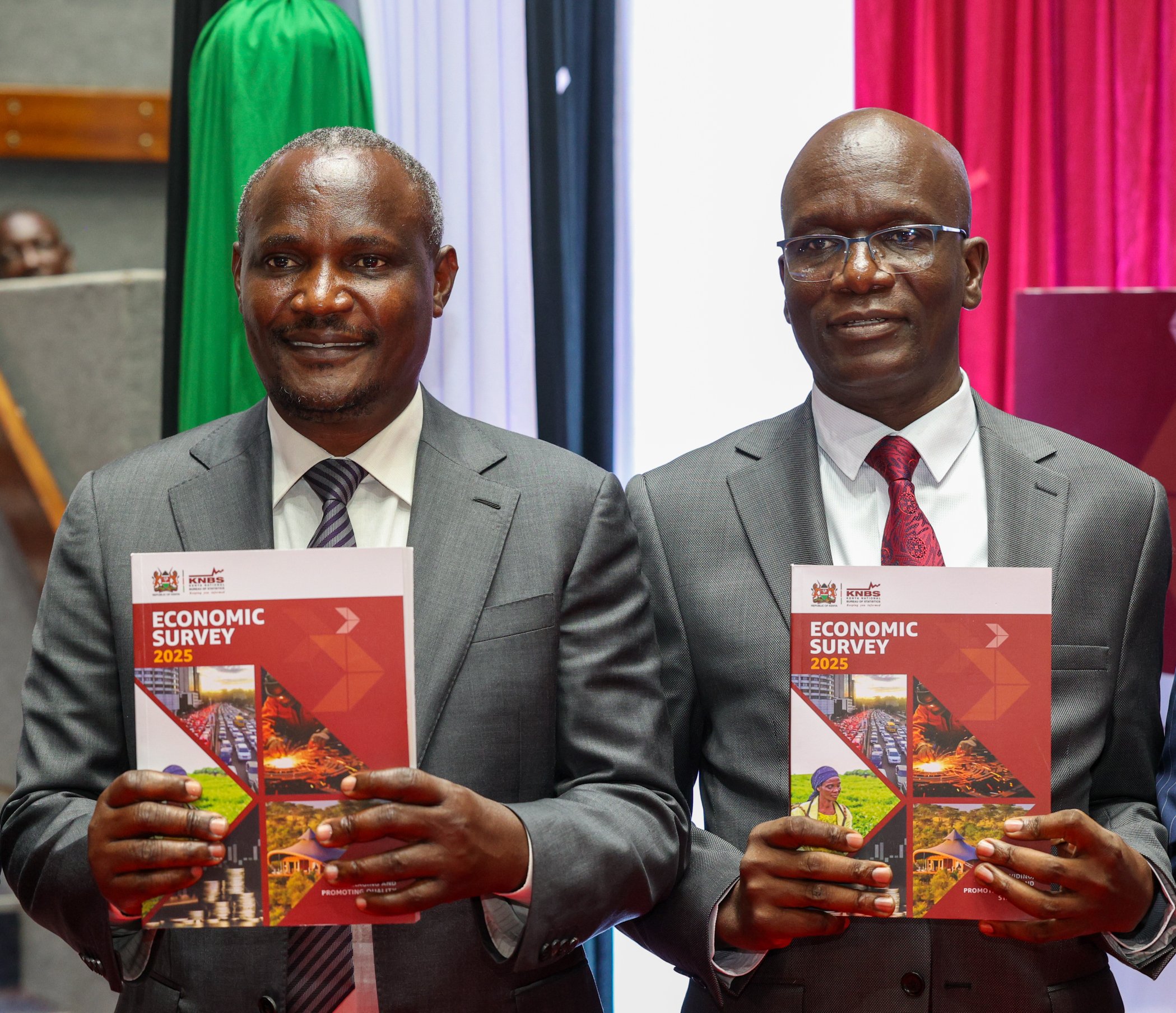
The State of The Hustle: Five Major Economic Wins in 2025

We usually don’t scroll through pages of economic data or statistical yearbooks, but if ever there was a time to pay attention, it’s now.

The 2025 Economic Survey by the Kenya National Bureau of Statistics (KNBS) dropped this week – it’s perfect mirror of where we stand and where we’re headed.

And no, it’s not just for economists in suits. It’s for every mama mboga, every student, every boda rider, every entrepreneur chasing a dream.

We’ve combed through the maze and spotlighted five key areas that affect all of us – no jargon, just facts with a pulse.

Kenya Vision 2030 Director General Mr Kenneth Mwige display the KNBS 2025 document alongside CS Finance John Mbadi during the launch in Nairobi. (Image: X)

1. Jobs: Who’s Hiring?

Jobs are bouncing back.

In 2024, the number of people in formal employment hit 3.3 million, up by 3.7%. What’s driving this? The private sector.

It created 91,800 new jobs, dwarfing the 27,100 added by the public sector. But let’s not forget: informal employment – think jua kali, market stalls, gigs – still accounts for over 80% of all jobs.

That’s 16.8 million hustles powering the nation.

So yes, the economy is healing. But the spotlight must stay on dignifying informal work and ensuring youth and women get a bigger slice of the employment pie.

2. Big Strides in Infrastructure

If you’ve been stuck in traffic or dodging potholes, here’s some hope.

The government spent KSh 471.9 billion on roads, rail, ports, and housing – a 13.2% jump from the previous year.

This isn’t just concrete and tarmac; it’s a signal of serious intent to connect people, markets, and opportunities.

Road construction took the lion’s share, with 11,908 km of roads under maintenance or development.

Housing projects, under the Affordable Housing Programme, also picked up pace – and we’re seeing more keys handed to first-time homeowners.

3. Industry & Manufacturing

Manufacturing grew by 2.0% in 2024.

Not explosive, but steady. Food and beverages led the pack, contributing over 40% of the total manufacturing output. Cement, sugar, and steel were also on the up.

But we still import more than we make.

The message is clear – we must produce more locally, and the government’s focus on value addition and Buy Kenya, Build Kenya must now translate into real action on the ground.

4. Trade & Investment: Who’s Buying What?

Kenya exported goods worth KSh 1 trillion, up from KSh 873 billion.

That’s progress – especially in tea, horticulture, and apparel. But imports still dominate, clocking in at KSh 2.5 trillion. That’s a trade deficit of KSh 1.5 trillion.

However, the rise in exports means local producers are finding footing globally.

What’s needed now is more muscle for SMEs, easing logistics, and pushing regional trade aggressively under the AfCFTA umbrella.

A jua kali artisan in a workshop in Githurai 44, Nairobi (Image: Files)

5. Money Matters: Banking & Finance

The financial sector is holding strong. Commercial bank deposits grew by 11.4%, hitting KSh 5.2 trillion.

Lending to the private sector increased too, a good sign for business growth.

Mobile money remains king – with over 2 billion transactions made through services like M-PESA and Airtel Money.

In short, more Kenyans are banking, saving, and transacting digitally. The shift to mobile and agency banking is not just convenience – it’s power in your palm.

In a Nutshell …… 

The 2025 Economic Survey doesn’t just capture numbers – it tells the story of resilience, rebuilding, and recalibration.

We’re not yet at the summit, but the path is clearing.

The government’s agenda is clear: build, empower, include. It’s now up to us – citizens, businesses, communities – to plug in, participate, and push forward.

KNBS has provided a list of industries where one can find lucrative employment opportunities

Multilateral organizations and non-governmental entities like the World Bank and the United Nations offer the most lucrative employment opportunities, while sectors such as real estate and agriculture tend to offer lower pay, according to recent data from the Kenya Bureau of Statistics (KNBS).

CHECK OUT:

Trisha Khalid Reveals Odd Jobs She Did Before Fame (Video)

The KNBS report, released on Monday, May 20, revealed that employees in extraterritorial organizations and bodies, such as the UN, received the highest average monthly salary of Sh339,274, despite experiencing a modest pay rise of 1.6 percent.

In the private sector, the electricity, gas, steam, and air conditioning supply industry ranked second in terms of highest-paying jobs, with an average monthly salary of Sh202,680, followed by financial and insurance activities at Sh190,151.

Among the top-paying sectors in the public sector were accommodation and food service activities (Sh234,698), transport and storage (Sh202,680), and financial and insurance services (Sh176,275).

ALSO CHECK OUT:

Rapcha humourously calls out Ruto for foreign jobs statement

Conversely, several sectors, including water supply, real estate activities, agriculture, accommodation and food services, and mining and quarrying, offered monthly salaries below Sh50,000.

Despite employing a significant portion of the workforce, sectors like agriculture, which accounted for nearly 11 percent of total wage employment, tend to offer lower pay.

The report highlights Kenya’s dependence on agriculture, which contributes more than one-fifth of the country’s GDP. However, despite being the largest employer, the sector pays lower wages compared to extraterritorial organizations, exacerbating income inequality in the country.

While the economy grew by 5.6 percent last year, driven by agricultural recovery, the formal job market struggled to create quality employment opportunities. The informal sector accounted for the majority of new job openings, with formal sector jobs increasing to 122,900.

Professions in the financial sector, administration, information technology, transport and storage, electricity, gas, steam, air conditioning, and human health were among those where workers earned at least Sh100,000 per month. However, only 12.3 percent of wage employees enjoyed such earnings by the end of 2022.

Top 10 Counties that have the fattest men in Kenya

KDHS has published a list of the top ten counties with the highest obesity rates.

Kajiado is at the top of the list, while Embu is at the bottom.

Weight that is higher than what is healthy for a particular height might be referred to as obesity or overweight.

Overweight can be caused by a variety of circumstances.

They include things like one’s activity levels, eating habits, and sleeping schedules:

Kajiado-31.1%

Kiambu- 28.2 %

Lamu 25.8%

Nairobi- 25%

Kirinyaga-23%

Nyeri- 22.6%

Isiolo- 22.4 %

Nakuru- 22.4%

Machakos- – 21.2%

Embu- 20.9