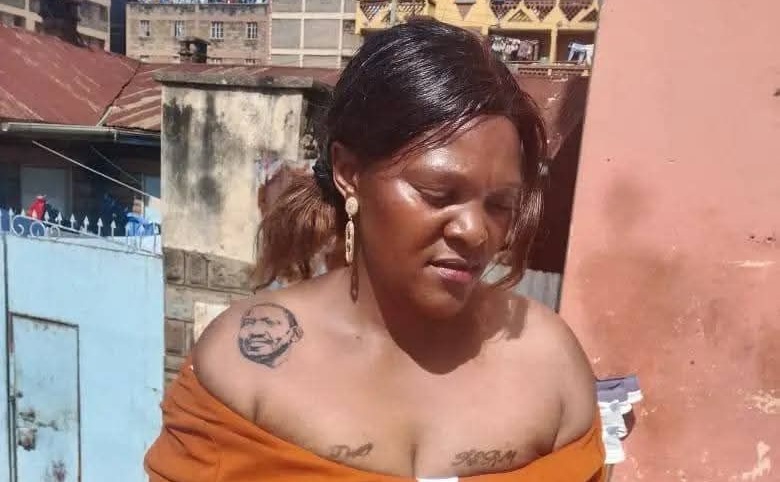
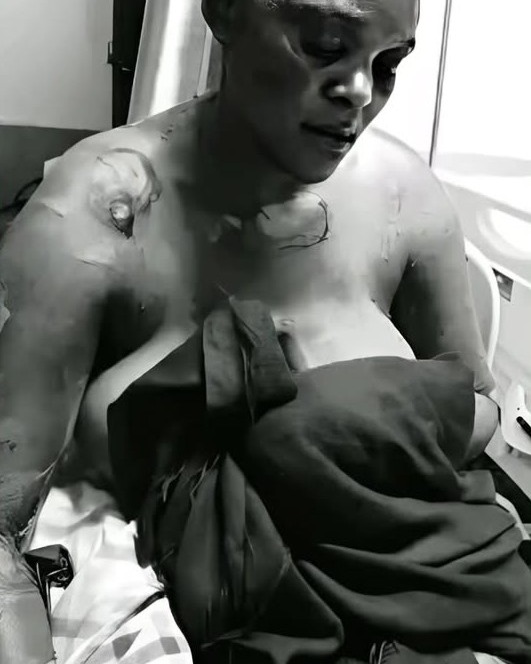
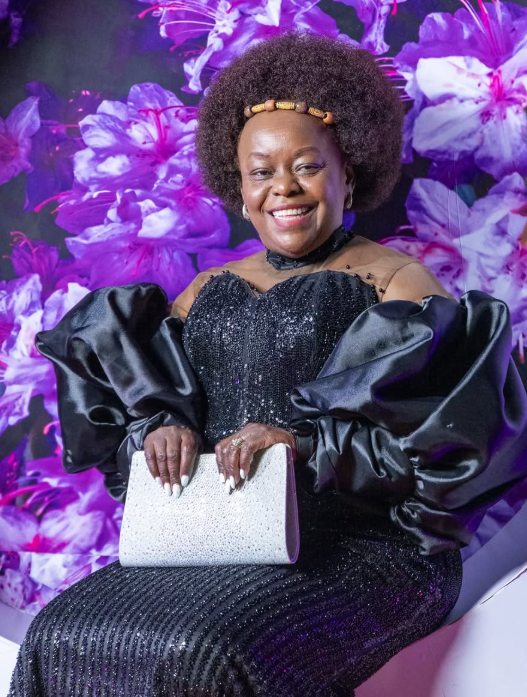
Tragedy has struck after Rachel Wandeto, the woman who suffered horrific burn injuries after allegedly being set on fire in Nairobi’s Mwiki area, died while receiving treatment at Kenyatta National Hospital.
Wandeto reportedly succumbed to complications following surgery after weeks of fighting for her life in critical condition.
The singer had allegedly sustained nearly 70 per cent burns after attackers reportedly doused her with petrol and set her ablaze in a shocking incident that sparked nationwide outrage and intense online debate.
According to reports that circulated after the attack, the assault was allegedly connected to a tattoo of President William Ruto on her body.
Family members and close friends confirmed that she passed away while doctors continued efforts to stabilise her through multiple medical procedures due to the severity of her injuries.
“She fought for her life until the very end,” a family source reportedly said.
Attack Triggered National Outrage
The horrifying incident quickly became a major topic online, with many Kenyans expressing shock and anger over the brutality of the attack.
Photos and videos shared on social media showed the extent of Wandeto’s injuries, prompting widespread condemnation and renewed conversations around political intolerance, violence, and online hostility in Kenya.
The late singer had previously gone viral after tattooing President Ruto’s face and political slogans associated with his leadership on her body, a move that generated mixed reactions online.
Her death has now reignited calls for justice, with Kenyans demanding swift investigations and accountability for those behind the attack.
Shock and outrage have gripped social media after gospel singer Rachel Wandeto was allegedly set ablaze by unknown attackers in a horrifying midnight attack in Kasarani’s Mwiki area.
The singer, who previously went viral after tattooing President William Ruto’s face on her shoulder and chest alongside the slogan “Tutam” (Two Terms), is now fighting for her life after sustaining severe burn injuries.
Midnight Horror Along Obama Road
According to police reports, the terrifying incident unfolded shortly after midnight on Friday along Obama Road, 11th Street in Mwiki.
Authorities say three masked men allegedly ambushed Wandeto before pouring a flammable liquid believed to be petrol on her body and setting her on fire.
Members of the public reportedly raised the alarm after the badly injured singer was rushed to Uzima Uhai Hospital for emergency treatment.
Police say the attack left Wandeto with approximately 70 per cent burns affecting her face, torso, arms, legs, and other parts of her body.
Due to the seriousness of her condition, she was later transferred to Kenyatta National Hospital for specialised treatment.
“Where Is The Money?”
In a chilling twist, relatives claim the attackers demanded money they believed Wandeto had received because of her outspoken political support for President Ruto.
According to family members, the assailants allegedly questioned the singer about supposed financial benefits tied to her loyalty to the Head of State before the confrontation turned violent.
When she reportedly told them she had nothing, the attackers allegedly doused her with petrol and set her ablaze before fleeing into the night.
The motive behind the shocking attack has not yet been officially confirmed, but detectives are actively investigating the claims.
Desperate Appeal For Blood Donations
As Wandeto battles for survival, family members and supporters have launched urgent appeals for blood donations to support her treatment.
Friends close to the singer say her condition remains critical because of the extensive burns she suffered during the brutal attack.
Online appeals have since flooded social media, with Kenyans calling on well-wishers to donate blood and support her recovery at Kenyatta National Hospital.
Tattoo That Sparked National Attention
Earlier this year, Wandeto became a viral sensation after permanently tattooing President Ruto’s face and political slogans linked to his leadership on her body.
The move triggered heated debate online and reportedly caused tension within sections of her family over political disagreements.
Now, disturbing photos showing the extent of her injuries have sparked anger, sympathy, and demands for justice from Kenyans online and fellow entertainers, including gospel musician Karangu Muraya.
Police Speak
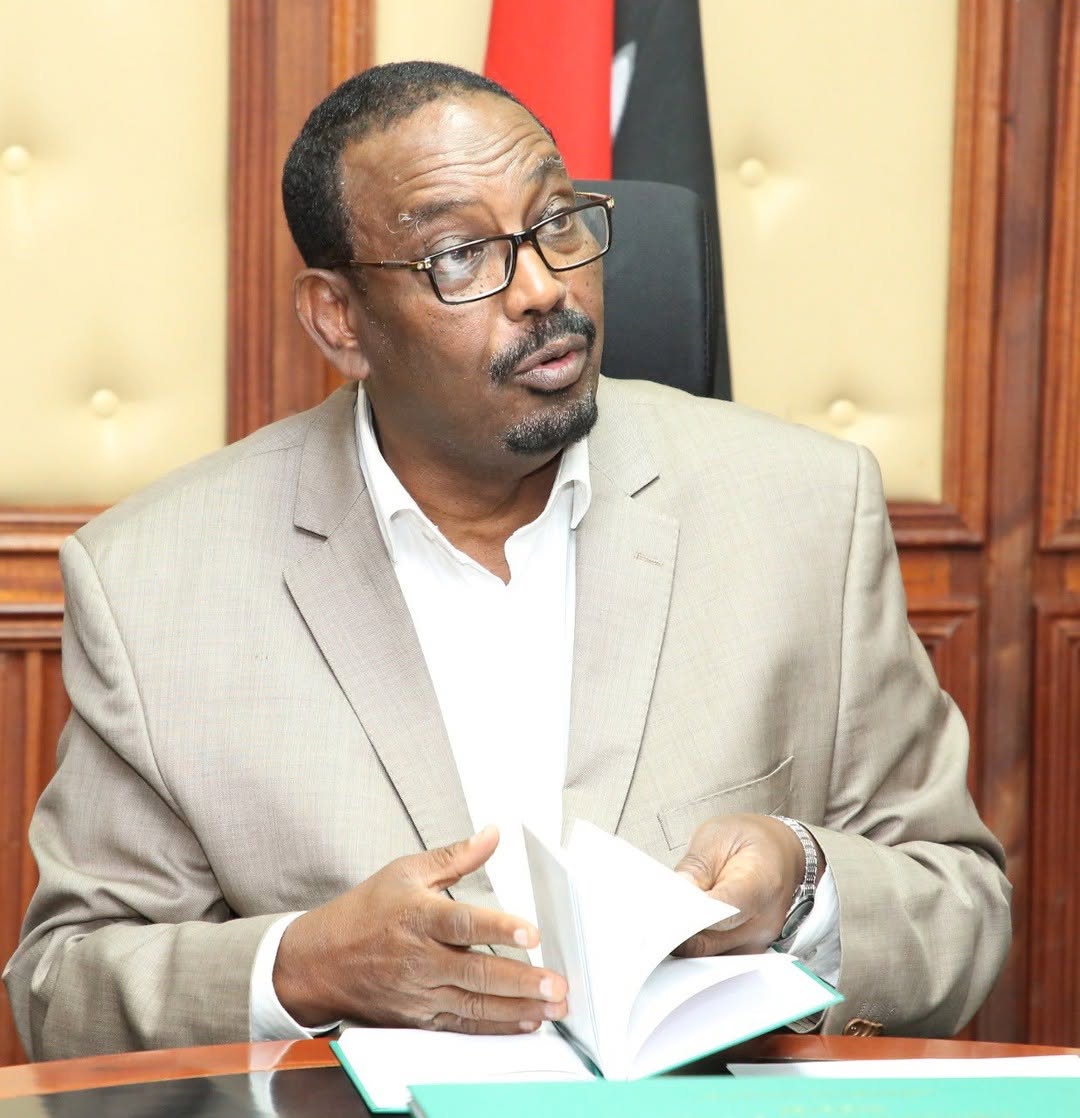
Nairobi police commander Issa Mohamud confirmed that investigations are ongoing and said detectives are pursuing those responsible for the attack.
“There is a team pursuing the matter for justice,” he stated.
As of the latest updates, no arrests had been announced, with authorities urging anyone with information to report to the police.
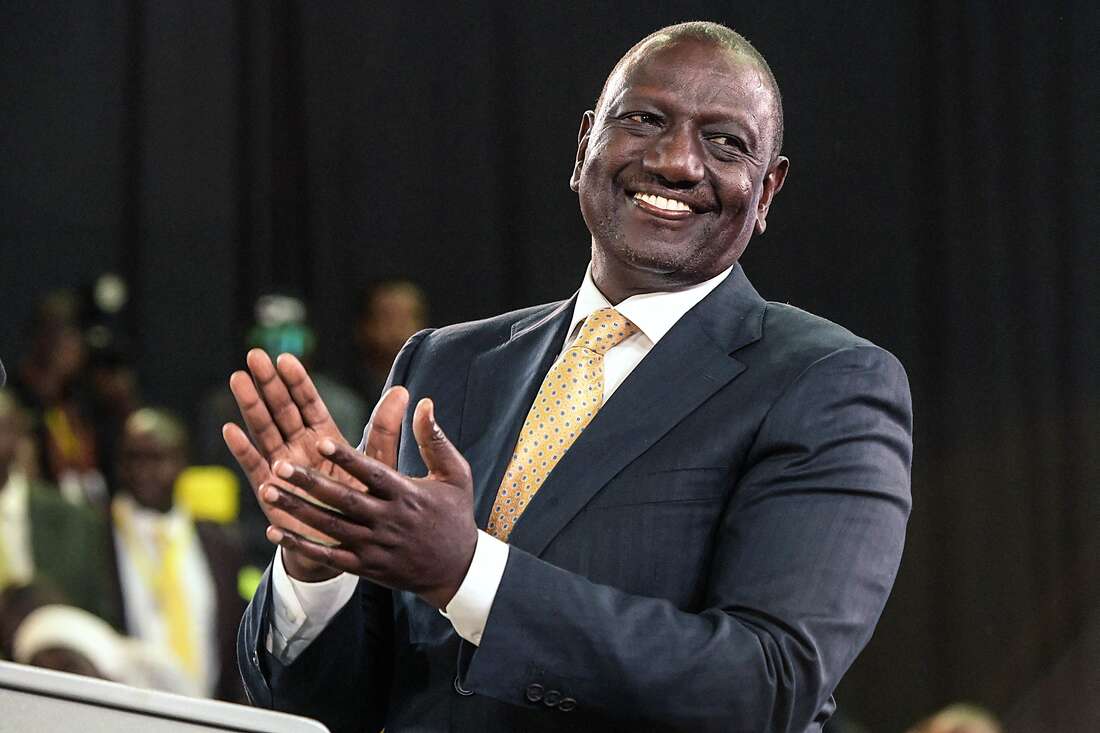
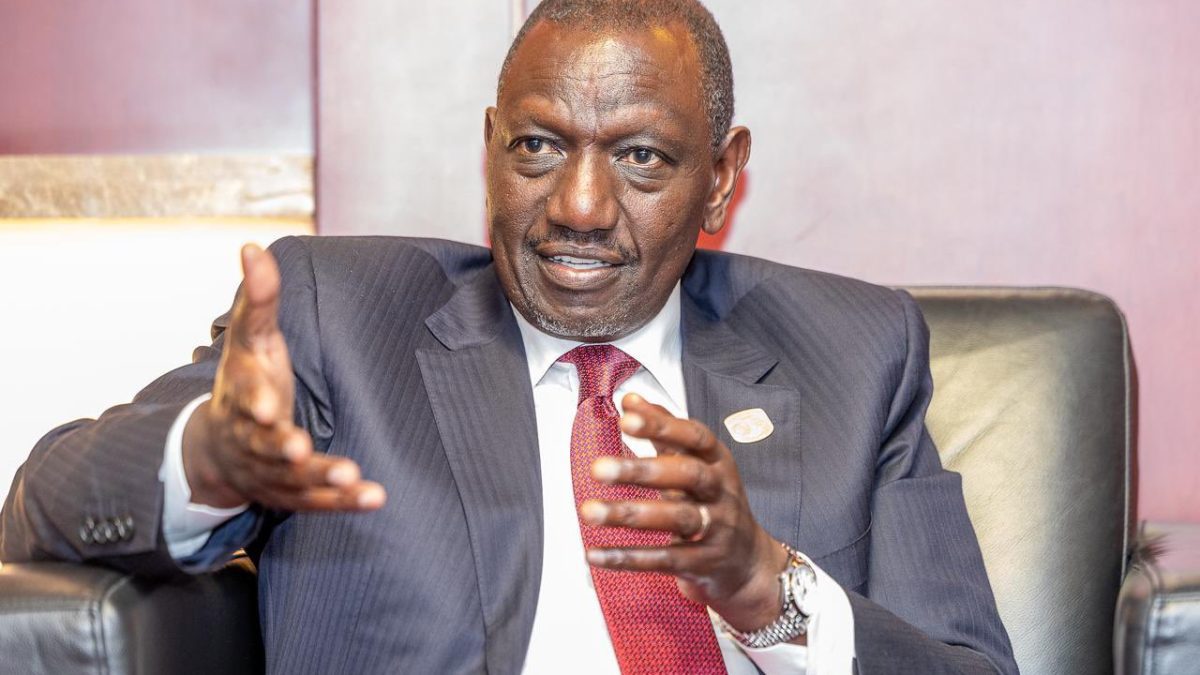
What was intended to be a historic tour to strengthen bilateral ties between Kenya and Tanzania has instead been overshadowed by a significant diplomatic blunder. President William Ruto’s recent address to the Tanzanian Parliament is now the latest entry in a series of unconventional—and often problematic—diplomatic moves that have forced the “Chief Diplomat” to backtrack on his own words.
In an arena governed by strict protocol, tact, and calculated communication, President Ruto has faced increasing criticism for an approach that analysts describe as impulsive and uncoordinated.
The Tanga Refinery “Surprise”
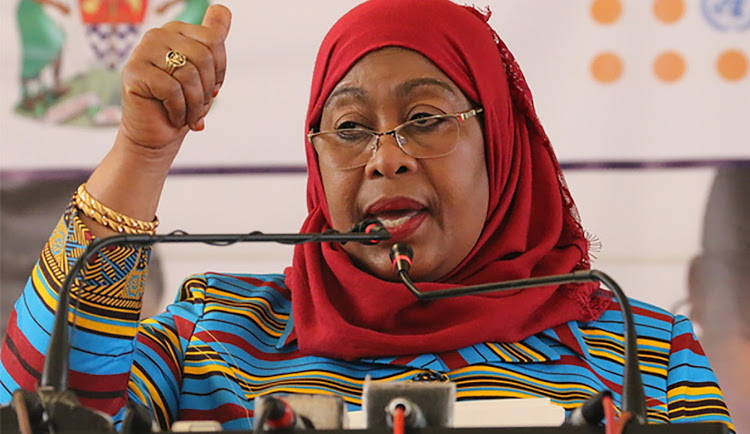
The most recent incident occurred in Tanzania, where President Ruto announced a multi-billion-dollar joint oil refinery project in Tanga. The revelation came as a shock to his host, President Samia Suluhu Hassan, who reportedly only learned of the “joint” plan through news reports.
During a subsequent meeting, President Suluhu did not mince words, noting that she had to “press” Ruto for an explanation as to why such a massive project was announced without her knowledge. President Ruto was forced to offer a public apology of sorts, admitting that his decision had not “sat well” with his host and jokingly suggesting he should have announced it for Mombasa instead.
A Pattern of “Unconventional” Diplomacy
This is not an isolated incident. Only weeks prior, the President drew the ire of Nigeria, the continent’s most populous nation, during a public address. While praising Kenya’s command of the English language, he took an unnecessary swipe at Nigerians.
“We speak some of the best English in the world. If you listen to a Nigerian speaking, you do not know what they are saying. You need a translator even when they are speaking English,” Ruto remarked.
The comment was widely viewed as demeaning and sparked a backlash from West African netizens and officials alike.
The Diplomat’s Dilemma
Nearly four years into his presidency, Ruto’s trail of verbal slip-ups has created a recurring headache for Kenya’s Ministry of Foreign Affairs. While the President is known for his eloquence and persuasive oratory, his tendency to make spontaneous policy announcements or off-the-cuff remarks about sovereign neighbors continues to test the patience of regional partners.
As Kenya seeks to position itself as a leader in regional integration and global climate action, analysts suggest that the Head of State may need to trade his “unconventional” style for the traditional rules of order and skill that international diplomacy demands.
Millie Odhiambo, the Member of Parliament for Suba North, has warned that the growing tolerance of gangster-style intimidation in Kenya could have serious consequences for the country’s future.
In a strongly worded statement, the legislator cautioned that the rise of organised groups being used to intimidate individuals and settle disputes could gradually erode the rule of law if authorities fail to act decisively.
According to Odhiambo, a recent incident in Kisumu illustrated the worrying trend. She claimed that around 100 suspected gangsters were allegedly mobilised in an attempt to forcefully evict a businessman from his premises.
The MP also pointed to another confrontation involving former Cabinet Secretary Raphael Tuju, where individuals described as hired goons were reportedly used to harass him during a property dispute.
Odhiambo warned that allowing such actions to continue unchecked could eventually destabilise the country and weaken public confidence in law enforcement institutions.
“If this gangster culture continues to be tolerated by authorities, it will come back to haunt us as a nation,” she cautioned.
Drawing comparisons with Haiti, a country that has struggled with widespread gang violence, Odhiambo said Kenya could eventually face a similar crisis if decisive action is not taken.
She warned that in the worst-case scenario, the country might even be forced to seek international assistance to restore order.
“Soon, like Haiti, we might need other nations to assist us in dealing with gangsters,” she said.
Her remarks come amid growing national debate about the use of organised groups to intimidate individuals in property disputes and political confrontations. Critics argue that such incidents highlight the need for stronger enforcement of the law and greater accountability to prevent the normalisation of violence in public affairs.
Former Kenyan MP Farah Maalim has strongly defended President William Ruto against claims that the United States could arrest him, dismissing the suggestion as unrealistic and an affront to Kenya’s sovereignty.
In a viral video statement circulating on social media, Maalim reacted sharply to remarks by former Deputy President Rigathi Gachagua, who recently urged U.S. President Donald Trump to investigate and potentially arrest Ruto over alleged corruption and money-laundering links. Gachagua likened such action to U.S. measures previously taken against leaders in countries such as Venezuela.
Maalim, a vocal ally of President Ruto, rejected the idea outright, arguing that any attempt by the United States to arrest a sitting Kenyan president would be impossible. To underscore his point, he drew a historical parallel to the failed 1993 U.S. military operation in Mogadishu, Somalia, famously known as the “Black Hawk Down” incident.
“The USA can’t even attempt to capture President William Samoei Ruto,” Maalim said in the video. “They tried it with Somalia [referring to warlord Mohamed Farrah Aidid], and they saw fire. If it could not happen in Mogadishu, it can’t happen to Ruto.”
Maalim emphasized Kenya’s status as a sovereign nation, suggesting that international powers cannot simply act against its leadership without severe consequences. By invoking the Mogadishu battle—where U.S. forces suffered heavy losses while attempting to capture Aidid—he framed Gachagua’s call as both reckless and detached from geopolitical reality.
The comments have sparked debate online, with supporters viewing Maalim’s remarks as a robust defense of national sovereignty, while critics argue that comparisons to military operations distract from the substance of corruption allegations raised by Ruto’s opponents.
As political tensions continue to simmer, the exchange highlights deepening divisions within Kenya’s political class and the increasingly international tone being adopted in domestic political battles.
President William Ruto has announced plans to introduce the death penalty for drug traffickers and individuals involved in the sale of illicit alcohol, describing substance abuse as a national emergency threatening Kenya’s social and economic stability.
In his New Year’s address, the President said the widespread use of drugs and illegal alcohol was undermining productivity and slowing economic growth. He argued that existing laws are too lenient and have failed to deter offenders.
Under current legislation, individuals found in possession of hard drugs such as heroin can face fines of up to KSh 1 million. President Ruto proposed scrapping such penalties in favour of the maximum punishment, saying harsher consequences are necessary to curb the trade.
The government plans to table new legislation in Parliament that would formally classify drug trafficking and the sale of illicit alcohol as capital offences.
“For those involved in the illicit alcohol trade, we are going to change the law,” President Ruto said. “We are moving away from fines and introducing the ultimate punishment.”
The Scale of the Crisis
The proposal follows alarming statistics on substance abuse in Kenya. Data shows that one in six Kenyans aged between 15 and 65 uses at least one drug or substance, representing more than 4.7 million people nationwide.
Men are disproportionately affected, with one in every three reported to use drugs or alcohol. Young adults are also heavily impacted, with one in five individuals aged between 25 and 35 struggling with substance abuse. Alcohol remains the most commonly used substance, with over 3.2 million current users.
Expanded Police Powers and Enforcement
Interior Cabinet Secretary Kipchumba Murkomen has publicly supported the proposal, citing countries such as Malaysia, China and the Philippines, which impose the death penalty for drug-related offences.
Murkomen argued that existing fines encourage illicit trade because profits far outweigh the penalties. To strengthen enforcement, the government plans to establish a reinforced Anti-Narcotics Unit (ANU) within the Directorate of Criminal Investigations (DCI).
The unit will receive paramilitary-style training and enhanced surveillance equipment. Authorities also plan to seize assets, including vehicles and property, believed to be linked to drug trafficking and the illicit alcohol trade.
“We will begin with the major players — those running illegal businesses behind legitimate fronts,” Murkomen said. “We will pursue them relentlessly.”
Constitutional and Legal Challenges
The proposal is expected to face significant legal scrutiny. Article 26 of the Constitution guarantees the right to life and states that no person shall be deprived of life intentionally except as authorised by the Constitution or written law.
Although Kenya’s Penal Code still lists hanging as the method of execution, the country has not carried out an execution since 1987. In addition, a landmark Supreme Court ruling in 2017 declared the mandatory death penalty unconstitutional, requiring courts to consider mitigating factors in sentencing.
Notably, President Ruto commuted all existing death sentences to life imprisonment in 2023. Human rights organisations continue to argue that capital punishment violates Article 28 of the Constitution, which protects human dignity.
As the proposed legislation heads to Parliament, it is expected to trigger intense legal debate and public discourse on crime, punishment and constitutional rights in Kenya.
A new nationwide survey by TIFA Research has revealed deepening public frustration, with a majority of Kenyans saying the country is headed in the wrong direction.
The poll, released on December 18, 2025, indicates that dissatisfaction is especially strong in the Mt Kenya region, an area traditionally regarded as a powerful voting bloc in national politics.
Conducted between November 10 and 17, 2025, the survey interviewed 2,053 adults across all 47 counties. The results show that 68 per cent of respondents believe Kenya is on the wrong path, while only 17 per cent feel the country is moving in the right direction.
Overall, the findings suggest that pessimism dominates public sentiment, with nearly two-thirds of Kenyans holding a negative view of the country’s trajectory—an outlook that outweighs optimism by a margin of four to one.
President William Ruto has unveiled the ambitious financial blueprint required to elevate Kenya from a developing to a first-world nation, estimating that the country needs approximately KSh 4 trillion to achieve the transformation.
Speaking on Sunday, November 2, 2025, at the African Divine Church in Gamalenga, Vihiga County, President Ruto outlined a comprehensive development strategy anchored on infrastructure, energy, and agriculture.
He expressed strong optimism that Kenya possesses the vision, talent, and determination to accomplish this goal within the lifetime of the current generation.
“We have the greatest potential as a nation. Our being a third-world country is a mistake. We have what it takes — the men and women, the plans and the vision — to change this country from a third-world country to a first-world country,” Ruto declared.
Breaking Down the KSh 4 Trillion Plan
The President explained that the KSh 4 trillion target will be invested across three key sectors critical to Kenya’s growth:
Infrastructure Development (KSh 1.5 trillion): Funds will go toward expanding the national road network, modernizing rail transport, and upgrading airports to enhance domestic and international connectivity.
Energy Generation and Supply (KSh 1.5 trillion): The investment will support reliable and affordable electricity for industries and households, a crucial step toward industrialization.
Agriculture (KSh 1.5 trillion): A core pillar of the plan, agriculture will receive funding to bring an additional two million acres under irrigation, aiming to make Kenya a net food exporter.
Ruto emphasized that this level of investment will not only reduce Kenya’s dependence on imports but also stimulate productivity and job creation nationwide.
“We need possibly 1.5 trillion shillings for roads, rail, and airports; another 1.5 trillion for energy; and another 1.5 trillion for agriculture,” he said.
“We Need Intelligence, Not Higher Taxes”
Addressing concerns about how the government intends to raise the colossal amount, President Ruto reassured Kenyans that the transformation does not require new taxes.
Instead, he said the focus should be on innovation, efficiency, and strategic partnerships.
“Moving this country forward doesn’t require higher taxation — it requires intelligence and planning. Akili inahitajika,” he stated.
Citing the economic success stories of South Korea, Singapore, and Malaysia, Ruto expressed confidence that Kenya could replicate similar progress within 20 to 30 years through deliberate planning and disciplined execution.
“In the next 20 to 30 years, we can move this country to a first-world nation. I am urging leaders to prepare because this country cannot remain poor forever,” he said.
The President concluded by announcing that proposals detailing the national economic roadmap will soon be presented to Parliament, setting the stage for what he described as “Kenya’s most transformative economic journey yet.”
Kenya’s recent update to its cybercrime legislation — the Computer Misuse and Cybercrimes (Amendment) Act — alongside proposed stricter social media regulations, is set to reshape how young Kenyans interact online.
For Generation Z (those born roughly between 1997 and 2012), who live, work, and express themselves through the internet, the impact could be far-reaching — bringing more oversight, reduced anonymity, and tougher penalties for digital conduct. The move has sparked both optimism and unease about the country’s digital future.
What the new laws introduce
The amendments broaden the scope of cyber offences and grant authorities expanded powers to order content removals, block apps or websites, and demand account verification. Social media platforms may now be required to share user data and verify identities, while penalties for cyber offences — including impersonation, phishing, and SIM swap fraud — have been made harsher.
While supporters say these measures are needed to curb online crime, rights groups and opposition leaders have warned that the changes could limit free speech and invade digital privacy.
How the changes could affect Gen Z
1. Reduced anonymity and freer speech at risk
New verification rules linking online accounts to legal IDs could end the veil of anonymity many young people use to explore their identities or challenge authority. Critics fear this will discourage open expression and increase self-censorship, especially on sensitive political or social issues.
2. Greater legal risks for everyday posts
The expanded list of offences means even casual online activity could carry legal risk. A meme, tweet, or satirical video might now fall under scrutiny if deemed defamatory, misleading, or offensive. Observers warn that vague language could make it easier for authorities to penalise dissent under the pretext of enforcing order.
3. Disruption to digital careers
For Gen Z creators who depend on content monetisation, affiliate marketing, or online business, new restrictions could affect income. Account suspensions, takedown orders, or verification delays may reduce visibility and hinder earnings. On the upside, stronger anti-fraud provisions might increase trust in online marketplaces and collaborations.
4. Privacy and surveillance concerns
By empowering service providers to hand over user data, the amendments raise fears of state surveillance. Without strict judicial oversight, personal details, locations, and private conversations could be exposed — a serious concern for activists, journalists, and whistleblowers.
5. Mental health and moderation challenges
Platforms may react to stricter regulations by tightening content moderation, leading to more automated bans and removals. For young creators, losing an account or content unfairly can be stressful and financially damaging. Still, better enforcement against cyberbullying and online harassment could make the internet safer if applied fairly.
A delicate balance
Supporters of the amendments say they are crucial for protecting citizens from digital fraud, identity theft, and misinformation, which disproportionately affect young users. However, digital-rights advocates argue that vague definitions and weak oversight could open the door to censorship and abuse of power.
The real challenge lies in balancing online safety with freedom of expression — ensuring that regulation protects, rather than silences, Kenya’s most digitally active generation.
What Gen Z can do
Strengthen online privacy with two-factor authentication and mindful sharing.
Separate personal and professional accounts to limit exposure.
Keep digital backups in case of wrongful takedowns or suspensions.
Stay informed about their digital rights and responsibilities.
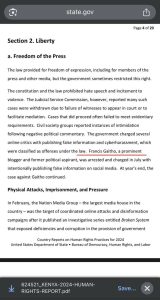
The arrest and prosecution of prominent activist and blogger Francis Gaitho have drawn renewed scrutiny after being highlighted in the 2024 U.S. Department of State Human Rights Report as a major rights violation under President William Ruto’s administration.
The report’s inclusion of Gaitho’s case signals mounting international concern over Kenya’s human rights trajectory and could set the stage for targeted sanctions against officials implicated in the incident.
Human rights observers note that the move is significant not only for its political implications but also for its acknowledgment of blogging as a legitimate and impactful medium of information dissemination—on par with traditional journalism. This recognition elevates the role of independent digital voices in shaping public discourse and safeguarding democratic freedoms.
Gaitho, known for his outspoken critiques of government policy, was arrested and prosecuted in what rights groups describe as an orchestrated attempt to silence dissent. The U.S. report’s focus on his case adds to a growing chorus of local and international voices warning that Kenya’s civic space is shrinking under the current administration.
As diplomatic pressure mounts, analysts warn that Kenya could face serious diplomatic and economic consequences if the allegations lead to formal sanctions.
The U.S. government has raised alarm over what it terms a sharp decline in Kenya’s human rights record in 2024, citing widespread reports of unlawful killings, enforced disappearances, torture, and growing restrictions on media freedom.
In its latest Country Reports on Human Rights Practices, the U.S. Department of State accuses President William Ruto’s administration of committing serious abuses during the youth-led “Gen Z” protests in June and July 2024, which erupted over proposed tax hikes in the Finance Bill before escalating into broader anti-government demonstrations after the bill was withdrawn.
According to the Kenya National Commission on Human Rights (KNCHR), at least 60 people died in protest-related incidents, while the Independent Policing Oversight Authority (IPOA) documented 50 deaths and 199 injuries, blaming excessive police force.
Allegations of Impunity and Police Brutality
The report highlights arbitrary arrests, prolonged detentions without charge, enforced disappearances, and the use of hooded, masked officers in civilian clothes—despite a High Court ruling prohibiting such attire during protests. KNCHR reported 82 abductions or disappearances since June 2024, with 29 people still missing by year’s end.
Former detainees told investigators they had been threatened by individuals believed to be police officers, warning them against posting protest-related content online. Human rights NGOs cited routine use of torture, including beatings, stress positions, and electric shocks during interrogations.
“Impunity was a serious problem across security agencies,” the report notes, accusing the government of failing to acknowledge or hold officers accountable for abuses committed during the Gen Z demonstrations. Rights groups further allege that disciplinary transfers and deliberate obstruction of investigations were used to shield officers’ identities.
Transnational Repression Concerns
Washington also accuses Kenyan authorities of collaborating in cross-border crackdowns on dissidents. In July 2024, a registered Ugandan refugee and 36 members of Uganda’s opposition FDC party were arrested in Kisumu during a governance training course and forcibly returned to Uganda to face terrorism-related charges.
In November, veteran Ugandan opposition figure Kizza Besigye was abducted in Nairobi—allegedly by Ugandan agents—and driven across the border to Kampala, where he now faces treason charges. While Nairobi initially denied knowledge of the operation, Ugandan authorities claimed it was coordinated between the two governments.
Attacks on Press Freedom
The report also details intimidation and violence against journalists, including physical assaults during live broadcasts and incidents of media self-censorship following government threats. The Media Council of Kenya recorded at least 24 cases of harassment and attacks on journalists during the Gen Z protests, with some reporters targeted with tear gas and detained by police.
Other Rights Issues
Beyond political repression, the State Department flags poor labour law enforcement, hazardous working conditions, persistent child marriage, and ongoing female genital mutilation in certain communities.
While acknowledging that the Kenyan government took some steps to investigate and punish abuses, the report concludes that “impunity was a problem at all levels of government.”
President William Ruto has raised the stakes for Kenya’s Harambee Stars, announcing a lucrative package of rewards as the team advances to the knockout stages of the African Nations Championship (CHAN).
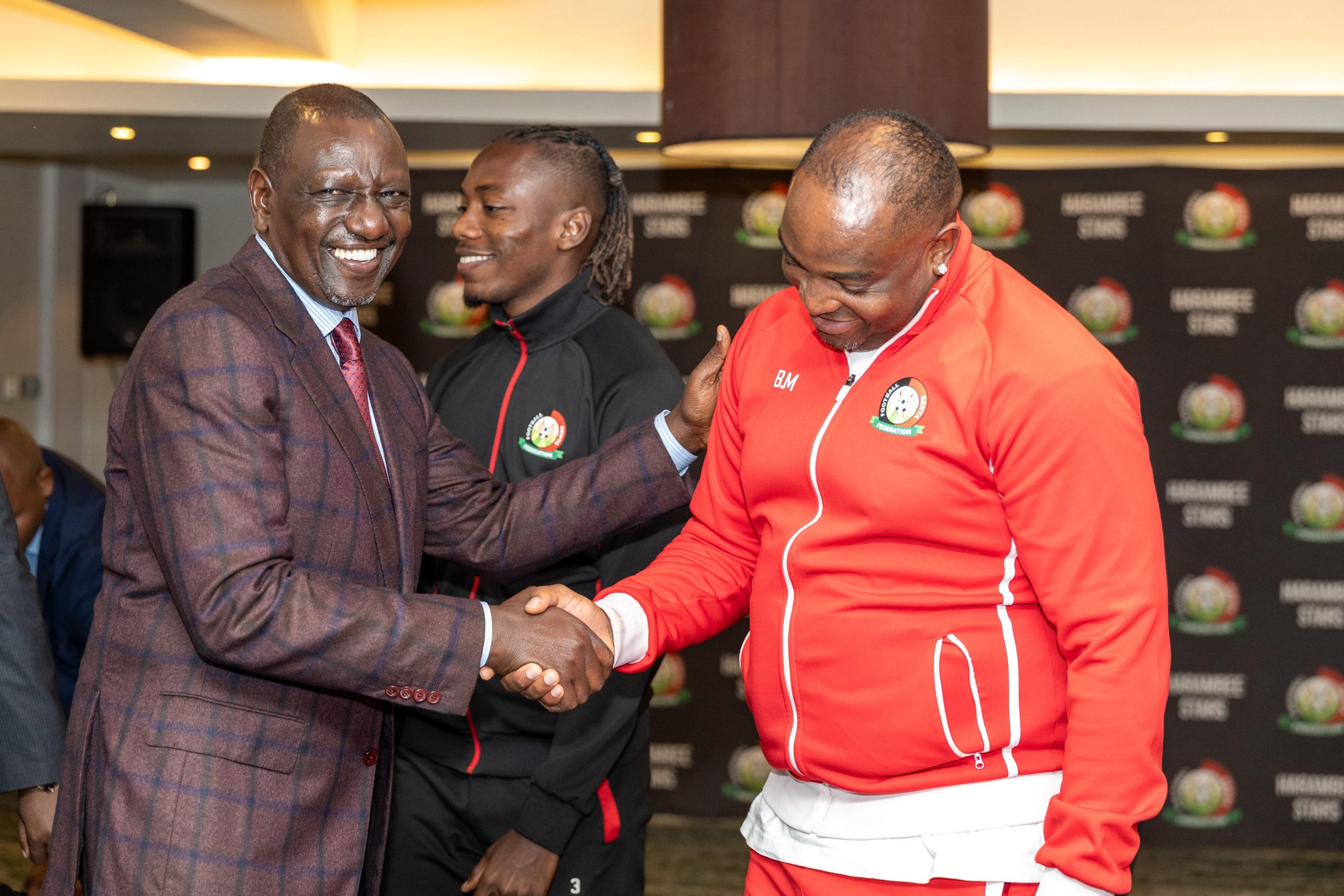
The pledge came after Kenya’s hard-fought win over Morocco, which secured their historic spot in the next round. Meeting the squad at the Pullman Hotel in Upper Hill, Nairobi, on Monday, August 11, 2025, Ruto praised the players’ resilience and urged them to push even harder in the matches ahead.
Fresh Rewards to Keep the Momentum Ruto outlined a new set of high-value incentives:
Sunday’s clash against Zambia – KSh 2.5 million for each player if they win.
Quarter-final bonus – KSh 1 million per player, plus a two-bedroom affordable housing unit in a location of their choice.
Building on Earlier Promises These offers add to generous pledges made earlier in the tournament. Ahead of the group stage, Ruto promised KSh 1 million per player for a win, KSh 500,000 for a draw, and lump-sum team rewards of KSh 60 million for reaching the quarter-finals, KSh 70 million for the semi-finals, and an unprecedented KSh 600 million for winning the title.
The President has already followed through on previous commitments. After the victory over DR Congo, KSh 42 million was paid out—KSh 1 million each to 27 players and 15 technical staff.
Inspiration Beyond Borders The announcement has drawn admiration across East Africa. One Ugandan football fan lauded the move, saying:
“Wow! You’re an amazing and practical president. Local-based players earn very little in our domestic leagues and work under tough conditions. Rewarding them for their effort and sacrifice is inspiring. It proves resilience always pays.”
With Kenya riding high in CHAN, the President’s latest incentives are expected to further fire up the squad as they eye continental glory.
In a stunning announcement, President William Ruto’s administration has declared it can no longer fund free primary and secondary education, citing a lack of resources. The move has triggered a firestorm of criticism, anger, and biting sarcasm across Kenya, with citizens accusing the government of breaking one of the country’s most cherished social promises.
What was once a celebrated hallmark of Kenya’s education system now faces an uncertain future—scrapped in the name of “insufficient funding.” The backlash online has been swift, with many Kenyans accusing Ruto’s government of failure and misplaced priorities.
“Kibaki Did It for 10 Years, Uhuru for 10—Ruto Can’t Do 3?”
One viral tweet from @chel0goi captured national frustration: “Kibaki sustained free education for 10 years. Uhuru did for 10 years. But Ruto in 3 years can’t—and he still wants 10 years like the rest.”
Others chimed in with both humor and fury. @GeraldGathirwa wrote sarcastically: “@WilliamsRuto ondokea tu roho clean.” @JKMW682679 was more direct: “You need to look within to discover the honourable thing to do now… resign.”
“We Studied for Free—Now Our Siblings Can’t?”
Kenyans took to social media to reminisce about when access to education was not a privilege, but a right. @cokoyoh wrote: “We went to school from primary through college virtually free. Now, our siblings cannot enjoy the same. The mad man has to go.” @kavoi_eunice added: “His main mission was to kill the education sector and health… WANTAM is inevitable.”
The hashtag #RutoMustGo trended, and many users accused the government of mismanaging public funds while prioritizing non-essential spending.
Dissent Meets Backlash
While the majority expressed dismay, a lone voice, @nairobimercury, stirred controversy with a contrarian take: “‘Free education’ is sht. It’s long overdue. It should be scrapped.”
The response was swift and unforgiving, with many branding the comment out of touch and insensitive, given the socio-economic realities facing most Kenyan families.
A Broken Promise or Misplaced Priorities?
With Treasury CS John Mbadi standing by the decision, citizens are demanding to know: If the government cannot afford free education, what is it spending on instead? And with Ruto seeking a decade in power, why are essential services being cut so early into his first term?
One user, @Taylorkiarie, summed up the public mood with bitter humor: “Let’s laugh out loud to WANTAM
President William Ruto has publicly dismissed former Chief Justice David Maraga’s announcement that he intends to contest the presidency in the 2027 general elections. Speaking at a press conference, Ruto openly questioned Maraga’s faith in the nation and its people, casting doubt on his motivations for seeking the highest office in the land.
“We have a great nation, and we have a duty and responsibility to make it greater,” the President remarked. “I listened to one gentleman who just retired the other day and now wants to be president.”
“Do You Believe in Kenya?”
Challenging Maraga directly, President Ruto criticized what he perceived as the former Chief Justice’s negative outlook on the country.
“You want to be president of a failed state? You want us to entrust you with leadership when you don’t believe in this country or its people?” Ruto asked pointedly.
He also addressed growing opposition to his administration: “I hear people saying ‘Ruto must go.’ Is it because of the way I spell my name? Let’s be serious—what exactly is your reason?”
In response to mounting criticism and growing interest in his presidential bid, David Maraga recently revealed that his campaign had raised over KSh 500,000 within just two days of launching his campaign website, Davidaga.com.
Appearing on K24 TV, Maraga expressed confidence in the public’s desire for change. “Very confident, very confident,” he said. “People are tired; they just want change.”
According to Maraga, contributions have come from Kenyans both locally and abroad, including donations in foreign currency—a sign, he argues, of widespread support for his candidacy.
“In two days, we raised over 500,000 shillings in Kenya, and contributions are still coming in from the diaspora in dollars. That tells you Kenyans want change,” he stated.
Concerns Over Governance and “Captured” Parliament
Maraga says his decision to run for president is driven by growing concern over what he describes as the deterioration of governance under the current administration.
He accuses President Ruto of “weaponizing” the judicial system and using it to intimidate citizens. Maraga also criticized Parliament, claiming it has been compromised and is failing in its constitutional duties, including holding the president accountable for alleged violations.
“The president is terrorizing his people. He’s weaponizing the justice system. Parliament is supposed to act when the president violates the constitution, but it’s been captured and cannot act,” Maraga said.
“Since Parliament won’t do its job, I have stepped forward—and I have the support to remove him in 2027.”
Political Tensions Rising Ahead of 2027
Maraga’s bold entry into the 2027 presidential race and his direct criticisms of President Ruto have added a new dimension to Kenya’s political landscape. As debate intensifies, it’s clear that both men are preparing for a contentious campaign, with Maraga positioning himself as a reform candidate and Ruto defending his record and leadership.
On Monday, July 21, members of Kenya’s creative industry gathered at Blue Springs Hotel in Nairobi to pay tribute to fallen comedian Zakaria Kariuki, better known by his stage name KK Mwenyewe. The 23-year-old rising star passed away on July 14, 2025, following a short illness.
The emotional memorial brought together friends, fellow comedians, politicians, and supporters who came to honour KK’s life and legacy. Best known for his spot-on impersonations of former Deputy President Rigathi Gachagua, KK quickly rose to national prominence through his relatable humour and social commentary. But beyond the laughter, many remembered him as the sole provider for his family, including his elderly grandmother.
Leaders Step Forward with Financial Support
In a powerful show of solidarity, several political leaders led fundraising efforts to support KK’s family and funeral preparations. Dennis Itumbi, Head of Presidential Special Programmes and Creative Economy Coordination, announced that President William Ruto had donated Ksh1 million to the family.
“President Ruto donated Sh1 million to the family of KK Mwenyewe,” Itumbi told mourners, noting that the contribution helped push the fundraiser beyond its initial Ksh1.2 million target, eventually surpassing Ksh1.5 million.
Other contributions included:
Sh200,000 from Nakuru Governor Susan Kihika
Sh100,000 from Itumbi
Sh100,000 from Itumbi’s “Radical” team and MCAs
Sh100,000 from Lari MP Mburu Kahangara
Sh100,000 pledged by National Assembly Majority Leader Kimani Ichung’wah
Itumbi also promised to visit KK’s mother in Gathiroini, Lari, on Tuesday, July 22 to personally deliver condolences and reassurances of continued support on behalf of the president and the creative sector. KK Mwenyewe will be laid to rest on Wednesday, July 23.
Personal Reflections and a Call to Action
The memorial service was punctuated by emotional tributes from those closest to KK. His girlfriend, Pauline, addressed mourners with a heartfelt message of gratitude for the overwhelming support, adding a poignant and deeply personal moment to the ceremony.
Content creator Kabugi, a close friend and colleague, called on former Deputy President Rigathi Gachagua to extend support to the family of the young man who had humorously portrayed him and brought joy to thousands.
Comedian Eric Omondi, who had already visited KK’s family, made an impassioned plea to the entertainment industry and the wider public to rally around the bereaved family.
“They are not okay,” he said. “We lost our brother abruptly. No one saw it coming. It caught his mum and the family completely off guard. We want to stand with them in mourning and, more importantly, help them financially so they can give our brother a decent burial.”
He urged fellow comedians to lead by example: “We should be the first to contribute. Myself, Kabugi, Mulamwah, Churchill, Butita—you know yourselves.”
KK Mwenyewe had recently completed his university studies and was pursuing content creation full-time before his untimely death.
As tributes continue to pour in, the outpouring of love and support at the memorial underscored just how deeply the young comedian touched lives—through laughter, humility, and the promise of a future cut tragically short.
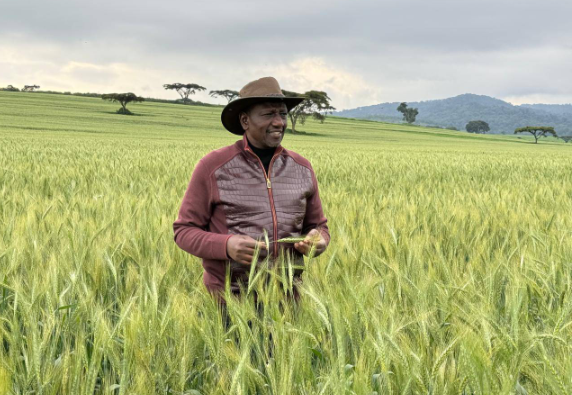
Kenya is gripped by controversy after President William Ruto was photographed inspecting a wheat farm while wearing what many believe to be a designer jacket worth Sh6.2 million, prompting outrage from a nation already reeling from economic hardship.
The jacket—reportedly a luxury lambskin and crocodile blouson from Italian fashion house Stefano Ricci—was flagged by political commentator Aoko Otieno, who shared images of the president on social media alongside screenshots of a similar item listed for $48,350 (approx. Sh6.2 million) on the brand’s official website.
Though the presidency has not confirmed the jacket’s origin or cost, the timing and context of the images have provoked intense public backlash.
Photos Fuel Public Anger Amid Economic Struggles
The president’s designer outfit became symbolic of what many see as the widening gap between the country’s leadership and its citizens—especially after the June 2025 protests that left dozens dead. The demonstrations were driven by frustrations over high taxes, unemployment, and the rising cost of living.
Social media exploded with criticism. On X (formerly Twitter), @Ja_tello1 voiced what many felt:
“Yaani ameva mita sita?? Na sina hata breakfast kumamaye,” —a raw and biting expression of economic despair.
Echoing this sentiment, @SenatorAbdi05 reposted the same phrase, highlighting just how many Kenyans feel abandoned by those in power.
Critics Link Outfit to Systemic Corruption
Beyond the outrage over the jacket itself, critics used the moment to call out broader governance issues.
“More than 100 Billion looted. You gettin’ where Kenyans’ taxpayers money goin’ to?” tweeted @thee_alfa_house.
@rgc99f2byt accused the government of enriching allies while public institutions crumble, while @Jbm_Evan stated bluntly:
“Totally out of touch with the suffering of Kenyans.”
@LensuMotors asked what many wondered:
“Yaani president haezi hurumia watu anaongoza. Hio pesa si atujengee shule?” —lamenting the lack of investment in basic infrastructure like schools.
Mockery of State Narratives and the Rise of Satire
Skepticism was also directed at the narrative surrounding Ruto’s farm. The government recently claimed that proceeds from the wheat project would help fund a Sh1.2 billion church.
@DexxieDexxy dismissed the claim as propaganda:
“They want to lie to us that the 1.2B church will be built by the proceeds of this farm. Wajinga wameisha Kenya.”
Others drew comparisons to former President Uhuru Kenyatta, suggesting that even during his wealth-laden photo-ops at Brookside or Northlands, he avoided such overt displays of luxury.
“Ata Uhunye hakua anapiga picha pale Brookside. EQ onge,” wrote @MumoMwas, referring to emotional intelligence in leadership.
Demand for Accountability Grows
Some Kenyans called for official scrutiny.
“Is this from his salary or something else? #Investigate,” demanded @PoliticalWatcherKE.
@HopefulKenyan summed up the prevailing sentiment:
“This is why we march—leaders must feel our pain, not flaunt wealth.”
Symbol of Discontent
Whether or not the jacket costs Sh6.2 million, the perception alone has become a powerful symbol of public discontent. For many, it represents a deeper frustration with perceived extravagance and a lack of empathy from leadership amid economic suffering.
As the phrase “Yaani ameva mita sita??” trends across platforms, it has evolved into a slogan for citizens demanding humility, accountability, and urgent reforms.
Kenya is in the grip of mounting public anger following two major developments that have shaken the nation’s trust in its leadership: President William Ruto’s recent comments about the 2027 succession and the explosive confession by a police officer over the death of blogger and teacher Albert Ojwang’.
In remarks posted by Kenyans.co.ke on June 15, 2025, President Ruto stirred controversy by saying, “We cannot hand over to people with no plan. All they keep saying is ‘Ruto must go.’ They have no agenda. They have no plan to do anything.” His comments sparked fierce backlash on social media, where users accused him of undermining democracy.
“He thinks he gets to decide who leads Kenya next? We’ll disappoint him by 6 a.m.,” mocked @Blatta001. Others like @sincara_son echoed a broader sentiment of political fatigue, forecasting Ruto’s swift downfall. Critics framed his words as an attempt to cling to power, reminiscent of former President Uhuru Kenyatta’s miscalculated succession maneuvers in 2022.
Online, the criticism was scathing. @Eddie_Mugoh claimed Ruto was now at odds with “55 million Kenyans,” while @mumbocharles4 reminded him, “You will comply with the Constitution. You will hand it over.” Some warned of regional historical parallels, with @Kyalo invoking Burkina Faso’s 2014 coup: “The former president thought the same… look at that country now.”
The unrest was only worsened by new developments in the tragic death of 31-year-old Albert Ojwang’. On June 7, he died in police custody at Nairobi’s Central Police Station. Now, a damning confession by Police Constable James Mukhwana has stunned the public further.
In a detailed statement to the Independent Policing Oversight Authority (IPOA), Mukhwana admitted to orchestrating the fatal assault under direct orders from senior officers, including Officer Commanding Station (OCS) Talaam and Deputy Inspector General (DIG) Eliud Kipkoech Lagat. He even alleged inmates were paid KSh 2,000 to carry out part of the beating.
The revelations have reignited outrage. “Mukhwana’s confession exposes the rot in our police force,” wrote @Kinyanjui254. “If Lagat ordered this, heads must roll!” @WanjiruKE demanded the immediate arrest of the senior officers involved, calling it “murder, not discipline.”
The confessional fallout has amplified calls for police reform and justice. @NjeriActivist warned of a broader cover-up: “The attempt to bury this shows how deep it goes. IPOA must dig deeper.” Others, like @MwangiJustice, questioned whether the brutality was politically motivated: “Who above Lagat gave the green light? #RutoMustAnswer.”
Opinions about Mukhwana’s confession remain divided. Some see him as a whistleblower—@KibetVoice said, “At least he came clean.” But others remain unforgiving. “Crocodile tears won’t save him,” said @ShiroKE. “He followed orders to beat a man to death. Jail him!”
With nationwide protests gaining momentum, President Ruto finds himself in a tightening vice of political pressure and public dissent. His recent acknowledgement that Ojwang’ died “at the hands of police” reversed earlier official statements and has only deepened suspicions.
From calls to dissolve police leadership to warnings of democratic backsliding, the message from Kenyans is loud and clear: accountability must be swift, systemic, and far-reaching. The coming months will test whether the Ruto administration can restore public trust—or face the wrath of an increasingly restless nation.
Here’s a rewritten version of the piece with a strong narrative flow and refined language, while preserving the core content and emotional depth:
Cleophas Malala’s Echoes of War Sparks Nationwide Controversy Ahead of Drama Festival
Echoes of War, a play penned by Cleophas Malala and slated for performance by Butere Girls High School at this year’s national drama festivals, has stirred widespread debate across Kenya.
Set in the fictional Royal Velvet Emirates—a Middle Eastern-inspired kingdom grappling with civil unrest—the play delves into themes of state control, repression, digital resistance, and the growing rift between progressive youth and a conservative ruling elite.
At the heart of the narrative is Mustafa, a university student and self-taught tech innovator, who embodies the aspirations and frustrations of a generation. His invention—a telemedicine app designed to bridge healthcare gaps—is dismissed by authorities as subversive. Rather than being hailed as a visionary, Mustafa is branded a digital rebel and imprisoned on charges of inciting unrest.
His journey from idealistic inventor to death row inmate mirrors the struggles of many young Kenyans navigating a system that often stifles innovation and dissent.
In a powerful scene before the Sultan, Mustafa pleads his case:
“I am not the problem. My generation is not the problem. We are just not understood.”
Adding a futuristic dimension to the play is Anifa Imana, an artificial intelligence entity portrayed with poise and precision. A digital oracle of sorts, she challenges tradition with cold logic and emotional depth. In a standout scene, she unveils a holographic pregnancy—not of a child, but of ideas:
“This womb pulses with the hopes of a generation,” she declares, delivering one of the play’s most unforgettable lines.
Her mother, Mama Anifa, embodies the emotional tension between heritage and change. A devout traditionalist, she is torn by her daughter’s radical views:
“You have no idea how hard it is to raise a daughter in this time and age,” she cries, her anguish highlighting the generational divide.
Presiding over the Velvet Emirates is the authoritarian Sultan, a symbol of unyielding power and fear. Convinced that youth-led reform threatens the nation’s unity, he orders Mustafa’s execution following mass protests sparked by social media:
“This boy must be executed. He has ruined our nation,” he proclaims from the opulence of his palace, which serves as a stage for power, betrayal, and eventual reckoning.
But in a dramatic reversal, Mustafa’s invention saves a life—an act that forces the Sultan to reconsider. Humbled by the transformative potential of youth and technology, he grants clemency and lends his support to Mustafa and Anifa:
“Let the rebuilding begin. Never again shall we dance to the echoes of war.”
Yet, Echoes of War resists the comfort of a happy ending. Before reconciliation can take root, the pent-up rage of a forgotten generation erupts. Youths burn down the police station and emergency hub in protest, culminating in one of the play’s most haunting visuals.
“We burn down this station to the ground!” Anifa screams as symbolic flames engulf the stage. The moment blurs the line between justice and destruction, leaving the audience to grapple with a sobering question: What is the cost of being heard?
Reactions to the play have been sharply divided. Some applaud its bold storytelling and relevance, while others argue it’s too provocative—and potentially inflammatory—for a school drama festival.
Regardless of the differing opinions, one thing is certain: Echoes of War is not fading into silence. Its message is loud, urgent, and still reverberating.
At just 27 years old, Fikirini Katoi Kahindi Jacobs has made history as the youngest nominee for a Principal Secretary position in Kenya’s recent administrations.
Nominated to head the State Department for Youth Affairs, his appointment is a powerful statement about the evolving nature of governance – one that is beginning to reflect the demographic reality of the country.
Born and raised in Kilifi County, Fikirini’s rise to this position is as symbolic as it is strategic.
As a nominee from the Orange Democratic Movement (ODM), his selection signals not only political inclusivity but also a deliberate effort to bring younger voices into the heart of decision-making.
For a country where over 75% of the population is under 35, his nomination is a turning point, raising hopes for fresh ideas, youth-centered policies, and a renewed focus on the challenges young people face, from unemployment to entrepreneurship opportunities.
But Fikirini’s nomination is part of a broader government strategy – one that emphasizes regional, ethnic, and generational inclusivity, expertise-driven leadership, and an expanded public service aimed at better service delivery.
His appointment fits within President William Ruto’s vision of a government that leaves no one behind, ensuring representation across communities, age groups, and genders.
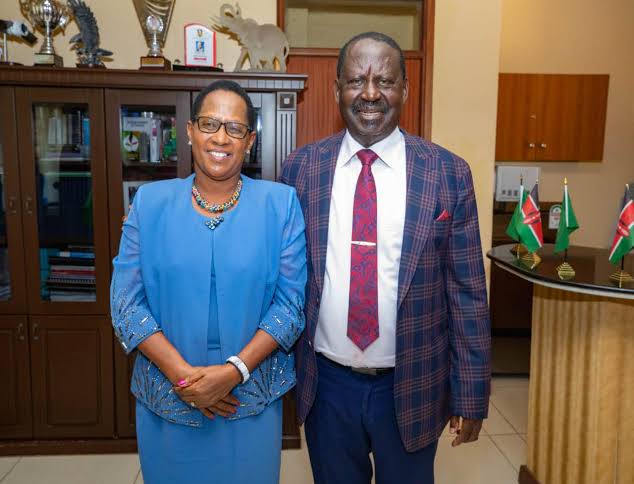
Ms. Judith Naiyai Pareno, PS nominee for Justice, Human Rights and Constitutional Affairs pictured alongside ODM party leader Raila Odinga (Image: Facebook)
A Government of Balance and Inclusion
President Ruto has been clear that no region should gain at the expense of another.
His approach to leadership ensures that the development strides made in areas like Nyanza do not translate into losses for others, such as Mt. Kenya.
This careful balancing act underpins the administration’s commitment to national unity.
Additionally, the government has demonstrated its dedication to continuity in governance by appointing former Cabinet Secretaries and Principal Secretaries to key roles.
This move ensures that past experience is not lost, allowing seasoned leaders to mentor the younger generation stepping into public service – Fikirini Katoi being a prime example.
Addressing Government Expansion Concerns
The nomination of new leaders has come alongside an expansion of State Departments, with seven additional portfolios created.
While this has sparked debate about government size, the focus remains on impact and efficiency.
Among the most notable additions is the State Department for Aviation and Aerospace, a sector where Kenya is seeking to reclaim its lost regional dominance amid stiff competition from Ethiopia.
Strengthening Advisory Roles and National Coordination
Another key shift has been the elevation of Presidential Advisors, many of whom are former high-ranking government officials.
This ensures that decision-making at the top levels of government is well-informed by experience.
Additionally, the Office of the Prime Cabinet Secretary (OPCS) is expected to become more effective with a proactive and creative Principal Secretary driving coordination efforts.
Strategic Appointments in Health and Human Rights
In healthcare, the appointment of Dr. Oluga to the Ministry of Medical Services marks a critical step toward addressing longstanding sector challenges.
His expertise is expected to enhance healthcare delivery and reforms.
Likewise, the creation of a dedicated State Department for Human Rights and Justice reflects a commitment to strengthening Kenya’s human rights framework, ensuring that issues of justice and fairness receive focused attention.
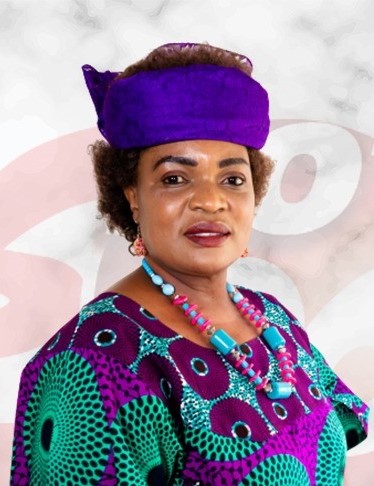
Dr. Jane Kare Imbunya, PS nominee for State Department for Trade in a past photograph (Image: Facebook)
Youth Representation: A Sign of Things to Come?
Fikirini Katoi’s nomination could mark the beginning of a deeper shift in governance – one where young leaders are not just seen as future leaders but as active participants today.
His success in the role will likely determine whether this trend continues in future administrations.
With a focus on expertise, inclusivity, and youth empowerment, President Ruto’s administration is setting a precedent.
The question now is whether this blend of experience and youthful energy will deliver the impactful governance that Kenyans hope for.
Fikirini Katoi’s story is still unfolding, but his nomination has already sent a powerful message:
The youth are not just being heard – they are being placed at the table.
What are your thoughts on the latest offering since President Ruto and ODM party leader Raila Odinga’s handshake?
Urgent Diplomatic Push to Save Kenyan Woman from Execution in Vietnam
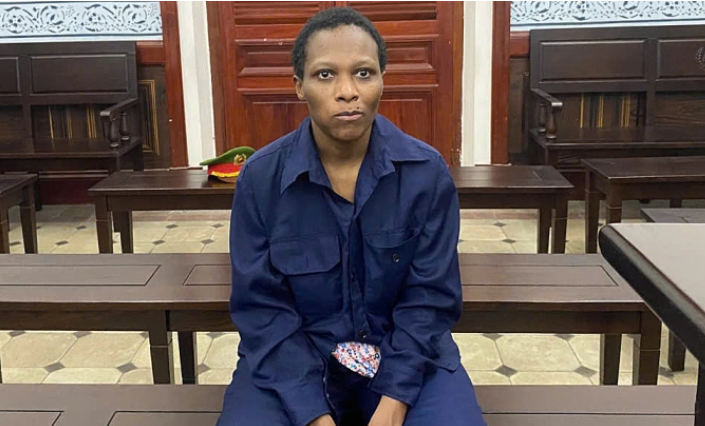
The case of Margaret Macharia Nduta, a Kenyan woman sentenced to death in Vietnam for drug trafficking, has triggered urgent diplomatic efforts as her execution date approaches.
Gatundu North MP Elijah Njoroge Kururia confirmed that President William Ruto and the Ministry of Foreign Affairs have reached out to the Vietnamese government, seeking to halt the execution. However, with time running out, Vietnam remains steadfast in enforcing its strict anti-drug laws.
Nduta’s Arrest and Conviction
Nduta was arrested at Tân Sơn Nhất International Airport in Ho Chi Minh City, one of Vietnam’s busiest travel hubs.
According to court records, she was paid $1,300 (approximately KSh 167,000) to transport a suitcase containing over two kilograms of narcotics.
Her journey took an unexpected turn in 2023 when a flight delay led airport personnel to advise her to complete immigration procedures for a rebooking to Laos. During routine security checks, customs officials discovered the illicit substances hidden in her luggage.
Appearing before the Ho Chi Minh City People’s Court, Nduta claimed she was unaware of the drugs, believing she was carrying legal items. However, prosecutors dismissed her defense as an attempt to evade responsibility, emphasizing that Vietnamese law mandates the death penalty for possession of such large quantities of drugs.
On March 6, 2024, she was sentenced to death, sparking widespread outcry from Kenyans and human rights activists urging government intervention.
Ruto’s Administration Steps In
As pressure mounted, MP Kururia addressed Kenyans via a TikTok Live session, confirming that President Ruto and the Foreign Affairs Ministry had contacted Vietnamese authorities, seeking clemency or extradition.
“The President and the Ministry reached out to Vietnam yesterday and are awaiting a response. Many Kenyans have been asking if Ruto is aware—yes, he is. The government is waiting, but time is running out,” said Kururia.
Meanwhile, Kenyans continue to demand a formal statement from President Ruto, hoping for a last-minute diplomatic breakthrough that could spare Nduta’s life.
Calls for Direct Negotiations
Embakasi East MP Babu Owino has urged President Ruto to personally engage the Vietnamese government, emphasizing that Kenya must not abandon its citizens, especially those caught in unfortunate circumstances.
“Margaret Nduta is innocent. She was unknowingly used as a drug mule. She does not deserve the death penalty,” Owino stated.
His remarks reflect growing public concern, with many advocating for Nduta to serve her sentence in Kenya rather than face execution abroad.
A Case Similar to Stephen Munyakho’s in Saudi Arabia
Nduta’s situation bears similarities to that of Stephen Munyakho (alias Stevo), a Kenyan man sentenced to death in Saudi Arabia for killing a colleague during a 2011 altercation. Unlike Vietnam, Saudi authorities agreed to postpone his execution for a year following diplomatic negotiations.
According to Foreign Affairs Principal Secretary Korir Sing’oei, the Kenyan government secured the delay to allow Munyakho’s family time to raise KSh 150 million in blood money (Diyah) for a possible pardon. So far, KSh 11 million has been raised through public contributions.
“I am pleased to inform you that after strenuous negotiations between our Mission in Riyadh, Saudi Authorities, and the widow, the impending execution of judgment against Stephen Munyakho has been postponed for another year to allow parties to settle outstanding obligations,” PS Sing’oei stated.
Unlike Saudi Arabia, Vietnam has shown no signs of leniency in Nduta’s case. With her execution looming, Kenyan officials are racing against time to secure a possible intervention.
Ruto has pledged to disregard critics, emphasizing that he is a product of generosity and has always given in adherence to biblical teachings.
Speaking during a church service at Jesus Winner Ministry in Roysambu, led by Bishop Edward Mwai, Ruto questioned why some members of the clergy opposed his donations, even refusing them, despite the offerings being meant for God, not individuals.
He proceeded to contribute Ksh 20 million toward the church’s construction project.
“I am a product of giving to God, and I’m unapologetic about it. I do so on the firm foundation of the scriptures,” he affirmed.
Notable Church Donations
Jesus Winner Ministry, Roysambu – On March 2, 2025, Ruto donated Ksh 20 million to support the church’s construction and pledged to raise an additional Ksh 100 million to complete the project.
Soweto Catholic Parish – In November 2024, the President donated Ksh 5.8 million, but the church’s bishop rejected and returned the money due to concerns about its source.
ACK Bungoma – During a visit to Bungoma, Ruto contributed Ksh 5 million to the church, which gladly accepted the donation, acknowledging that he had spent over Ksh 10 million in the region.
Church Harambee – MP Oscar Sudi sparked debate when he contributed Ksh 20 million at a church fundraiser. Amid speculation about the source of his wealth, he later explained in an interview that he had received financial support from his colleagues.
Two Churches in One Sunday – President William Ruto and Deputy President Kindiki jointly donated Ksh 12 million to two churches during a Sunday visit.
ACK St. James – Former Deputy President Rigathi Gachagua pledged Ksh 1 million to aid in the church’s construction. As he was unavailable at the time, the donation was delivered by Senator Karungo Thang’wa.
AIPCA Central Western Archdiocese – Deputy President Kindiki contributed Ksh 2 million, announcing during the service that President Ruto had just called to pledge an additional Ksh 5 million.
ACF Church, Banana – Kalonzo Musyoka and his team donated a total of Ksh 300,000 while attending a Sunday service, stating that their contribution was meant to support the church’s construction amid Kenya’s economic challenges.
President William Ruto’s recent interview has ignited a firestorm of reactions on social media, with many Kenyans expressing frustration, skepticism, and outright disbelief over his statements.
Ruto Denies Undermining Gachagua
A major talking point was Ruto’s insistence that he had no role in Deputy President Rigathi Gachagua’s political troubles, claiming that only Parliament holds the power to remove a sitting leader. However, many Kenyans were unconvinced, accusing the president of dishonesty.
One user sarcastically noted, “I love how Nyokabi is smiling—like, ‘You’re really a good liar.’” Others directly accused Ruto of betrayal, with one commenting, “Dear President, stop going in circles. You orchestrated Gachagua’s downfall. God is watching.”
Fact-Checking Ruto’s Claims
Another source of public outrage was Ruto’s assertion that his administration completed Karatina Market—despite the fact that former President Uhuru Kenyatta inaugurated it in 2018.
Social media users quickly called him out for alleged revisionist history. One netizen wrote, “2018—Uhuru opens Karatina Market. 2025—Ruto opens Karatina Market again.
The recent surge in abductions has sparked reactions from Kenyan celebrities, with many calling on President William Ruto’s administration to take action. While some have voiced their concerns, others remain silent, raising questions about whether they are out of touch with the gravity of the situation.
Catherine Kamau, widely known as Kate Actress, has consistently been a vocal advocate for Kenyan citizens. From participating in the #EndFemicideKE march in February to protesting against the Finance Bill 2024 and demanding better governance, Kate has never shied away from standing with ordinary Kenyans.
Unlike some celebrities who have hesitated to take a stand, Kate quickly joined Kenyans both online and on the streets to demand justice for victims of abductions. Addressing the issue, she urged her followers:
“Guys, as you celebrate, please note that so much is going on. So many abductions, which now the IG distances himself from, are happening… It’s a dark era. It is heart-wrenching to imagine the anguish and uncertainty these families must endure. The absence of their loved ones is a constant reminder of how cruel and unjust this government is, and it must go!”
CNN International Correspondent Larry Madowo has also played a pivotal role in bringing global attention to Kenya’s challenges. Madowo, who has covered various crises in the country, returned from leave to report on the abductions.
“I’m not here to support or oppose anything or anyone. I’m only here to tell the truth and ask questions,” Madowo stated. Highlighting the ongoing crisis, he noted:
“Two days after President Ruto promised to end abductions in Kenya, 29 people are still missing. Previous abductees were stripped, handcuffed to the floor, and tortured for weeks. Where do you draw the line between power and dictatorship?”
Madowo’s fearless reporting has earned him recognition from Kenyans on social media, who recently praised him as a true patriot for shedding light on the nation’s struggles.
Rapper Henry Ohanga, known as Octopizzo, also used his platform to address the crisis, condemning the abduction of young Kenyans expressing themselves through art and other creative means.
“Once again, I strongly condemn the abduction of young Kenyans using art, illustrations, and creative outlets to express frustrations and advocate for change. These actions, seemingly sanctioned by unknown forces within the government, violate our constitutional right to free expression,” he stated.
Octopizzo emphasized that art is a non-violent form of demonstration and an impactful way to raise awareness, urging the government to stop silencing young voices through repression.
During the protests earlier this year, celebrities came under scrutiny for their muted responses to the unrest. Many only spoke out after Kenyans threatened to withdraw their support, highlighting the importance of public figures using their platforms for advocacy and accountability.
Veteran gospel artist, songwriter, and disability advocate Daddy Owen recently shared his frustration after becoming the target of public backlash. The musician revealed that his personal contacts were leaked online, subjecting him to a flood of calls and messages from Kenyans, a phenomenon netizens have humorously referred to as “kusalimiwa” (being greeted).
The “Vanity” hitmaker said the messages ranged from harsh criticism to genuine inquiries. Some accused him of being a sellout for agreeing to perform at the national holiday celebrations led by President William Ruto. However, others reached out respectfully, seeking to understand his decision to participate in the event.
“Yesterday, I was greeted by Kenyans! Sema kusalimiwa! Gaitho shared my number so I could be greeted! My phone was blowing up with calls, texts, WhatsApp messages, and even a ton of Mpesa transactions. (Yes, they were sending me small amounts of money),” Daddy Owen shared on his X account, describing the overwhelming experience.
Despite the negativity, he noted that he took the time to return some calls, leading to meaningful conversations with a few individuals. “The abuse was next level! But some were very understanding, and we ended up having great chats.”
Reflecting on the reactions, Daddy Owen provided a breakdown of the interactions he received:
30%: Pure insults, heavy and unfiltered.
20%: Logical callers who wanted to understand his reasons for performing. After their discussions, they seemed to understand his perspective.
20%: Excited fans who were thrilled to have his number.
20%: Requests for help, ranging from pleas for money (“cabbage za kupika bro, nikubaya huku nje”) to genuine needs, prompting him to send small financial assistance.
5%: Encouragement from those who supported his decision.
5%: Flashing his number without saying anything.
“In the end, those who genuinely wanted to communicate got what they needed. As for the rest? I received their greetings and took them in stride,” Daddy Owen concluded.
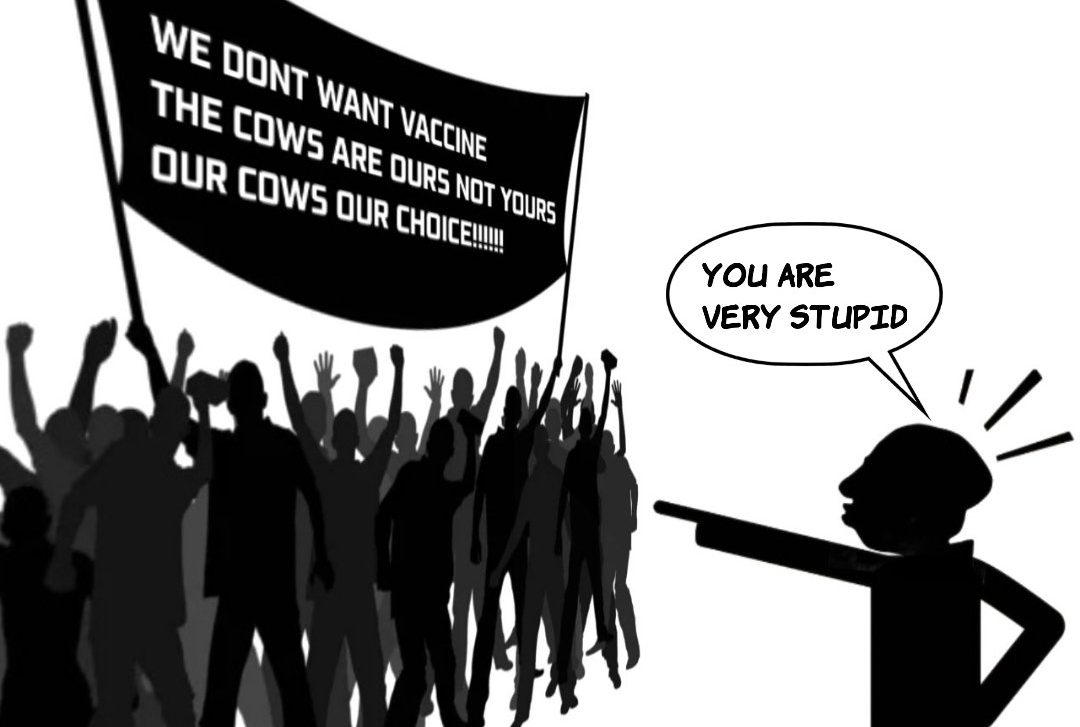
During the Pastoralist Leadership Summit in Wajir County on December 10, President William Ruto fiercely criticized leaders opposing his government’s national livestock vaccination program. The initiative aims to vaccinate 22 million cattle and 50 million goats and sheep, with the goal of improving disease control and enhancing market access for Kenyan livestock products both domestically and internationally.
Ruto dismissed critics of the program as “mad, unreasonable, and possibly stupid,” suggesting that their opposition was rooted in ignorance. He emphasized that the vaccines would be produced locally, ensuring that Kenyan livestock products meet export standards.
However, Ruto’s comments sparked intense debate online. Many took issue with his harsh language and questioned the program’s necessity and transparency. Some criticized his authoritarian approach to governance, with Gitau Warigi (@GitauWarigi) commenting, “Governance is about consensus, not edicts. If I don’t want to vaccinate my cows, it’s my choice.” Others, like JACKSON TOCHI (@jacksontochi24), argued that wisdom involves listening as much as speaking.
Skepticism about the vaccines’ safety and efficacy also surfaced, with some recalling Africa’s history of being overlooked during past global health crises. Emmanuel Motelin (@EmmanuelMotelin) raised concerns, asking, “What’s the agenda?” and questioning why Africa should trust the vaccines without scrutiny.
Critics also questioned the mandatory nature of the vaccination program. David Ngula (@david_ngula) called for a more balanced approach that considers farmers’ rights, traditions, and economic realities. Some supporters of vaccination suggested that politicians should be the first to test the vaccines, with @Maina_GenZ humorously proposing, “If they survive, the vaccine is SAFE.”
Ruto’s remarks also faced backlash for their perceived arrogance, with Roie (@Roienkatha) commenting, “You can take a villager from the village, but you can’t take the village from the villager.”
Meanwhile, Wiper Party leader Kalonzo Musyoka criticized the vaccination plan, claiming it was part
The Catholic Church ignited a political storm last week by criticizing President William Ruto’s government, which led to denials from state agencies and diplomatic efforts from government officials to repair relations with religious institutions.
In response to these efforts, some politicians made significant donations during church services. President Ruto contributed Ksh 5 million for the construction of the Father’s house at Soweto Catholic Church in Nairobi and Ksh 300,000 to buy children’s uniforms.
However, the Archdiocese of Nairobi made a bold decision to reject President Ruto’s donation of Ksh 5 million, citing the Kenya Conference of Catholic Bishops (KCCB) directives, which discourage political donations to churches and the use of church events for political gain. As a result, the Archdiocese decided to refund Ksh 200,000 from Nairobi’s Governor for the choir and Parish Missionary Council (PMC), Ksh 600,000 from Ruto to the choir and PMC, and Ksh 2 million from Ruto for the construction of the Father’s house.
The political tension deepened further when the Anglican Church of Kenya publicly supported the Catholic Church’s stance against the government, intensifying pressure on President Ruto’s administration.
The Catholic Church’s rejection of the donation has been widely interpreted as a stand against the use of financial contributions for political leverage. Reactions to the move varied, with some praising the church for its moral leadership, while others questioned the decision to initially accept the funds.