Investing In Our Chiefs Makes Stronger Communities

The graduation of 5,892 chiefs and assistant chiefs from the National Police College, Embakasi ‘A’ Campus quietly marks one of the most practical investments in how Kenya is governed.

It was an intensive induction, paralegal and security management programme, designed to strengthen the very first line of government authority Kenyans interact with every day.

For many households, a functioning chief’s office is the difference between calm and chaos, between help and helplessness.

When there’s a land dispute in Turkana, a birth document needed in Kwale, or a security scare in Marsabit, the first knock is rarely on a ministry door – it’s on the chief’s.

That is what makes chiefs and assistant chiefs unique.

As National Government Administration Officers (NGAOs), they are not abstract symbols of the state. They are the state – present, visible, and accountable – at the village, sub-location and location level.

Yet for years, the demands on these officers have grown while structured training has lagged behind.

Some had gone over 25 years without formal refresher training, even as legal expectations, security threats and public scrutiny became more complex.

The three-week paramilitary training programme – rolled out in three cohorts throughout 2025 – was a direct response to that gap.

It focused on paralegal skills, security coordination, disciplined leadership and lawful decision-making, all aimed at improving how authority is exercised on the ground.

This was not about turning chiefs into soldiers. It was about professionalising public administration – ensuring that power is applied with clarity, restraint and a firm understanding of the law.

Because when the frontline of government is underprepared, it is not policy that suffers first.

It is families, livelihoods and community trust.

The programme is rooted in the Jukwaa la Usalama framework, which emphasizes community-based approaches to safety and stability.

Through the training, chiefs strengthened their ability to resolve disputes, understand legal procedures, spot early warning signs of insecurity and coordinate more effectively with the National Government Administration Police Unit (NGAPU) and other agencies.
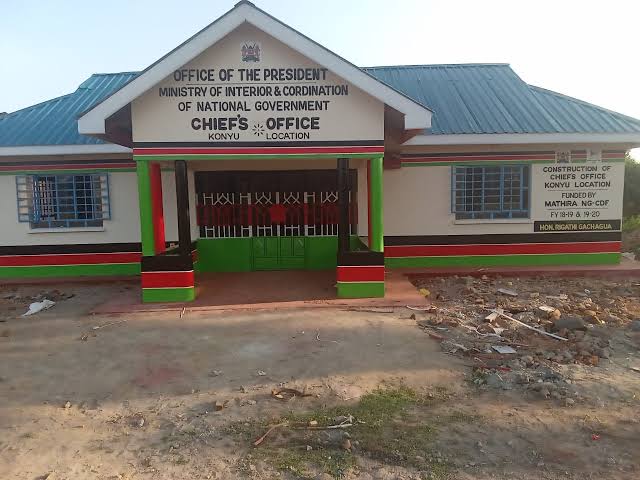
Konyu Chief’s Office in Mathira Constituency (Image: Files)

In higher-risk regions, including parts of North Eastern Kenya and the Rift Valley, additional paramilitary training and appropriate arming reflect a practical acknowledgement of the realities officers face – balancing community protection with their own safety.

At its core, this initiative recognizes a simple truth: security is not built only in command centres – it is built where people live.

Strengthen the institutions closest to citizens, and order follows. Neglect them, and instability finds room to grow.

Quiet as it may seem, this graduation is a reminder that when government chooses to invest in its frontline, the impact travels far beyond the parade ground – into homes, markets, farms and streets across the country.


PS Raymond Omollo: Violence Is Not Currency for Politics in Kenya

PS Raymond Omollo insists that planning Kenya’s future cannot be left to the whims of intimidation and violence.

In a meeting earlier today, the PS warned against turning violence into a currency for politics.

In his words, politicians must lead by persuasion, not coercion – a reminder that democracy only thrives where ideas and dialogue carry the day, not threats or force.

Omollo’s remarks land at a delicate moment.

Youth unemployment remains a pressing challenge, leaving many young Kenyans vulnerable to exploitation by opportunistic political actors or even criminal networks.

Yet, he was categorical that crime is not and can never be the alternative.

Instead, the government is widening pathways for opportunity, particularly through the Affordable Housing Programme and digital empowerment initiatives.

These, he argued, are not just projects on paper but practical solutions designed to absorb thousands of young people into meaningful, dignified work.

Sample model of the Ksh13B Affordable Housing scheme in Ziwani, Nairobi.

The Affordable Housing Programme

PS Omollo reminded the citizens that this is more than a construction drive.

It has become a powerful job creation engine, providing openings for skilled and unskilled labour, artisans, suppliers, and entrepreneurs across the country.

In parallel, digital skills programmes are equipping young people to compete in an economy that increasingly rewards innovation, coding, and online services.

For PS Omollo, the message is clear:

The youth must position themselves for these opportunities rather than be drawn into crime or become instruments of political intimidation.

This framing matters because political violence has long cast a shadow over Kenya’s democratic journey.

When leaders normalize coercion, institutions weaken and communities fracture.

Omollo’s speech sought to push back against that trend, calling on leaders to win support by ideas and persuasion rather than by fear.

It was also a reminder to citizens – especially young people – that there are alternatives, and that these alternatives are not abstract promises but tangible projects already reshaping neighbourhoods and job markets.

By highlighting housing and digital empowerment, the PS located the fight against violence within a broader vision of national transformation.

These are programmes that align with President Ruto’s three-year push for a more digitized, citizen-focused government.

They are evidence that the state is not merely condemning crime and political intimidation, but actively offering a different future.

Omollo’s words, then, should not be heard as just another government soundbite.

They are a call to redefine the culture of politics in Kenya:

To reject intimidation, to champion persuasion, and to match civic participation with economic opportunity.

For young Kenyans especially, the choice is stark – a path of fear and criminality that leads nowhere, or a path of innovation, work, and contribution to national growth.

Violence may make noise in the short term, but it never builds.

What builds nations are ideas, opportunity, and the courage to lead by persuasion.

Dr. Raymond Omollo: Ruto’s Legacy of Bold Disruption, Reform and Dreams

History remembers leaders not for comfort but for courage.

Transformative figures share three traits: they disrupt the status quo, they execute under extreme constraints, and they envision a future beyond the present horizon.

From America’s founders who broke free from empire to the Asian Tigers who charted their own industrial path, progress has always meant unsettling the present in order to unlock the future. Kenya today stands at such a moment of reckoning.

In his first three years, President William Ruto has chosen disruption not as chaos but as a deliberate catalyst for reform and renewal.

His style blends radical change with pragmatic execution and aspirational vision – a rare mix that has begun reshaping Kenya’s politics and economy at a critical juncture.

This philosophical grounding is not foreign to Kenya. At independence, leaders faced the ideological question of how to grow.

Through Sessional Paper No. 10 of 1965, the nation adopted African Socialism – a uniquely Kenyan philosophy rooted in democracy, dignity, mutual responsibility, and a mixed economy.

Today, the Hustler Nation revives that founding debate with 21st-century urgency: what kind of economy should Kenya build, who should it serve, and how should resources be shared?

By re-centering politics on ordinary Kenyans – farmers, teachers, traders, boda boda riders, and the youth – the President has reopened the nation’s most fundamental questions.

President Ruto shares a moment with PS. Dr. Raymond Omollo during a previous state function in Nairobi (Image: Files)

His restructuring of subsidies, unpopular but necessary, reflects the very essence of radical leadership: rarely comfortable, often contentious, but always defined by courage to make privileged enemies in order to secure a fairer system for the majority.

Yet disruption alone is not enough. Practical governance is what sustains nations.

Confronted with public debt, food insecurity, and joblessness, the President has anchored reforms in agriculture, affordable housing, Universal Health Coverage, and MSME empowerment.

The Hustler Fund, offering micro-credit to citizens excluded from the banking system, directly challenges a decades-old financial order.

Already, thousands of small traders have accessed credit and invested in their livelihoods – a quiet but powerful revolution in grassroots empowerment.

Other nations offer useful mirrors. During the Great Depression, Franklin D. Roosevelt dared to launch the New Deal despite fierce opposition.

He showed that radical courage, even when unpopular, can stabilize a nation and restore hope.

Lee Kuan Yew in Singapore proved that disciplined, practical execution – not rhetoric – can transform a struggling society into an economic powerhouse.

And Mahatma Gandhi envisioned empowerment from the village outward, insisting that prosperity must begin at the grassroots.

These leaders illustrate what President Ruto is attempting: radical enough to disrupt, practical enough to execute, and visionary enough to dream beyond the present.

Unlike populists who promise without delivery, President Ruto has favored execution. His frequent county tours – where he listens, launches projects, and measures progress firsthand – show a leader deeply invested in service, not spectacle.

Practicality for him means choosing sustainability over applause, and patient reforms over quick fixes.

The results are becoming evident with Kenya’s GDP expanding to over Ksh 17 trillion, cementing its position as East and Central Africa’s largest economy and 6th in Africa. Inflation has dropped sharply from 9.6% in October 2022 to 4.1% as of today, easing the cost of living for ordinary households.

The shilling, once battered, has stabilized, while foreign exchange reserves stand at USD 11.8 billion, safeguarding imports and trade.

Farmers productivity is at an all-time high intensively boosted by the fertilizer subsidy program, with maize production in the North Rift and Western Kenya hitting record surpluses.

Incidents of cattle rustling have reduced by over 70% on account of Operation Maliza Uhalifu; a strategic approach incorporating peace dialogues, disarmament, and the deployment of community policing units.

Markets once abandoned in Turkana and West Pokot are thriving again, and schools that had closed due to insecurity are reopening.

The once barely attainable Universal Health Coverage is now in hand as Kenya rolled-out Taifa Care bringing under the Social Health Authority over 25 Million citizens a number triple its preceding NHIF.

Families can access healthcare without catastrophic costs. Over 7,500 new healthcare workers have been recruited and deployed, reducing doctor-to-patient ratios while digital health records are improving efficiency in county hospitals.

Kenya’s voice has also grown abroad.

The Africa Climate Summit and his leadership within the AU have placed the country at the front row of continental diplomacy. From climate action to regional trade and peace mediation, Kenya now plays a bridging role that strengthens both its global standing and its domestic economy.

For a nation long seen as a follower, this renewed assertiveness has repositioned Kenya as a leader.

Recognizing that the challenges remain stark: debt, unemployment, food insecurity, and climate shocks, Kenya’s history will not remember the comfortable or the cautiously populist.

It will remember those radical in courage, practical in action, and visionary in purpose to place the nation firmly in the future.

In this moment, President Ruto stands as all three.