Silas Nyanchwani: Don’t Blame Al-Shaabab For The Mandera Massacre
“One thing you will notice about the Mandera deaths is that those who died are mostly young and from Western Kenya. Not that some deaths are more valuable than others, we are all equal. But here is how they end up there in the first place.”
These are not my words though. These are Standard Group’s Silas Nyanchwani’s words.
In his Facebook post, Nyanchwani gives a detailed account of what he exactly thinks is the reason why the slain 28 Kenyans faced their untimely demise in the hands of Al-Shabaab insurgents.
Majority of those who perished in the massacre were teachers from Western Kenya who had travelled all the way to Mandera to seek for employment opportunities.
Employment they indeed got but majority of them could not enjoy the fruits of their long journey to Mandera as their lives were cut short.
The deceased had sought job opportunities in Mandera where, according to Nyanchwani, corruption is less rampant and the demand for teachers is high.
He adds that in Western Kenya and other places, one has to part with colossal sums of money to get employed. This forces teachers and other professionals to travel all the way to the volatile North-Eastern regions, risk their lives to get employed.
Finally, they meet their death as their security is not ensured by the same government that does not want to employ them.
Here is Nyanchwani’s assertion:
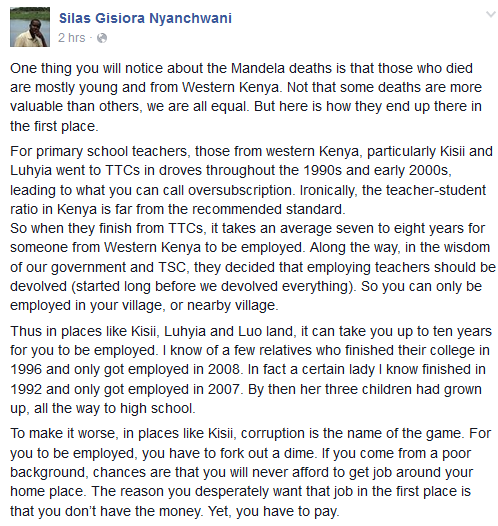
“One thing you will notice about the Mandela deaths is that those who died are mostly young and from Western Kenya. Not that some deaths are more valuable than others, we are all equal. But here is how they end up there in the first place.
For primary school teachers, those from western Kenya, particularly Kisii and Luhyia went to TTCs in droves throughout the 1990s and early 2000s, leading to what you can call oversubscription. Ironically, the teacher-student ratio in Kenya is far from the recommended standard.
So when they finish from TTCs, it takes an average seven to eight years for someone from Western Kenya to be employed. Along the way, in the wisdom of our government and TSC, they decided that employing teachers should be devolved (started long before we devolved everything). So you can only be employed in your village, or nearby village.
Thus in places like Kisii, Luhyia and Luo land, it can take you up to ten years for you to be employed. I know of a few relatives who finished their college in 1996 and only got employed in 2008. In fact a certain lady I know finished in 1992 and only got employed in 2007. By then her three children had grown up, all the way to high school.
To make it worse, in places like Kisii, corruption is the name of the game. For you to be employed, you have to fork out a dime. If you come from a poor background, chances are that you will never afford to get job around your home place. The reason you desperately want that job in the first place is that you don’t have the money. Yet, you have to pay.
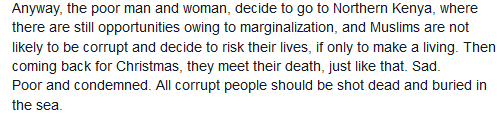
Anyway, the poor man and woman, decide to go to Northern Kenya, where there are still opportunities owing to marginalization, and Muslims are not likely to be corrupt and decide to risk their lives, if only to make a living. Then coming back for Christmas, they meet their death, just like that. Sad.
Poor and condemned. All corrupt people should be shot dead and buried in the sea.”